THE CLASSIC COLLECTION✦A dead man’s diaryCLASSIC FREE BOOKS
A dead man’s diary
Coulson Kernahan
THE CLASSIC COLLECTION · 1916
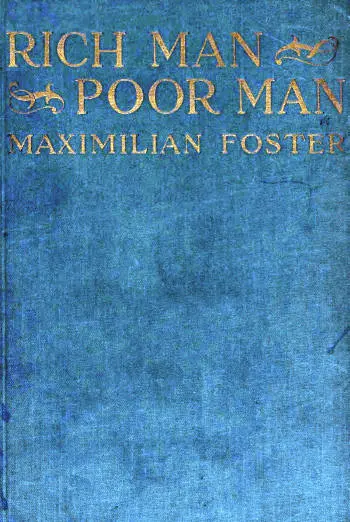
"Rich Man, Poor Man" by Maximilian Foster is a novel written in the early 20th century. The story explores themes of class, wealth, and personal connections, particularly focusing on the lives of Mr. Mapleson, a timid clerk in New York City, and Bab Wynne, a spirited young woman who is on the verge of discovering her true heritage. The interplay between these characters and their relationships will likely form a central part of the narrative as the plot unfolds. At the start of the novel, we meet Mr. Mapleson, an elderly clerk whose life appears mundane and lonely. On Christmas Eve, his character is established as he reflects on the loneliness and alienation he experiences, despite the joyful holiday spirit surrounding him. Meanwhile, the narrative shifts to Bab Wynne, who is depicted with a spirited demeanor that subtly suggests her yearning for a more exciting life, free from the confines of her boarding house existence. The initial chapters set the stage for a forthcoming transformation in their lives, hinting at the intertwining fates of the characters against the backdrop of societal expectations and personal dreams.
Introduction adapted from the source catalogue; source summaries may be automatically generated.
Free to read · English · 58,624 words · No account needed
MAKE TIME FOR A GOOD BOOK
On by default. Untick to stop anonymous reading totals. Each page counts after 10 seconds in view. How this works.
Anonymous counting is on unless you have switched it off.
"Sure, mum," replied the girl with convincing frankness, "she do look different f'm yer boarders!"
It proved, moreover, to be the truth. Upstairs in the parlor Mrs. Tilney found a slender, wan-faced woman to whose dripping skirts clung an equally rain-soaked child; and that they were persons of distinction not even their appearance could dispute. The visitor's voice, when she spoke, was low and modulated. It rang like the undertone of a bell.
"I am looking for rooms--a room," she corrected.
A shudder accompanied the words, and with a gesture of uncontrollable languor she held her hands to the coal glowing in the hearth.
The landlady debated. Transients of this sort were as little to her liking as they were rare. However, after some misgivings she showed her visitor the one vacancy. It was a top-floor bedroom just down the hall from Mr. Mapleson's. Board included, the rent would be sixteen dollars.
"Thanks," said the visitor. "I'll have my trunk sent in at once."
Her tone Mrs. Tilney had thought hasty, over-eager. Before the landlady, however, could utter that shibboleth of her calling, "You have references?" the child spoke. Clinging to her mother's skirts, she had been staring at Mrs. Tilney.
"Babbie Wynne's hungry," she said.
With a start and a swift contraction of her mouth the mother leaned
down to her.
"Hush! Yes, dear, in just a little while now!"
Mrs. Tilney did not ask to have her pay in advance. A certitude, subconscious but still confident, told her the visitor hadn't it. And to have turned that woman and her child outdoors on a night like this needed more courage than Mrs. Tilney had.
"Can we stay, mother?" asked the child earnestly.
There Mrs. Tilney had grimly interposed.
"You're married, aren't you?" she demanded, with a directness as
designed as it was blunt.
A startled look leaped into the visitor's eyes. Then with a quiet dignity she slipped off her glove, displaying on her finger a narrow gold band.
"I am a widow," she said.
Mrs. Tilney had asked no more.
"While you get your trunk," she directed, "you leave that child with me. Tonight's no night for her to be traipsing the street! I'll see she has her supper too. What's she eat?"
And there you are! Barbara Wynne had come to Mrs. Tilney's!
Your reading position is saved on this browser. Take it to another device with a library code. Reading pages adapt to text, rather than matching a printed edition.
BEHIND THE BOOK
This eBook is for the use of anyone anywhere in the United States and most other parts of the world at no cost and with almost no restrictions whatsoever. You may copy it, give it away or re-use it under the terms of the Project Gutenberg License included with this eBook or online at www.gutenberg.org. If you are not located in the United States, you will have to check the laws of the country where you are located before using this eBook. Read the source licence.
The original source file, including credits and licence, is retained by this library. Request an original-format copy at no charge. Please include the book title and Project Gutenberg identifier #46945.
KEEP YOUR CURIOSITY GOING
Coulson Kernahan

Maurice Baring
Frances Wright
Cécile Tormay

Frederic Jesup Stimson

W. H. P. (William Henry Pope) Jarvis