THE CLASSIC COLLECTION✦A dead man’s diaryCLASSIC FREE BOOKS
A dead man’s diary
Coulson Kernahan
THE CLASSIC COLLECTION · 1916
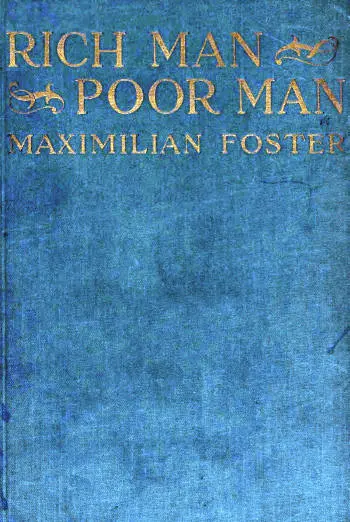
"Rich Man, Poor Man" by Maximilian Foster is a novel written in the early 20th century. The story explores themes of class, wealth, and personal connections, particularly focusing on the lives of Mr. Mapleson, a timid clerk in New York City, and Bab Wynne, a spirited young woman who is on the verge of discovering her true heritage. The interplay between these characters and their relationships will likely form a central part of the narrative as the plot unfolds. At the start of the novel, we meet Mr. Mapleson, an elderly clerk whose life appears mundane and lonely. On Christmas Eve, his character is established as he reflects on the loneliness and alienation he experiences, despite the joyful holiday spirit surrounding him. Meanwhile, the narrative shifts to Bab Wynne, who is depicted with a spirited demeanor that subtly suggests her yearning for a more exciting life, free from the confines of her boarding house existence. The initial chapters set the stage for a forthcoming transformation in their lives, hinting at the intertwining fates of the characters against the backdrop of societal expectations and personal dreams.
Introduction adapted from the source catalogue; source summaries may be automatically generated.
Free to read · English · 58,624 words · No account needed
MAKE TIME FOR A GOOD BOOK
On by default. Untick to stop anonymous reading totals. Each page counts after 10 seconds in view. How this works.
Anonymous counting is on unless you have switched it off.
As he led her from one to another of Byewolde's wonders, Bab again grew conscious that behind his animation, the exhilarant eagerness he showed, David had some purpose. His air again grew feverish. The gardener, an elderly Scotchman, hobbled along after them, dilating proudly on these flowers to which his life had been devoted. David and he long had been cronies, Bab discovered. It was "Maister Davvy" this and "Maister Davvy" that. He seemed hardly aware of Bab; all his attention he devoted to the young man, his master. On one occasion, though, there came near to being a misunderstanding between those two--on one side David, gay, animated; on the other the Scotchman, old and dour, his soul wrapped in the flowers that had been his life. Bab's attention was called by a sudden exclamation from the old man.
"Oh, Maister Davvy!" he cried in consternation.
They had been standing before one of the orchids, a bronzelike exotic on which a single bloom, a flower with strange pale lilac and green petals, had just burst forth. Bab, filled with admiration, had exclaimed at its beauty, and David had plucked it from the plant.
At the old gardener's evident dismay he laughed lightly.
"What's the difference, McNare? Here, Bab," he said, and handed her the flower. "Pin it on your waist."
McNare's distress still persisted.
"Ye've pluckit it, my orchid!" he cried. "Yon's the Sanctu, Maister Davvy; 'twull be the prize of a'!"
But David only laughed again. If a prize it would be fit, then, for a lady to wear. It was fortunate McNare had it ready to pick. At this point, however, with quick understanding he detected something in the old gardener's expression, and his bantering ceased. The ancient face had grown grayer, more furrowed.
"It was my bairn!" said McNare. "It was the apple o' my eye! I'd gi'ed it a year and more's care." He drew the back of one horny hand across his eyes.
"McNare!" cried David contritely.
Bab turned away as David impulsively put a hand on the old gardener's shoulder. That was like David. He would not for the world have hurt another.
A shadow seemed to have fallen on his spirit when he rejoined her. He was repressed, less eager, less animatedly talkative. He pointed to the flower in her hand.
"You don't want that, Bab," he said suddenly. "Throw it away."
Throw away the blossom which before the calamity McNare had said was priceless! Bab hesitated, but David insisted on it.
"It's blighted, Bab. You mustn't have about you anything that isn't all suggestive of happiness. Not today certainly, and never if I can help it."
Your reading position is saved on this browser. Take it to another device with a library code. Reading pages adapt to text, rather than matching a printed edition.
BEHIND THE BOOK
This eBook is for the use of anyone anywhere in the United States and most other parts of the world at no cost and with almost no restrictions whatsoever. You may copy it, give it away or re-use it under the terms of the Project Gutenberg License included with this eBook or online at www.gutenberg.org. If you are not located in the United States, you will have to check the laws of the country where you are located before using this eBook. Read the source licence.
The original source file, including credits and licence, is retained by this library. Request an original-format copy at no charge. Please include the book title and Project Gutenberg identifier #46945.
KEEP YOUR CURIOSITY GOING
Coulson Kernahan

Maurice Baring
Frances Wright
Cécile Tormay

Frederic Jesup Stimson

W. H. P. (William Henry Pope) Jarvis