THE CLASSIC COLLECTION✦A dead man’s diaryCLASSIC FREE BOOKS
A dead man’s diary
Coulson Kernahan
THE CLASSIC COLLECTION · 1916
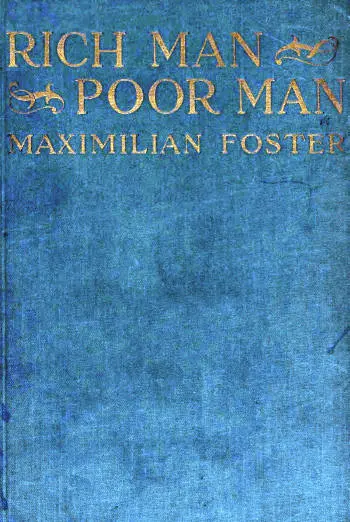
"Rich Man, Poor Man" by Maximilian Foster is a novel written in the early 20th century. The story explores themes of class, wealth, and personal connections, particularly focusing on the lives of Mr. Mapleson, a timid clerk in New York City, and Bab Wynne, a spirited young woman who is on the verge of discovering her true heritage. The interplay between these characters and their relationships will likely form a central part of the narrative as the plot unfolds. At the start of the novel, we meet Mr. Mapleson, an elderly clerk whose life appears mundane and lonely. On Christmas Eve, his character is established as he reflects on the loneliness and alienation he experiences, despite the joyful holiday spirit surrounding him. Meanwhile, the narrative shifts to Bab Wynne, who is depicted with a spirited demeanor that subtly suggests her yearning for a more exciting life, free from the confines of her boarding house existence. The initial chapters set the stage for a forthcoming transformation in their lives, hinting at the intertwining fates of the characters against the backdrop of societal expectations and personal dreams.
Introduction adapted from the source catalogue; source summaries may be automatically generated.
Free to read · English · 58,624 words · No account needed
MAKE TIME FOR A GOOD BOOK
On by default. Untick to stop anonymous reading totals. Each page counts after 10 seconds in view. How this works.
Anonymous counting is on unless you have switched it off.
So, though Varick single might exist with propriety in a boarding house, there was a vast difference between that and a Varick married--a Varick setting up for life, say, in a four-room Harlem flat. And Bab, too, don't forget, was a boarding-house keeper's nameless ward.
"Tell me something," she said.
Slipping from her perch, she drew up a chair and, seating herself, bent forward with her chin on her hands.
"You've heard of the Beestons, haven't you--that family uptown. By any
chance do you know them?"
"The Beestons!"
She saw him frown, his air amazed. However, though she wondered at the moment at his air, her interest was entirely in what he would answer.
"Why do you ask?" he inquired.
"I wanted to know," Bab returned slowly. "I wanted to find out something. Do they ever give parties--dances like the one you're going to tonight? And do you ever go to them?"
Varick's look grew all the more amazed. He not only knew the Beestons, he had often been in the huge house they occupied in one of the uptown side streets off the Avenue. But though that was true, for some reason the fact did not seem to afford him any great satisfaction. His face suddenly had grown hard.
"Who told you about them?" he demanded.
Bab smiled vaguely.
"There's a boy, isn't there?" she parried. "Old Mr. Beeston's grandson?"
The look of wonder in his face grew.
"Who? David Lloyd, you mean? How did you know him?" he questioned.
"I don't," said Bab, smiling at his vehemence; "I've only heard about him. He's a cripple, isn't he--a hopeless cripple?"
It proved that all his life Varick had known the boy--the man
rather--whom she meant.
"Look here, Bab," he directed, puzzled, "why do you ask me about those people? I'd like to know that! Will you tell me?"
She deliberated for a moment.
"It was something I heard," she said then, hesitating.
"Here? In this house?" he questioned, all the more amazed; and Bab
nodded.
"I heard Mr. Mapy say it," she returned.
Varick in return gazed at her, his face a picture.
Your reading position is saved on this browser. Take it to another device with a library code. Reading pages adapt to text, rather than matching a printed edition.
BEHIND THE BOOK
This eBook is for the use of anyone anywhere in the United States and most other parts of the world at no cost and with almost no restrictions whatsoever. You may copy it, give it away or re-use it under the terms of the Project Gutenberg License included with this eBook or online at www.gutenberg.org. If you are not located in the United States, you will have to check the laws of the country where you are located before using this eBook. Read the source licence.
The original source file, including credits and licence, is retained by this library. Request an original-format copy at no charge. Please include the book title and Project Gutenberg identifier #46945.
KEEP YOUR CURIOSITY GOING
Coulson Kernahan

Maurice Baring
Frances Wright
Cécile Tormay

Frederic Jesup Stimson

W. H. P. (William Henry Pope) Jarvis