THE CLASSIC COLLECTION✦My diaries, being a personal narrative of events 1888-1914, Part 2 (1900-1914)CLASSIC FREE BOOKS
My diaries, being a personal narrative of events 1888-1914, Part 2 (1900-1914)
Wilfrid Scawen Blunt
THE CLASSIC COLLECTION · 1854
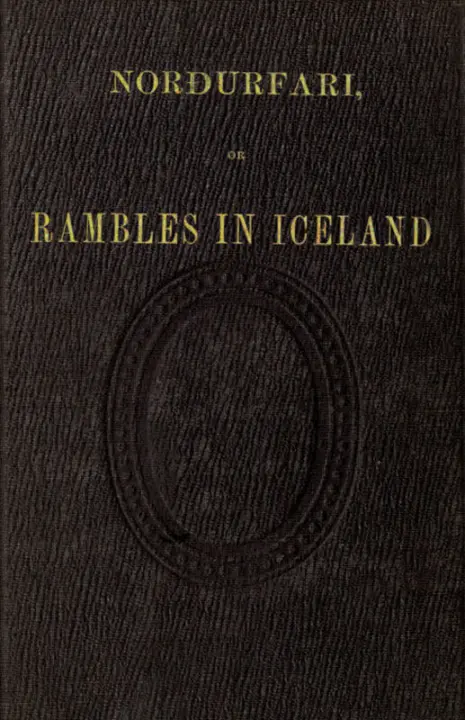
"Norðurfari; or, Rambles in Iceland" by Pliny Miles is a travel narrative written in the mid-19th century. The book chronicles the author's adventures as he journeys to Iceland, exploring its natural beauty, culture, and history, and provides a remarkable commentary on the people and landscapes he encounters. With a mix of personal reflection and historical insight, the narrative aims to depict the real Iceland, dispelling myths and misconceptions about the island. At the start of the narrative, Miles describes his voyage to Iceland aboard the schooner "Sölöven," detailing stops in Copenhagen and Elsinore before finally arriving in Reykjavik. He vividly recounts the ship's experiences, including challenges of the journey, interactions with fellow passengers, and a celebratory Fourth of July marked by cannon fire and spirited oration. The opening focuses on the excitement of travel, the camaraderie among passengers, and the author's first impressions of Iceland's unique geography and culture, setting the stage for deeper explorations to come.
Introduction adapted from the source catalogue; source summaries may be automatically generated.
Free to read · English · 86,267 words · No account needed
MAKE TIME FOR A GOOD BOOK
On by default. Untick to stop anonymous reading totals. Each page counts after 10 seconds in view. How this works.
Anonymous counting is on unless you have switched it off.
“Roses in December, ice in June.”
Here, too, we found that most beautiful of all the shrubs and flowers of Iceland, the fragrant heath. It is very plentiful, and of the same species so common in the Highlands of Scotland. Here it is of small size, seldom more than a foot in height. It is one of the first vegetables found growing on the lava beds. It seems to grow on a medium soil between the naked barren lava and the fertile meadows. Nearly one half of Iceland is covered with heath, and some day it may be fertile enough to produce grass. I have been told more than once that this beautiful shrub will not grow in North America, but I cannot believe it. In Europe and the northern isles, and Africa and Madeira, there are over a hundred different varieties of heath. Why will not some horticulturists rear a good variety, and try them from various climes, Madeira, Scotland, and Iceland, and get some of them naturalized with us in America, that they might cover our barren hills and waysides, and adorn our gardens and fields? The heath and the ivy—two plants almost unknown in America—are more beautiful and do more in Great Britain to cover up and adorn barren hills and old walls and ruins than all other vegetation, and yet they are rarely seen with us. I have been told, however, that the late lamented Mr. Downing has planted and naturalized the beautiful evergreen ivy, obtaining it from England. Let gardeners and farmers blush or boast, neither nature nor cultivation has adorned our hills with one nor ten plants that look half so beautiful as the blooming heather that covers the hills of far-off northern Iceland. The same species that grows here, I have seen in the Orkney and Shetland Islands, the Hebrides, the Highlands and Lowlands of Scotland, England, Ireland, France, Germany, Holstein, Denmark, Sweden, and Norway. It also grows in Africa, as far south as the Cape of Good Hope, the Cape heaths forming the most beautiful varieties of floral contributions that are seen at the splendid Chiswick flower-shows in London. Wilkes, in his Exploring Expedition, describes and pictures the forests of heath in Madeira, the trees nearly or quite a foot in diameter, and forty or fifty feet in height. I have an idea of offering a prize for the most beautiful variety of heath that will flourish in the open air in our Northern States, and then I think I will import some Iceland heath, and carry off the reward myself! Perhaps some of our horticultural societies will take the hint, go to work, and get it all done before I get back to America. Leaving Næfrholt, we took our back track as far as Skarth, where I had stayed all night, and slept in the church a few days before. The farmer seemed glad to see me, gave me “a grip of his flipper,” and a fine bowl of milk. I returned the grip, gave him a piece of silver, mounted my horse, and off we galloped to the southwest. If the world was not “all before us where to choose,” all Iceland was, and on we journeyed. Some hours’ travel brought us to the banks of the Thiorsá, and we prepared to face its turbulent and mighty current. Any one who supposes that that little white spot in the Arctic sea, called Iceland, cannot produce a river worthy of the name, had better try to swim across this one. I should far rather breast the Hellespont, and follow Leander. Larger than the Hudson at Newburgh, swift as an arrow, white with clay from the mountains, and cold as ice,—really it is the most formidable stream in appearance that I have ever seen. But we had ferried it once, and could again; and a frail skiff put off from the opposite shore to take us across. The only ferryman was a small boy, and so I manned one oar myself. The guide sat in the stern of the boat, and led the horses as they swam after us. The boy could not row evenly with me; the current bore us furiously down the stream; the boat leaked badly; and, by the time we were in the middle of the river, the horses got unmanageable, nearly upset our frail craft, and finally broke loose altogether, and floated and swam down the stream, the tips of their noses and their ears just out of water. We let the horses go, and rowed like good fellows, and landed on the west side of the river, but a good long way farther down than the point opposite where we started. The poor ponies followed the boat as well as they could, and after a while all came ashore, some in one place, and some in another. We now traveled directly down the Thiorsá, towards the south coast, bordering the Atlantic. We had a fine journey through the valley of this great river. There was no crossing except at the ferries; but the fine farming region, and a wish to get a near view of the Westmann Islands, and, if possible, visit them, induced me to make a long and circuitous journey on the southern coast. The weather was clear and fine, and Hekla, and the Eyjafjalla and Tindfjalla Jokulls stood up in bold relief against the eastern sky. The Eyjafjalla Jokull, as its name imports—Mountain of Islands—shows, on its broad, sloping summit, several knobs that stand up like islands. Near the top, where it inclines towards the west, I could see a broad, deep chasm, filled with snow. This pit must be of immense depth, for while it is nearly filled with snow it is plainly visible for over thirty miles. On the more even summit of the Tindfjalla Jokull, there are several little elevations like islands or miniature mountains. Hekla looks black, clear to the summit, except now and then a small spot of snow. I do not know where those writers get their information from, regarding this mountain, when they speak of the “three-coned Hekla.” From different points of compass, including nearly every position whence Hekla can be seen, and also from a sojourn on its summit, I must say that I have never seen three cones, nor even two. From all sides, the highest point rises in one single cone, like the profiles of most other volcanoes. On arriving at the top, it is rather broad and flat, as I have mentioned; but this is not observed from a distance. It is steeper than Ætna, but not so steep as Vesuvius. That old Madam Pfeiffer should speak of Hekla as having three cones, and no crater at all, is exactly in accordance with the most of her statements about Iceland. Where she does not knowingly tell direct falsehoods, the guesses she makes about those regions that she does not visit—while stating that she does—show her to be bad at guess-work, and poorly informed about the country. The valleys of the Hvitá, the Thiorsá, and the Markarfliot, south, southwest, and west of Hekla, comprise the largest tract of grass land in all Iceland. A large share of it is in cultivated farms, and the rest is bog. In drawing near to the coast, how magnificent the Westmann Islands appear! Rising up like columns, they stand from one to two thousand feet above the ocean. Formed of perpendicular, basaltic rocks, these and other islands of the north of Europe rank with the most splendid coast-scenery in the world. The Westmann Islands are most difficult to approach. The place of landing is so treacherous, that unless the weather is calm and the sea very still, a landing cannot be effected. A high cascade on the main land of Iceland, near the town of Holt, is a sort of weatherometer that decides whether a boat can put off with a prospect of gaining the island. This cascade is one long stream of spray, formed by a small brook falling a height of 800 feet. In windy weather, the spray is blown entirely away, so that from the landing no cascade is in sight. If it is still enough for this cascade to appear constantly two days in succession, then the sea is usually calm enough to allow boats to land, and they venture out. In the winter, it sometimes happens that for weeks no boats can pass between the islands and the main shore.
Your reading position is saved on this browser. Take it to another device with a library code. Reading pages adapt to text, rather than matching a printed edition.
BEHIND THE BOOK
This eBook is for the use of anyone anywhere in the United States and most other parts of the world at no cost and with almost no restrictions whatsoever. You may copy it, give it away or re-use it under the terms of the Project Gutenberg License included with this eBook or online at www.gutenberg.org. If you are not located in the United States, you will have to check the laws of the country where you are located before using this eBook. Read the source licence.
The original source file, including credits and licence, is retained by this library. Request an original-format copy at no charge. Please include the book title and Project Gutenberg identifier #61992.
KEEP YOUR CURIOSITY GOING
Wilfrid Scawen Blunt
Wilfrid Scawen Blunt

E. W. (Edgar Watson) Howe
Francis Greenleaf Allinson & Anne C. E. (Anne Crosby Emery) Allinson
Cyrenus Cole

John Martineau