THE CLASSIC COLLECTION✦An outlaw’s diary: the CommuneCLASSIC FREE BOOKS
An outlaw’s diary: the Commune
Cécile Tormay
THE CLASSIC COLLECTION · 1908
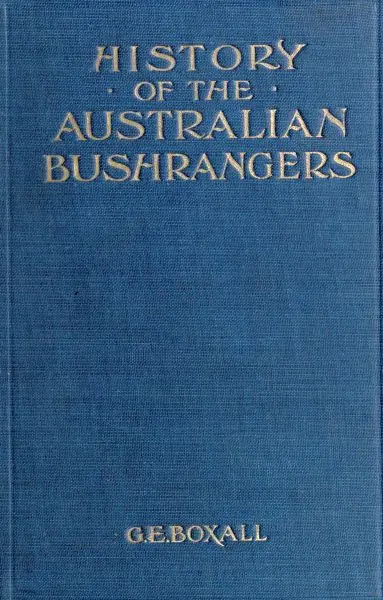
"History of the Australian Bushrangers" by George Boxall is a historical account written in the late 19th century. This work delves into the complex era of bushranging in Australia, examining the social and legal conditions that fostered the emergence of these outlaw groups. The narrative is rooted in the historical treatment of convicts and explores the motivations behind their descent into bushranging, shedding light on a significant period of Australian history. The opening of the text provides a foundational understanding of bushranging, highlighting its origins connected to the convict system in Australia. Boxall discusses how the harsh treatment and oppressive laws against convicts often pushed them to revolt against the system, leading many to take to the bush to escape their dire circumstances. He emphasizes that early bushrangers were often driven by desperation rather than inherent criminality and illustrates the grim realities they faced, including severe punitive measures like flogging. Boxall aims to present a comprehensive picture of bushranging and its implications for Australian society, suggesting that the bushrangers, despite their notorious actions, were products of their brutal environment.
Introduction adapted from the source catalogue; source summaries may be automatically generated.
Free to read · English · 150,077 words · No account needed
MAKE TIME FOR A GOOD BOOK
On by default. Untick to stop anonymous reading totals. Each page counts after 10 seconds in view. How this works.
Anonymous counting is on unless you have switched it off.
On the 9th May, 1869, Mr. Henry Kidder Gillham, manager of the Australian Joint Stock Bank at Braidwood, returned home at eight p.m., and entered by the side gate, when a man sprang out from the shadow and called on him to stand. The bushranger presented a revolver, which Mr. Gillham pushed aside, when another man struck him with a life preserver and knocked him down. Two shots were fired from revolvers. Michael Collins, a gardener living on the bank premises, was in the kitchen when the two bushrangers entered. One of them called out: "Not a word, or it will be the worse for you." The tall man had a "Northumberland voice--that is, he could not pronounce the r." They tied Collins, and went out of the kitchen. In the meantime the firing had been heard, and Mr. Finnigan, a teacher, with Sergeant Duffy and Constable Luke Dacy, ran to the bank. When they got there two men ran out of the garden, and after a chase, during which several shots were fired, Joseph Horne was captured. He had no boots on. The other man, John Bollard, escaped at the time, but was tracked and captured subsequently. The Chief Justice, Sir Alfred Stephen, said that Horne had been sentenced to seven years' hard labour at Maitland. He was afterwards convicted in Melbourne and had escaped from Pentridge stockade, having been shot in the shoulder. Horne said that punishment had made him what he was, and pleaded hard for Bollard, who was young and had been enticed from the right path by him. Horne was sentenced to fifteen years' imprisonment and Bollard to ten years.
John Baker and William Bertram divided their attentions between New South Wales and South Australia. In May, 1869, warrants were issued for their arrest for horse stealing from the Mount Murchison station. They took to the road and stuck up a number of people. In October they bailed up a hawker named Charles Young, who resisted and was shot dead. This occurred at the Barrier Ranges, not a great way from where the Broken Hill silver-lead lode was afterwards discovered. Bertram was followed and captured, and was subsequently tried, convicted, and hung at Bathurst. Baker escaped for the time and made his way to Koringa. Said the South Australian Register, "He showed a remarkable want of caution in returning to a district where he had passed his hobble-de-hoy years and was consequently well known." He had been employed as a horse-breaker at the Cross Roads Grounds, Burra Burra, about seven years previously and had afterwards worked for Messrs. Macdonald & Hockin, mail coach proprietors, on the Great Northern Road. On his arrival at Koringa he went into a barber's shop and asked to have his hair cut and dyed. The hairdresser refused to dye it. Baker swore at him, but could not change his determination. The bushranger also grumbled at the time spent in cutting his hair, and continually urged the barber to "hurry up." When the job was completed Baker walked to Redruth, and sat down in the main street opposite the Court House, where the police sessions were being held at the time. There were a number of people about, but Baker sat and cut his tobacco with all the nonchalance of innocence. He filled and lighted his pipe, and was smoking comfortably, when Corporal Smith and Constable Walker came up and said "You're our prisoner." "What for?" asked Baker. "Bushranging," was the short reply. Baker sprang up from his seat, and raced away at a great rate along the road. He was speedily followed by the police on horseback and brought back. He struggled furiously, slipping his hands from the handcuffs with the greatest ease. The police, however, carried him into the lock-up, and put him into a cell. When questioned, he said he had brought a mob of horses down country for sale, and carried a revolver for his own protection. In the same cell was a man named Dobson arrested for horse stealing, who had been quiet until Baker came. But the door was barely closed and locked when the gaoler heard a suspicious noise in the cell. On opening the door he found that Baker and Dobson were trying to make a hole in the roof with a heavy board seat which they had wrenched from its mortice, and were now using as a battering-ram. Baker was placed in another cell and ironed. He was a small wiry man, very active, and a daring rider. In company with Bertram he had stuck up the Mount Murchison station; stuck up Mr. Cobham's station two hundred miles from Wilcannia, and taken money, a revolver, and several horses; stolen the horse he was riding from Mr. O'Leary, of Poolamacca; robbed and murdered a hawker at the Barrier ranges, and stuck up and robbed a number of people on the roads about Tiers, Gummeracha, and other places near the Murray River, on both sides of the New South Wales-South Australian border. When Bertram was captured, Baker endeavoured to induce a young man whom he met to join him, telling him that they could easily raise £200 to £300, but the young fellow replied that he "didn't want to be hung yet." Baker was extradited to New South Wales, and was tried and hung at Bathurst early in 1871.
Your reading position is saved on this browser. Take it to another device with a library code. Reading pages adapt to text, rather than matching a printed edition.
BEHIND THE BOOK
This eBook is for the use of anyone anywhere in the United States and most other parts of the world at no cost and with almost no restrictions whatsoever. You may copy it, give it away or re-use it under the terms of the Project Gutenberg License included with this eBook or online at www.gutenberg.org. If you are not located in the United States, you will have to check the laws of the country where you are located before using this eBook. Read the source licence.
The original source file, including credits and licence, is retained by this library. Request an original-format copy at no charge. Please include the book title and Project Gutenberg identifier #58799.
KEEP YOUR CURIOSITY GOING
Cécile Tormay

Moritz Busch
John L. Ransom
Frances Wright
Cécile Tormay

Mabel Potter Daggett