THE CLASSIC COLLECTION✦An outlaw’s diary: the CommuneCLASSIC FREE BOOKS
An outlaw’s diary: the Commune
Cécile Tormay
THE CLASSIC COLLECTION · 1908
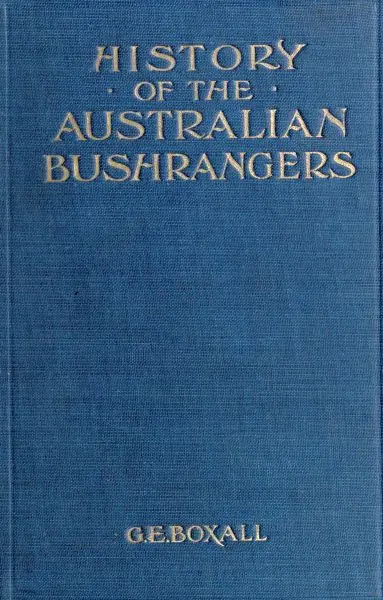
"History of the Australian Bushrangers" by George Boxall is a historical account written in the late 19th century. This work delves into the complex era of bushranging in Australia, examining the social and legal conditions that fostered the emergence of these outlaw groups. The narrative is rooted in the historical treatment of convicts and explores the motivations behind their descent into bushranging, shedding light on a significant period of Australian history. The opening of the text provides a foundational understanding of bushranging, highlighting its origins connected to the convict system in Australia. Boxall discusses how the harsh treatment and oppressive laws against convicts often pushed them to revolt against the system, leading many to take to the bush to escape their dire circumstances. He emphasizes that early bushrangers were often driven by desperation rather than inherent criminality and illustrates the grim realities they faced, including severe punitive measures like flogging. Boxall aims to present a comprehensive picture of bushranging and its implications for Australian society, suggesting that the bushrangers, despite their notorious actions, were products of their brutal environment.
Introduction adapted from the source catalogue; source summaries may be automatically generated.
Free to read · English · 150,077 words · No account needed
MAKE TIME FOR A GOOD BOOK
On by default. Untick to stop anonymous reading totals. Each page counts after 10 seconds in view. How this works.
Anonymous counting is on unless you have switched it off.
A few days later, Daly was arrested by Sir Frederick Pottinger. He was a native of the district, under twenty years of age. When brought up and charged at the police court, Captain Norton failed to identify him, but Billy Durgan exclaimed, when called upon for his evidence: "Mine know it, Patsy Daly like it brudder." Daly was placed on trial for having, in company with others, robbed Myers Solomon, store-keeper, of property, including money, horses, guns, revolvers, clothing, food, &c., to a large amount. George Johnson identified Daly as the man who had knocked the boy down and kicked him when he placed the revolver on the counter. Johnson called Daly a coward, and was told to keep quiet unless he wanted his "---- brains blown out." Johnson replied: "I'd like to meet you man to man fairly." Another of the bushrangers asked: "Will you stand up and fight me if I give you a pistol?" Johnson replied, "Yes," and stepped forward. The third bushranger, however, ordered him back, and told his mates to "quit fooling." Johnson and the other men in the store were then made to lie on their faces, with a bushranger over them on guard, while the other bushrangers selected what they wanted, packed it in bundles, and strapped it on the pack horses. While thus employed, the bushranger who had challenged Johnson kicked him in the ribs savagely, and told him to keep still. The other persons present gave their versions of the occurrence, but they differed little from what has been recorded above. Daly was convicted, and was sentenced to fifteen years' penal servitude.
On March 30th, two men called at James Brown's hut at Wallenbeen and asked for something to eat. Brown told his wife to give them some breakfast. It may be necessary to remark that such hospitality is common in Australia. Having eaten as much as they required, the travellers demanded Brown's hat and boots. After some dispute these were handed over. The boots were too small, and the man who wanted them took out his pocket-knife to cut them, when his mate said, "Oh, come on; we'll get plenty at McKay's." They left the boots, went out, mounted their horses, and rode away. They had only gone a few yards when they met Mr. Barnes, a store-keeper at Cootamundra, and his assistant, Mr. Hanlow, who was in charge of a branch store at Murrumburrah. The travellers ordered Barnes to "bail up." Barnes said, "I know you, O'Meally," and O'Meally replied, "I know you, you----. Get off that horse; I want him." Barnes wheeled his horse round and galloped away, and O'Meally followed. They galloped round the hill, back past the stockyard, and then down the gully out of sight among the trees. In the meantime, Hanlow was conducted by the other bushranger off the road to the stockyard, where they were soon joined by O'Meally. "Where's Mr. Barnes?" asked Hanlow, as the robber rode up. "Down there," replied O'Meally nonchalantly, pointing down the gully. "You haven't shot him?" inquired Hanlow anxiously. "Oh, no," replied the bushranger coolly, "he hit himself against a tree and tumbled off." Mr. Alexander McKay, the squatter who owned the stockyard, and whose house was not far away, had heard the galloping and shouting, and went on to the verandah of his house to ascertain the cause of the noise. It was then about half-past eleven a.m., and the day was Sunday. He saw one man chasing another, and thought it was a trooper after a bushranger. He watched them gallop down the gully, and saw the one he took to be a trooper shoot the other, and then wheel his horse round and gallop back without waiting to see whether the man who had fallen off his horse was dead or not. As O'Meally came nearer McKay recognised him, and his suspicions were aroused. He started to walk down the gully to the wounded man, when he was stopped by O'Meally who ordered him to go back and open the store, adding, "I want some boots and clothes for my mate. He lost his in a brush with the traps." Mr. McKay went to the store and gave O'Meally the things he had asked for. The bushranger then said he wanted fresh horses. McKay replied that the horses were never brought in on a Sunday and therefore he could not get them. "Ah," said O'Meally, "I had Chance from you. He was a good 'un. Well, I'll come some other time and get one." The bushrangers then went away and McKay and Hanlow walked down the gully to where Barnes was lying. They found that he was quite dead, and sent word to the nearest police station. An inquest was held next day, and a verdict of wilful murder was returned against O'Meally and another man whose name was unknown.
Your reading position is saved on this browser. Take it to another device with a library code. Reading pages adapt to text, rather than matching a printed edition.
BEHIND THE BOOK
This eBook is for the use of anyone anywhere in the United States and most other parts of the world at no cost and with almost no restrictions whatsoever. You may copy it, give it away or re-use it under the terms of the Project Gutenberg License included with this eBook or online at www.gutenberg.org. If you are not located in the United States, you will have to check the laws of the country where you are located before using this eBook. Read the source licence.
The original source file, including credits and licence, is retained by this library. Request an original-format copy at no charge. Please include the book title and Project Gutenberg identifier #58799.
KEEP YOUR CURIOSITY GOING
Cécile Tormay

Moritz Busch
John L. Ransom
Frances Wright
Cécile Tormay

Mabel Potter Daggett