THE CLASSIC COLLECTION✦An outlaw’s diary: the CommuneCLASSIC FREE BOOKS
An outlaw’s diary: the Commune
Cécile Tormay
THE CLASSIC COLLECTION · 1908
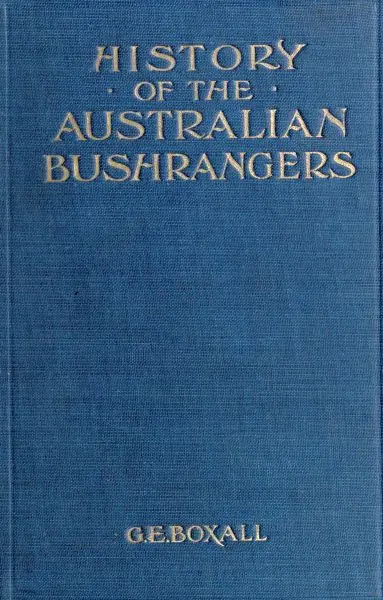
"History of the Australian Bushrangers" by George Boxall is a historical account written in the late 19th century. This work delves into the complex era of bushranging in Australia, examining the social and legal conditions that fostered the emergence of these outlaw groups. The narrative is rooted in the historical treatment of convicts and explores the motivations behind their descent into bushranging, shedding light on a significant period of Australian history. The opening of the text provides a foundational understanding of bushranging, highlighting its origins connected to the convict system in Australia. Boxall discusses how the harsh treatment and oppressive laws against convicts often pushed them to revolt against the system, leading many to take to the bush to escape their dire circumstances. He emphasizes that early bushrangers were often driven by desperation rather than inherent criminality and illustrates the grim realities they faced, including severe punitive measures like flogging. Boxall aims to present a comprehensive picture of bushranging and its implications for Australian society, suggesting that the bushrangers, despite their notorious actions, were products of their brutal environment.
Introduction adapted from the source catalogue; source summaries may be automatically generated.
Free to read · English · 150,077 words · No account needed
MAKE TIME FOR A GOOD BOOK
On by default. Untick to stop anonymous reading totals. Each page counts after 10 seconds in view. How this works.
Anonymous counting is on unless you have switched it off.
Melville had been removed from the hulks to the Melbourne gaol a short time before because it was believed that he had been planning a general mutiny, and now it was said that the murder of Mr. Price had been included in his scheme. During the first two or three months of his residence at "Wintle's Hotel," as the Melbourne gaol was facetiously called, Melville behaved very quietly, and was treated as an ordinary prisoner. On July 28th, 1857, he made a savage attack on Mr. Wintle, the Governor of the gaol, and was afterwards confined to his cell. Later it was reported that for weeks he would behave in the most exemplary manner, but would suddenly and unexpectedly break out into a paroxysm of fury, during which he would destroy everything destructible. At these times the warders and officers were ordered to keep away from his cell, and leave him to himself. He was placed under medical surveillance, with a view to ascertain whether he was sane or not, great care being taken, it was said, not to excite him. On August 10th he was locked up as usual, and appeared to be in his normal condition as regards health and spirits, but, on his cell being opened next morning, he was found lying dead on the ground. A blue handkerchief with red spots, which he had brought with him from the hulks, was tied round his neck with a slip knot and twisted up tightly. Dr. McCrae was called in immediately, and said that death was due to strangulation. Life had been extinct some three or four hours. He was of the opinion that the prisoner had tied the knot himself. A verdict of felo de se was returned by the coroner's jury which heard the case. A variety of opinions were expressed as to this verdict. So far as is known, there is no evidence to prove that Melville came to his death in any other way than that stated at the inquest, but there were numbers of people who asserted their belief that the bushranger was strangled by the gaolers. As a rule these people did not blame the gaolers for this act. The opinion generally expressed was that Melville was little better than a wild beast, and was better dead than alive. They also asserted that it would have been more satisfactory if the bushranger had been hung openly instead of being murdered secretly, and they blamed the Governor and the Judge for having been so "soft-hearted" as to commute his sentence when he was condemned to the gallows. There appears, however, to be no evidence in support of this view. The records of the inquest are brief, but they seem clearly enough to prove that the most noted bushranger of the gold-digging era took his own life in one of the paroxysms to which he was liable. Whether these paroxysms were due to his harsh treatment on the hulks is another matter, but we are not in the "Fifties" now. The hulks have been destroyed or sold, and the prisoners are treated as humanely now in Australia as they are in any other civilised country. The treatment of the bushrangers all through the later developments of that crime tend to prove that the Australians considered bushranging as a sort of exotic introduced into the country with the convicts sent from England, and only to be wiped out by the suppression of the convict element in the population. We see the influence of this view in New South Wales, Van Diemen's Land, and elsewhere, as well as in Victoria. In this colony the appointment of Mr. John Price as Inspector General of convicts was an expression of the popular belief. Mr. Price had had a long experience among convicts, and the very fact that his treatment of them was harsh was a recommendation in his favour. He had been superintendent of the convict station of Port Arthur, where he was known to the convicts placed under his charge as "Bloody Tyrant Price." When that establishment, of the character of which the late Marcus Clarke gives us an idea, but an idea only, in his story, "For the Term of his Natural Life," was broken up, in consequence of the cessation of transportations to Van Diemen's Land, in 1853, Mr. Price was specially chosen for the position he held in Victoria because of his knowledge, not merely of convict character, but of the personal appearance of a large number of the criminals who were disturbing the peace of the colony, because the majority of them had already been under his charge in Van Diemen's Land. The Victorians desired above all things to keep the convicts out of their colony, and as a means to this end they endeavoured to make their prisons a "holy terror" to this class of immigrant. When that object had been achieved, or the convict element in the population had died out by the effluxion of time, they modified their prison discipline in accordance with the growth of humanitarian ideas. Whether they have done all that is possible in this direction may be doubted, but this is not the place to discuss this question. The evidence so far as it has been collected and considered tends to show that the chief remedy for crime is education. It is impossible to believe that even the worst of the bushrangers would have grown up to be such scourges to society had they been properly cared for during the impressionable period of their lives, and many of them amid all their savagery show traces of qualities which might, under happier circumstances, have fitted them for useful positions in the world. It may be added here that Mr. John Price is popularly supposed to have been the prototype of "Maurice Freere" in Marcus Clarke's novel, which should be read by every student of Australian history.
Your reading position is saved on this browser. Take it to another device with a library code. Reading pages adapt to text, rather than matching a printed edition.
BEHIND THE BOOK
This eBook is for the use of anyone anywhere in the United States and most other parts of the world at no cost and with almost no restrictions whatsoever. You may copy it, give it away or re-use it under the terms of the Project Gutenberg License included with this eBook or online at www.gutenberg.org. If you are not located in the United States, you will have to check the laws of the country where you are located before using this eBook. Read the source licence.
The original source file, including credits and licence, is retained by this library. Request an original-format copy at no charge. Please include the book title and Project Gutenberg identifier #58799.
KEEP YOUR CURIOSITY GOING
Cécile Tormay

Moritz Busch
John L. Ransom
Frances Wright
Cécile Tormay

Mabel Potter Daggett