
Last letters from the living dead man
David Patterson (Spirit) Hatch
THE CLASSIC COLLECTION · 1909
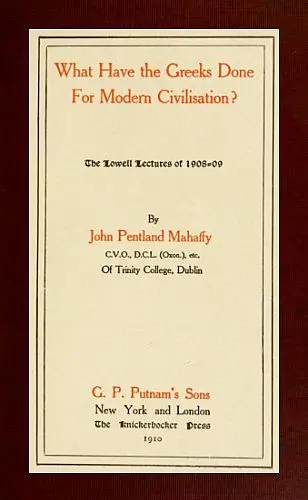
"What Have the Greeks Done for Modern Civilisation?" by J. P. Mahaffy is a series of lectures written in the early 20th century. The work explores the profound influence of ancient Greek culture on contemporary society, particularly focusing on the arts, philosophy, science, and education. Its purpose is to reevaluate the significance of Greek studies in modern education and society. The opening of the text introduces Mahaffy as a seasoned scholar delivering a series of lectures that aim to highlight the contributions of the Greeks to modern civilization. He expresses his initial doubts about the diminishing interest in Greek studies, particularly in America, and outlines the various domains—literature, art, politics, and science—through which Greek thought has indelibly shaped contemporary understanding. He emphasizes that understanding the Greek legacy is essential for appreciating the foundations upon which modern culture is built and suggests that reforming the teaching of Greek is vital to reviving its significance in educational curricula.
Introduction adapted from the source catalogue; source summaries may be automatically generated.
Free to read · English · 58,758 words · No account needed
MAKE TIME FOR A GOOD BOOK
On by default. Untick to stop anonymous reading totals. Each page counts after 10 seconds in view. How this works.
Anonymous counting is on unless you have switched it off.
Frere’s translation of Aristophanes, 61, 64
Geometry, Euclid’s, 158-161, 167;
books on history of, 170
Georgics of Virgil, 24
Germany, reduction of many states into one empire, 204
Gibbon, Edward, Decline and Fall of the Roman Empire, conception which moved author to write, 79
Gladstone, William E., style of eloquence, 89
Goethe, Faust: a world epic, 27;
borrowings from Argonautics, 44
Golden Age of Greek Literature, 91
Gray, Thomas, Greek temper, 54;
compared with Simonides
and Bacchylides, 54;
swept away by Romantic wave, 54;
prefers Celtic and national subjects, 54;
Greek style, 54;
grasps splendour of Pindar, 54;
shows influence of Greek poetry, 54, 55;
love of nature, 59
Greece, advantageous position of, 11;
economic conditions in time of Polybius, 206;
modern character of civilisation, 207
Greek culture, vital essence, 182;
Latin, compared with, 182
Greek learning, revival of, 17-20
Greek scholars in Western Europe, 17, 18
Greek society, conditions, 213, 214
Greek studies, place in higher education, 20-22;
and Latin, 22, 23;
source of culture, 23;
comparative value of originals and translations, 23-26
Greeks, the, explanations of pre-eminence insufficient, 3-7;
pre-eminence unexplained, 7-9;
originality, 9;
genius of race analogous to genius of individual, 9;
powers of assimilation and reproduction, 10-12;
important position between two civilisations, 11;
effect of diverse influences, 11, 12;
receptive, but not
absorbed, 13, 14;
persistence of characteristics, 15;
accomplishments in world’s history, 16-18;
influence of, 53;
not wanting in love for nature, 59;
why no means of expressing Christian spirit, 113;
and Christianity, 113;
race of varied experience, 116;
sense of fitness in sculpture, 116;
power of logic upon their minds, 152;
triumphs gained by hard thinking, 179;
traders, 187;
attitude toward monarchy, 205;
furnish lessons in failures as well as in achievements, 205, 206;
middle classes most important, 206;
adopt limitation of family, 207
Grote, George, historian, 56;
not interested in travelling in Greece, 56;
on Attic citizens, 208
Grotius, Hugo, De Jure Pacis et Belli, 198
Guesses at Truth, see Hare
Hamlet of Shakespeare, 48
Hare, Guesses at Truth, quoted, 52
Hecatæus, historian, 71
Hegemony of Greece, what it was, 201;
leaders, 201
Hellenic race, see Greeks
Heracleitus of Ephesus, early writer of prose, 67;
his fundamental element of the world, 219;
on qualities of matter, 220, 221
Herculaneum, 145
Hermes of Praxiteles, 106
Hero and Leander, 96
Herodotus, Father of History, world model of art of history, 71-75;
subject, 71, 74, 78;
essence of history as an art, 73;
agrees with Aristotle as to style and subject of history, 74;
style, 74, 75;
so-called inventions of, 76;
vindicated, 76;
compared with Thucydides, 76, 78;
on Cyrene, 77;
quoted, 116
Heron, development of mechanics and hydrostatics, 147, 162, 167; ingenious inventions of, 162-164, 165
Herondas, Mimes, inferior poetry, 39
Hiero of Xenophon, 116
Hipparchus, astronomer, 167
Hippocrates of Kos, Father of Rational Medicine, 67, 171;
founds school of medicine, 171;
style of writing, 172;
works out a system of treatment, 172;
Aphorisms quoted, 172;
John Stearne on works of, 174;
mental attitude of, 174;
ignores supernatural causes of diseases and cures, 175;
quoted, 175;
combats superstition, 176;
principles, 177;
oath of practitioners, 178
Hipponax, 41
Your reading position is saved on this browser. Take it to another device with a library code. Reading pages adapt to text, rather than matching a printed edition.
BEHIND THE BOOK
This eBook is for the use of anyone anywhere in the United States and most other parts of the world at no cost and with almost no restrictions whatsoever. You may copy it, give it away or re-use it under the terms of the Project Gutenberg License included with this eBook or online at www.gutenberg.org. If you are not located in the United States, you will have to check the laws of the country where you are located before using this eBook. Read the source licence.
The original source file, including credits and licence, is retained by this library. Request an original-format copy at no charge. Please include the book title and Project Gutenberg identifier #59132.
KEEP YOUR CURIOSITY GOING
David Patterson (Spirit) Hatch
Cécile Tormay

Moritz Busch
Coulson Kernahan
John L. Ransom

Ralph Waldo Emerson