
Last letters from the living dead man
David Patterson (Spirit) Hatch
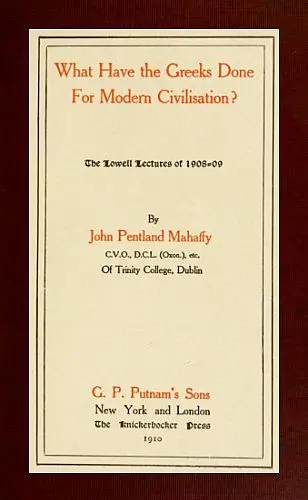
THE CLASSIC COLLECTION · 1909
"What Have the Greeks Done for Modern Civilisation?" by J. P. Mahaffy is a series of lectures written in the early 20th century. The work explores the profound influence of ancient Greek culture on contemporary society, particularly focusing on the arts, philosophy, science, and education. Its purpose is to reevaluate the significance of Greek studies in modern education and society. The opening of the text introduces Mahaffy as a seasoned scholar delivering a series of lectures that aim to highlight the contributions of the Greeks to modern civilization. He expresses his initial doubts about the diminishing interest in Greek studies, particularly in America, and outlines the various domains—literature, art, politics, and science—through which Greek thought has indelibly shaped contemporary understanding. He emphasizes that understanding the Greek legacy is essential for appreciating the foundations upon which modern culture is built and suggests that reforming the teaching of Greek is vital to reviving its significance in educational curricula.
Introduction adapted from the source catalogue; source summaries may be automatically generated.
Free to read · English · 58,758 words · No account needed
MAKE TIME FOR A GOOD BOOK
On by default. Untick to stop anonymous reading totals. Each page counts after 10 seconds in view. How this works.
Anonymous counting is on unless you have switched it off.
Alexandrian school, development of mechanics, 162;
invention of the sakia, 165
Alkestis, see Euripides
Alma-Tadema, Sir Edward, influenced by Greek art, 131, 132
Amyot, imitated Greek novel, 96
Anatomy, how studied by Greeks, 148
Anaxagoras, principal feature of his system, 229;
on original particles, 229;
Aristotle on, 229;
his famous Nous, 230, 231
Anaximander, makes advances in astronomy, 216, 217;
geological observations of, 218
Anaximenes, idea of the fundamental element of the world, 216, 217;
theory of eclipses, 217
Antiphon, treatises of, 82
Antony and Cleopatra, see Shakespeare
Aphrodite of Melos, mentioned, 118
Apollonius of Perga, treatment of conic sections, 161, 167
Apollonius Rhodius, delights in nature, 59
Argonautics: great epic, 41;
model for Milton, 43;
and Goethe’s Faust, 44
Arabic numerals, 157
Archilochus, poet, 37
Archimedes, triumphs of, in mechanics, 162, 167
Architecture, earliest form of house, 99;
houses of the dead, 100-102, 110, 111;
square house, 102;
evolution of classical, 103;
building materials, 103;
Doric, 104;
temples, 105, 110;
distinction between house and temple, 106, 107;
perfection of religious, 106, 107;
arch not used by Greeks, 107, 108;
Greek and Roman, compared, 108;
purpose in parts of a building, 109;
origin of arch, 109;
Roman use of arch, 110;
ornamentation of, by sculpture, 120
Archytas, 167
Areopagitica, see Milton
Argonautics, see Apollonius Rhodius
Argos, slaves in, 188
Aristides, studied oratory, 70
Aristocracies, in classical and mediæval times, 184
Aristophanes, as critic, 92;
ridicules Asklepiads, 176
Aristophanes, diction and metre, 37;
greatest master of Greek comedy, 60, 61;
Frere’s translation, 61, 64;
Rogers’s translation, 61;
influence and legacy, 61
Birds and Frogs: 27
Aristotle, almost canonised, 19;
criticism of Iphigenia in Aulis, 62, 72;
criticism of Medea, 62;
distinction between prose and poetry, 62, 63;
on Herodotus, 62, 63, 73;
on dramatic poetry and history, 72, 74;
and Herodotus, on style and subject of history, 74;
treatise on Language, 149;
treatise on Reasoning, 150;
arithmetical proof of theorem in geometry, 156;
on geometry, 159;
“master of those that knew,” 167;
brought up in Socratic method, 167;
style of writing, 167, 168;
system of collaboration, 168, 171;
collaborators, 169;
does no original work in mathematics, 169;
competence in mathematics, 170;
sciences promoted by, 171;
views on slavery, 189;
views on craftsmen, 189;
essential in his ideal of a state, 206;
objection to atomic theory, 233;
influence on modern thought, 237;
his philosophy and the Church, 242
Constitution of Athens: 169
Poetic: on tragic poetry, 61;
on dramatic poetry and history, 72
Aristoxenus, collaborator with Aristotle, 169
Arithmetic, starting-point of mathematics, 153;
importance of, to Pythagoras, 153;
numbers the essence of the universe, 153, 154;
Greek meaning of, 154;
Pythagorean speculations on natural series of units, 155;
specimens of treatment by Pythagoras, 156;
importance of numbers ten and twelve, 156;
Greek notation, 157;
Euclid’s works on, 161;
books on history of, 170
Arnold, Matthew, compares Milton’s style with Virgil’s, 46;
writes plays after Greek models, 58
Merope: 58
Art, earliest Greek, 12;
proper province of, 33, 34;
use of the term, 98
Artificiality of Greek poetry, defined, 33, 34
Asklepiads, method of, 176
Assemblies, in Greek democracies, 183
Astronomy, books on history of, 170
Atalanta, see Swinburne
Athens, debts in, 186;
leadership, 201;
degeneration of spiritual life in, 210
Atomic theory, developed by Leucippus and Democritus, 231, 232;
results of, 233;
Aristotle’s objections to, 233
Atomists, doctrine of, 218, 219
Atreus, tomb of, 102, 111
Attic citizens, character, 208
Attic Code of laws, 190, 261
Your reading position is saved on this browser. Take it to another device with a library code. Reading pages adapt to text, rather than matching a printed edition.
BEHIND THE BOOK
This eBook is for the use of anyone anywhere in the United States and most other parts of the world at no cost and with almost no restrictions whatsoever. You may copy it, give it away or re-use it under the terms of the Project Gutenberg License included with this eBook or online at www.gutenberg.org. If you are not located in the United States, you will have to check the laws of the country where you are located before using this eBook. Read the source licence.
The original source file, including credits and licence, is retained by this library. Request an original-format copy at no charge. Please include the book title and Project Gutenberg identifier #59132.
KEEP YOUR CURIOSITY GOING
David Patterson (Spirit) Hatch
Cécile Tormay

Moritz Busch
Coulson Kernahan
John L. Ransom

Ralph Waldo Emerson