
Last letters from the living dead man
David Patterson (Spirit) Hatch
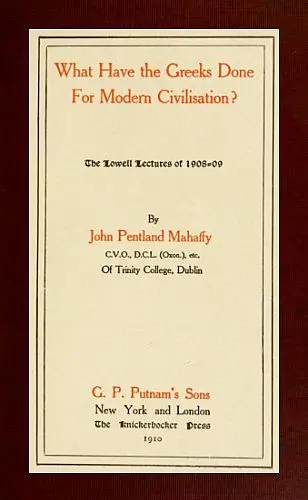
THE CLASSIC COLLECTION · 1909
"What Have the Greeks Done for Modern Civilisation?" by J. P. Mahaffy is a series of lectures written in the early 20th century. The work explores the profound influence of ancient Greek culture on contemporary society, particularly focusing on the arts, philosophy, science, and education. Its purpose is to reevaluate the significance of Greek studies in modern education and society. The opening of the text introduces Mahaffy as a seasoned scholar delivering a series of lectures that aim to highlight the contributions of the Greeks to modern civilization. He expresses his initial doubts about the diminishing interest in Greek studies, particularly in America, and outlines the various domains—literature, art, politics, and science—through which Greek thought has indelibly shaped contemporary understanding. He emphasizes that understanding the Greek legacy is essential for appreciating the foundations upon which modern culture is built and suggests that reforming the teaching of Greek is vital to reviving its significance in educational curricula.
Introduction adapted from the source catalogue; source summaries may be automatically generated.
Free to read · English · 58,758 words · No account needed
MAKE TIME FOR A GOOD BOOK
On by default. Untick to stop anonymous reading totals. Each page counts after 10 seconds in view. How this works.
Anonymous counting is on unless you have switched it off.
If the time should ever come when men will no longer be led by revelation, when they will reject miracle and prophecy, and determine to be led by the mere light of reason (men have often anticipated such a future, regardless of the fact that hitherto religious scepticism has always ended in a recoil from this liberty, and a revival of positive and even superstitious creeds)--if, I say, such an age should ever lay aside the Christian faith, there will still remain the ethical types which Zeno and Epicurus have crystallised in their systems--there will always remain the man of duty and the man of pleasure, the man who lives for others and he who lives for himself, in terms of modern philosophic jargon, the Altruist and the Egoist, the Spiritualist and the Materialist.
And here I break off my unfinished task, unfinished indeed as it must be, for beyond the many things that I have omitted though I knew them, there are many more omitted because I knew them not, because I have not fathomed the unfathomable depth and the myriad variety of that genius which is living, and suggesting, and working all through the ideal aspects of our modern life. There are probably few men who have lived longer and more intimately with the old Greeks, in more phases of their life, ever probing and seeking for deeper and better knowledge of their vast legacy to mankind, of which the rodent tooth of time, the sacrilegious hands of men, have lost or destroyed so much. The farther I seek, the wider the vistas I see opening before me. So now, when my part in the race is nearly run, there remains to me no higher earthly satisfaction than this, that I have carried the torch of Greek fire alight through a long life--no higher earthly hope than this, that I may pass that torch to others, who in their turn may keep it aflame with greater brilliancy perhaps, but not with more earnest devotion, “in the Parliament of men, the Federation of the world.”
Achæan League, organisation and dissolution, 203, 204
Acontius and Cydippe, love story of a modern type, 94
Actium, battle, 71
Æneid of Virgil, see Virgil
Æolic school, characteristic, 53
Æschylus, source of his tragedy, 36, 37;
one of the “three tragic poets,” 47;
Milton’s view of, 47;
characters of his plays, 48;
judge of tragedy, 73;
music of, 136
Agamemnon: great play, 27;
opening of, 48;
“vulgar and trivial persons,” 48;
contributes to Byron, 55;
Browning’s version, 57;
often translated into English, 58
Prometheus Vinctus: model for Paradise Lost, 47
Æsculapius, shrine of, 176
Agamemnon, see Æschylus
Agatharchus, discovers principles of perspective, 130
Alcæus, poet, 37
Alexander, Life of, 97
Alexandria, library, collecting of, gives impetus to literary criticism, 91
Your reading position is saved on this browser. Take it to another device with a library code. Reading pages adapt to text, rather than matching a printed edition.
BEHIND THE BOOK
This eBook is for the use of anyone anywhere in the United States and most other parts of the world at no cost and with almost no restrictions whatsoever. You may copy it, give it away or re-use it under the terms of the Project Gutenberg License included with this eBook or online at www.gutenberg.org. If you are not located in the United States, you will have to check the laws of the country where you are located before using this eBook. Read the source licence.
The original source file, including credits and licence, is retained by this library. Request an original-format copy at no charge. Please include the book title and Project Gutenberg identifier #59132.
KEEP YOUR CURIOSITY GOING
David Patterson (Spirit) Hatch
Cécile Tormay

Moritz Busch
Coulson Kernahan
John L. Ransom

Ralph Waldo Emerson