
Jocelyn
John Galsworthy
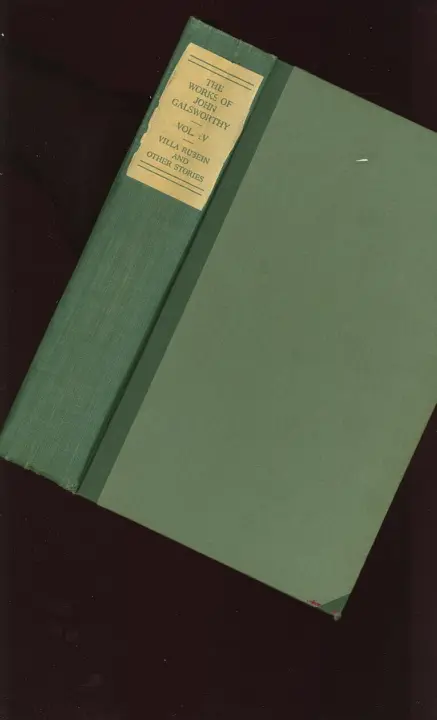
THE CLASSIC COLLECTION · 1920
"Villa Rubein and Other Stories" by John Galsworthy is a collection of short stories likely written during the early 20th century. The stories explore themes of human emotion and the complexity of relationships, often set against a backdrop of social dynamics and individual aspirations. The opening story introduces the central character, Harz, a painter who is deeply engaged in his creative process and his interactions with a mixed household at Villa Rubein, highlighting the contrasts between artistic ambition and societal expectations. The opening of the story unfolds with Harz, an artist, as he navigates his daily life in Botzen, where he meets Edmund Dawney, a doctor; their conversations reveal contrasting views on passion and duty towards their respective professions. Harz is depicted as passionate and driven by a desire to create, while Dawney is practical and focused on social success. When Harz's isolation in his creative pursuits is interrupted by interactions with the family at Villa Rubein—including the innocent and curious young girl Greta- an unexpected warmth begins to bloom. The narrative transitions into deeper explorations of relationships and the philosophical underpinnings of art and life, setting the stage for both personal and artistic growth throughout the collection.
Introduction adapted from the source catalogue; source summaries may be automatically generated.
Free to read · English · 96,246 words · No account needed
MAKE TIME FOR A GOOD BOOK
On by default. Untick to stop anonymous reading totals. Each page counts after 10 seconds in view. How this works.
Anonymous counting is on unless you have switched it off.
“After a long time, we began to run more slowly. I put my head out and could see in the distance a ring of lights hanging in the blackness. I loosened the carriage door and waited for the train to run slower still; I didn't mean to go into Linz like a rat into a trap. At last I could wait no longer; I opened the door, jumped and fell into some bushes. I was not much hurt, but bruised, and the breath knocked out of me. As soon as I could, I crawled out. It was very dark. I felt heavy and sore, and for some time went stumbling in and out amongst trees. Presently I came to a clear space; on one side I could see the town's shape drawn in lighted lamps, and on the other a dark mass, which I think was forest; in the distance too was a thin chain of lights. I thought: 'They must be the lights of a bridge.' Just then the moon came out, and I could see the river shining below. It was cold and damp, and I walked quickly. At last I came out on a road, past houses and barking dogs, down to the river bank; there I sat against a shed and went to sleep. I woke very stiff. It was darker than before; the moon was gone. I could just see the river. I stumbled on, to get through the town before dawn. It was all black shapes-houses and sheds, and the smell of the river, the smell of rotting hay, apples, tar, mud, fish; and here and there on a wharf a lantern. I stumbled over casks and ropes and boxes; I saw I should never get clear—the dawn had begun already on the other side. Some men came from a house behind me. I bent, and crept behind some barrels. They passed along the wharf; they seemed to drop into the river. I heard one of them say: 'Passau before night.' I stood up and saw they had walked on board a steamer which was lying head up-stream, with some barges in tow. There was a plank laid to the steamer, and a lantern at the other end. I could hear the fellows moving below deck, getting up steam. I ran across the plank and crept to the end of the steamer. I meant to go with them to Passau! The rope which towed the barges was nearly taut; and I knew if I could get on to the barges I should be safe. I climbed down on this rope and crawled along. I was desperate, I knew they'd soon be coming up, and it was getting light. I thought I should fall into the water several times, but I got to the barge at last. It was laden with straw. There was nobody on board. I was hungry and thirsty—I looked for something to eat; there was nothing but the ashes of a fire and a man's coat. I crept into the straw. Soon a boat brought men, one for each barge, and there were sounds of steam. As soon as we began moving through the water, I fell asleep. When I woke we were creeping through a heavy mist. I made a little hole in the straw and saw the bargeman. He was sitting by a fire at the barge's edge, so that the sparks and smoke blew away over the water. He ate and drank with both hands, and funny enough he looked in the mist, like a big bird flapping its wings; there was a good smell of coffee, and I sneezed. How the fellow started! But presently he took a pitchfork and prodded the straw. Then I stood up. I couldn't help laughing, he was so surprised—a huge, dark man, with a great black beard. I pointed to the fire and said 'Give me some, brother!' He pulled me out of the straw; I was so stiff, I couldn't move. I sat by the fire, and ate black bread and turnips, and drank coffee; while he stood by, watching me and muttering. I couldn't understand him well—he spoke a dialect from Hungary. He asked me: How I got there—who I was—where I was from? I looked up in his face, and he looked down at me, sucking his pipe. He was a big man, he lived alone on the river, and I was tired of telling lies, so I told him the whole thing. When I had done he just grunted. I can see him now standing over me, with the mist hanging in his beard, and his great naked arms. He drew me some water, and I washed and showed him my wig and moustache, and threw them overboard. All that day we lay out on the barge in the mist, with our feet to the fire, smoking; now and then he would spit into the ashes and mutter into his beard. I shall never forget that day. The steamer was like a monster with fiery nostrils, and the other barges were dumb creatures with eyes, where the fires were; we couldn't see the bank, but now and then a bluff and high trees, or a castle, showed in the mist. If I had only had paint and canvas that day!” He sighed.
Your reading position is saved on this browser. Take it to another device with a library code. Reading pages adapt to text, rather than matching a printed edition.
John Galsworthy
John Galsworthy
John Galsworthy

John Galsworthy
BEHIND THE BOOK
This eBook is for the use of anyone anywhere in the United States and most other parts of the world at no cost and with almost no restrictions whatsoever. You may copy it, give it away or re-use it under the terms of the Project Gutenberg License included with this eBook or online at www.gutenberg.org. If you are not located in the United States, you will have to check the laws of the country where you are located before using this eBook. Read the source licence.
The original source file, including credits and licence, is retained by this library. Request an original-format copy at no charge. Please include the book title and Project Gutenberg identifier #2639.
KEEP YOUR CURIOSITY GOING
Coulson Kernahan

Maurice Baring
Frances Wright
Cécile Tormay

Frederic Jesup Stimson

W. H. P. (William Henry Pope) Jarvis