
Jocelyn
John Galsworthy
THE CLASSIC COLLECTION · 1920
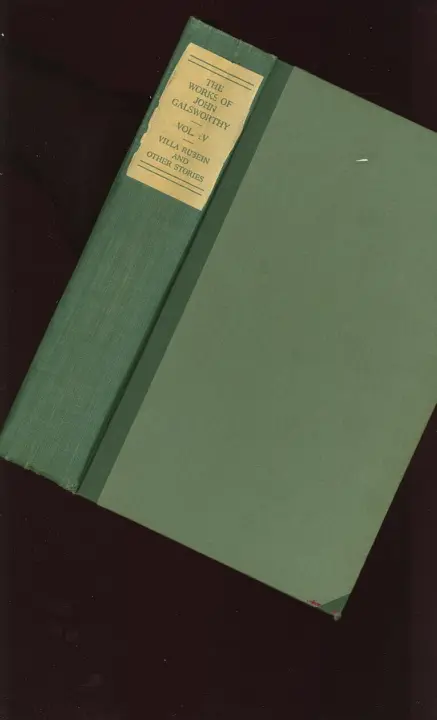
"Villa Rubein and Other Stories" by John Galsworthy is a collection of short stories likely written during the early 20th century. The stories explore themes of human emotion and the complexity of relationships, often set against a backdrop of social dynamics and individual aspirations. The opening story introduces the central character, Harz, a painter who is deeply engaged in his creative process and his interactions with a mixed household at Villa Rubein, highlighting the contrasts between artistic ambition and societal expectations. The opening of the story unfolds with Harz, an artist, as he navigates his daily life in Botzen, where he meets Edmund Dawney, a doctor; their conversations reveal contrasting views on passion and duty towards their respective professions. Harz is depicted as passionate and driven by a desire to create, while Dawney is practical and focused on social success. When Harz's isolation in his creative pursuits is interrupted by interactions with the family at Villa Rubein—including the innocent and curious young girl Greta- an unexpected warmth begins to bloom. The narrative transitions into deeper explorations of relationships and the philosophical underpinnings of art and life, setting the stage for both personal and artistic growth throughout the collection.
Introduction adapted from the source catalogue; source summaries may be automatically generated.
Free to read · English · 96,246 words · No account needed
MAKE TIME FOR A GOOD BOOK
On by default. Untick to stop anonymous reading totals. Each page counts after 10 seconds in view. How this works.
Anonymous counting is on unless you have switched it off.
Harz looked at him intently; he did not want to quarrel.
“I am not too fond of other people's thoughts,” he said at last; “I prefer to think my own.
“And is Society never right? That poor Society!”
“Society! What is Society—a few men in good coats? What has it done for
me?”
Sarelli bit the end off a cigar.
“Ah!” he said; “now we are coming to it. It is good to be an artist, a fine bantam of an artist; where other men have their dis-ci-pline, he has his, what shall we say—his mound of roses?”
The painter started to his feet.
“Yes,” said Sarelli, with a hiccough, “you are a fine fellow!”
“And you are drunk!” cried Harz.
“A little drunk—not much, not enough to matter!”
Harz broke into laughter. It was crazy to stay there listening to this mad fellow. What had brought him in? He moved towards the door.
“Ah!” said Sarelli, “but it is no good going to bed—let us talk. I have a lot to say—it is pleasant to talk to anarchists at times.”
Full daylight was already coming through the chinks of the shutters.
“You are all anarchists, you painters, you writing fellows. You live by playing ball with facts. Images—nothing solid—hein? You're all for new things too, to tickle your nerves. No discipline! True anarchists, every one of you!”
Harz poured out another glass of wine and drank it off. The man's feverish excitement was catching.
“Only fools,” he replied, “take things for granted. As for discipline, what do you aristocrats, or bourgeois know of discipline? Have you ever been hungry? Have you ever had your soul down on its back?”
“Soul on its back? That is good!”
“A man's no use,” cried Harz, “if he's always thinking of what others think; he must stand on his own legs.”
“He must not then consider other people?”
“Not from cowardice anyway.”
Sarelli drank.
“What would you do,” he said, striking his chest, “if you had a devil-here? Would you go to bed?”
A sort of pity seized on Harz. He wanted to say something that would be consoling but could find no words; and suddenly he felt disgusted. What link was there between him and this man; between his love and this man's love?
“Harz!” muttered Sarelli; “Harz means 'tar,' hein? Your family is not an
old one?”
Harz glared, and said: “My father is a peasant.”
Sarelli lifted the kummel bottle and emptied it into his glass, with a
steady hand.
“You're honest—and we both have devils. I forgot; I brought you in to
see a picture!”
Your reading position is saved on this browser. Take it to another device with a library code. Reading pages adapt to text, rather than matching a printed edition.
John Galsworthy
John Galsworthy
John Galsworthy

John Galsworthy
BEHIND THE BOOK
This eBook is for the use of anyone anywhere in the United States and most other parts of the world at no cost and with almost no restrictions whatsoever. You may copy it, give it away or re-use it under the terms of the Project Gutenberg License included with this eBook or online at www.gutenberg.org. If you are not located in the United States, you will have to check the laws of the country where you are located before using this eBook. Read the source licence.
The original source file, including credits and licence, is retained by this library. Request an original-format copy at no charge. Please include the book title and Project Gutenberg identifier #2639.
KEEP YOUR CURIOSITY GOING
Coulson Kernahan

Maurice Baring
Frances Wright
Cécile Tormay

Frederic Jesup Stimson

W. H. P. (William Henry Pope) Jarvis