
Jocelyn
John Galsworthy
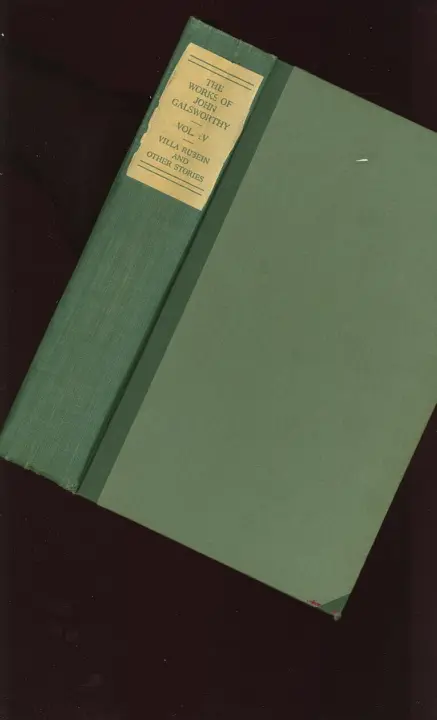
THE CLASSIC COLLECTION · 1920
"Villa Rubein and Other Stories" by John Galsworthy is a collection of short stories likely written during the early 20th century. The stories explore themes of human emotion and the complexity of relationships, often set against a backdrop of social dynamics and individual aspirations. The opening story introduces the central character, Harz, a painter who is deeply engaged in his creative process and his interactions with a mixed household at Villa Rubein, highlighting the contrasts between artistic ambition and societal expectations. The opening of the story unfolds with Harz, an artist, as he navigates his daily life in Botzen, where he meets Edmund Dawney, a doctor; their conversations reveal contrasting views on passion and duty towards their respective professions. Harz is depicted as passionate and driven by a desire to create, while Dawney is practical and focused on social success. When Harz's isolation in his creative pursuits is interrupted by interactions with the family at Villa Rubein—including the innocent and curious young girl Greta- an unexpected warmth begins to bloom. The narrative transitions into deeper explorations of relationships and the philosophical underpinnings of art and life, setting the stage for both personal and artistic growth throughout the collection.
Introduction adapted from the source catalogue; source summaries may be automatically generated.
Free to read · English · 96,246 words · No account needed
MAKE TIME FOR A GOOD BOOK
On by default. Untick to stop anonymous reading totals. Each page counts after 10 seconds in view. How this works.
Anonymous counting is on unless you have switched it off.
There had been a gentle breeze all day, but now it had died away; not a leaf quivered, not a blade of grass was stirring; from the house were heard faint sounds as of some one playing on a pipe. A blackbird came hopping down the path.
“When you were a boy, did you go after birds' nests, Uncle Nic?” Greta
whispered.
“I believe you, Greta.” The blackbird hopped into the shrubbery.
“You frightened him, Uncle Nic! Papa says that at Schloss Konig, where he lived when he was young, he would always be after jackdaws' nests.”
“Gammon, Greta. Your father never took a jackdaw's nest, his legs are
much too round!”
“Are you fond of birds, Uncle Nic?”
“Ask me another, Greta! Well, I s'pose so.”
“Then why did you go bird-nesting? I think it is cruel”
Mr. Treffry coughed behind his paper: “There you have me, Greta,” he
remarked.
Harz began to gather his brushes: “Thank you,” he said, “that's all I
can do to-day.”
“Can I look?” Mr. Treffry inquired.
“Certainly!”
Uncle Nic got up slowly, and stood in front of the picture. “When it's for sale,” he said at last, “I'll buy it.”
Harz bowed; but for some reason he felt annoyed, as if he had been asked to part with something personal.
“I thank you,” he said. A gong sounded.
“You'll stay and have a snack with us?” said Mr. Treffry; “the doctor's stopping.” Gathering up his paper, he moved off to the house with his hand on Greta's shoulder, the terrier running in front. Harz and Christian were left alone. He was scraping his palette, and she was sitting with her elbows resting on her knees; between them, a gleam of sunlight dyed the path golden. It was evening already; the bushes and the flowers, after the day's heat, were breathing out perfume; the birds had started their evensong.
“Are you tired of sitting for your portrait, Fraulein Christian?”
Christian shook her head.
“I shall get something into it that everybody does not see—something behind the surface, that will last.”
Christian said slowly: “That's like a challenge. You were right when you said fighting is happiness—for yourself, but not for me. I'm a coward. I hate to hurt people, I like them to like me. If you had to do anything that would make them hate you, you would do it all the same, if it helped your work; that's fine—it's what I can't do. It's—it's everything. Do you like Uncle Nic?”
The young painter looked towards the house, where under the veranda old Nicholas Treffry was still in sight; a smile came on his lips.
Your reading position is saved on this browser. Take it to another device with a library code. Reading pages adapt to text, rather than matching a printed edition.
John Galsworthy
John Galsworthy
John Galsworthy

John Galsworthy
BEHIND THE BOOK
This eBook is for the use of anyone anywhere in the United States and most other parts of the world at no cost and with almost no restrictions whatsoever. You may copy it, give it away or re-use it under the terms of the Project Gutenberg License included with this eBook or online at www.gutenberg.org. If you are not located in the United States, you will have to check the laws of the country where you are located before using this eBook. Read the source licence.
The original source file, including credits and licence, is retained by this library. Request an original-format copy at no charge. Please include the book title and Project Gutenberg identifier #2639.
KEEP YOUR CURIOSITY GOING
Coulson Kernahan

Maurice Baring
Frances Wright
Cécile Tormay

Frederic Jesup Stimson

W. H. P. (William Henry Pope) Jarvis