
Jocelyn
John Galsworthy
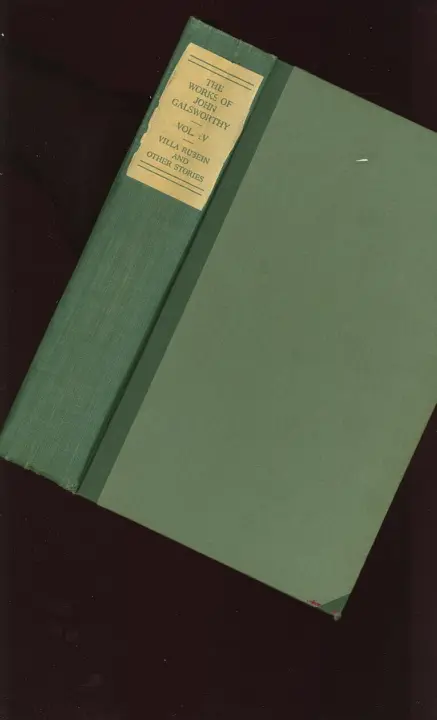
THE CLASSIC COLLECTION · 1920
"Villa Rubein and Other Stories" by John Galsworthy is a collection of short stories likely written during the early 20th century. The stories explore themes of human emotion and the complexity of relationships, often set against a backdrop of social dynamics and individual aspirations. The opening story introduces the central character, Harz, a painter who is deeply engaged in his creative process and his interactions with a mixed household at Villa Rubein, highlighting the contrasts between artistic ambition and societal expectations. The opening of the story unfolds with Harz, an artist, as he navigates his daily life in Botzen, where he meets Edmund Dawney, a doctor; their conversations reveal contrasting views on passion and duty towards their respective professions. Harz is depicted as passionate and driven by a desire to create, while Dawney is practical and focused on social success. When Harz's isolation in his creative pursuits is interrupted by interactions with the family at Villa Rubein—including the innocent and curious young girl Greta- an unexpected warmth begins to bloom. The narrative transitions into deeper explorations of relationships and the philosophical underpinnings of art and life, setting the stage for both personal and artistic growth throughout the collection.
Introduction adapted from the source catalogue; source summaries may be automatically generated.
Free to read · English · 96,246 words · No account needed
MAKE TIME FOR A GOOD BOOK
On by default. Untick to stop anonymous reading totals. Each page counts after 10 seconds in view. How this works.
Anonymous counting is on unless you have switched it off.
“We must be in front of the others; it's nice to be in front—let's dawdle. I forgot—you never dawdle, Herr Harz.”
“After a big fit of work, I can dawdle against any one; then I get another fit of work—it's like appetite.”
“I'm always dawdling,” answered Christian.
By the roadside a peasant woman screwed up her sun-dried face, saying in a low voice: “Please, gracious lady, help me to lift this basket!”
Christian stooped, but before she could raise it, Harz hoisted it up on
his back.
“All right,” he nodded; “this good lady doesn't mind.”
The woman, looking very much ashamed, walked along by Christian; she kept rubbing her brown hands together, and saying; “Gracious lady, I would not have wished. It is heavy, but I would not have wished.”
“I'm sure he'd rather carry it,” said Christian.
They had not gone far along the road, however, before the others passed them in a carriage, and at the strange sight Miss Naylor could be seen pursing her lips; Cousin Teresa nodding pleasantly; a smile on Dawney's face; and beside him Greta, very demure. Harz began to laugh.
“What are you laughing at?” asked Christian.
“You English are so funny. You mustn't do this here, you mustn't do that there, it's like sitting in a field of nettles. If I were to walk with you without my coat, that little lady would fall off her seat.” His laugh infected Christian; they reached the station feeling that they knew each other better.
The sun had dipped behind the mountains when the little train steamed down the valley. All were subdued, and Greta, with a nodding head, slept fitfully. Christian, in her corner, was looking out of the window, and Harz kept studying her profile.
He tried to see her eyes. He had remarked indeed that, whatever their expression, the brows, arched and rather wide apart, gave them a peculiar look of understanding. He thought of his picture. There was nothing in her face to seize on, it was too sympathetic, too much like light. Yet her chin was firm, almost obstinate.
The train stopped with a jerk; she looked round at him. It was as though she had said: “You are my friend.”
At Villa Rubein, Herr Paul had killed the fatted calf for Greta's Fest. When the whole party were assembled, he alone remained standing; and waving his arm above the cloth, cried: “My dears! Your happiness! There are good things here—Come!” And with a sly look, the air of a conjurer producing rabbits, he whipped the cover off the soup tureen:
“Soup-turtle, fat, green fat!” He smacked his lips.
Your reading position is saved on this browser. Take it to another device with a library code. Reading pages adapt to text, rather than matching a printed edition.
John Galsworthy
John Galsworthy
John Galsworthy

John Galsworthy
BEHIND THE BOOK
This eBook is for the use of anyone anywhere in the United States and most other parts of the world at no cost and with almost no restrictions whatsoever. You may copy it, give it away or re-use it under the terms of the Project Gutenberg License included with this eBook or online at www.gutenberg.org. If you are not located in the United States, you will have to check the laws of the country where you are located before using this eBook. Read the source licence.
The original source file, including credits and licence, is retained by this library. Request an original-format copy at no charge. Please include the book title and Project Gutenberg identifier #2639.
KEEP YOUR CURIOSITY GOING
Coulson Kernahan

Maurice Baring
Frances Wright
Cécile Tormay

Frederic Jesup Stimson

W. H. P. (William Henry Pope) Jarvis