
Jocelyn
John Galsworthy
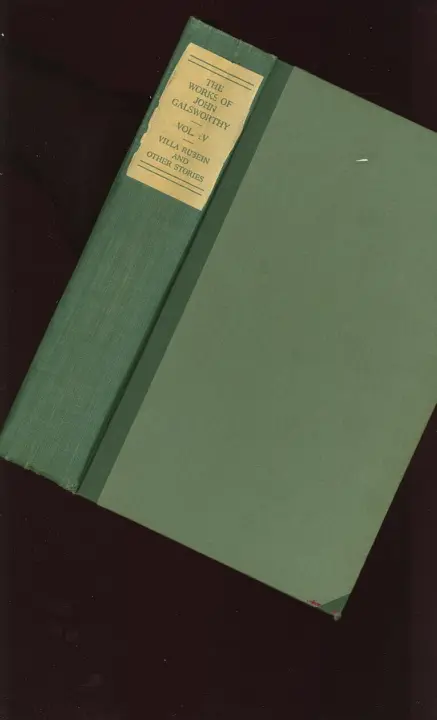
THE CLASSIC COLLECTION · 1920
"Villa Rubein and Other Stories" by John Galsworthy is a collection of short stories likely written during the early 20th century. The stories explore themes of human emotion and the complexity of relationships, often set against a backdrop of social dynamics and individual aspirations. The opening story introduces the central character, Harz, a painter who is deeply engaged in his creative process and his interactions with a mixed household at Villa Rubein, highlighting the contrasts between artistic ambition and societal expectations. The opening of the story unfolds with Harz, an artist, as he navigates his daily life in Botzen, where he meets Edmund Dawney, a doctor; their conversations reveal contrasting views on passion and duty towards their respective professions. Harz is depicted as passionate and driven by a desire to create, while Dawney is practical and focused on social success. When Harz's isolation in his creative pursuits is interrupted by interactions with the family at Villa Rubein—including the innocent and curious young girl Greta- an unexpected warmth begins to bloom. The narrative transitions into deeper explorations of relationships and the philosophical underpinnings of art and life, setting the stage for both personal and artistic growth throughout the collection.
Introduction adapted from the source catalogue; source summaries may be automatically generated.
Free to read · English · 96,246 words · No account needed
MAKE TIME FOR A GOOD BOOK
On by default. Untick to stop anonymous reading totals. Each page counts after 10 seconds in view. How this works.
Anonymous counting is on unless you have switched it off.
“He said you ought to have another doctor; two doctors, he said, better than one. He said, also, he would look in again on his way 'home.'”
Swithin grunted, “Umph! What else did he say?”
“He said you didn't take care of yourself.”
Swithin glared.
“Has anybody else been to see me?”
The valet turned away his eyes. “Mrs. Thomas Forsyte came last Monday
fortnight.”
“How long have I been ill?”
“Five weeks on Saturday.”
“Do you think I'm very bad?”
Adolf's face was covered suddenly with crow's-feet. “You have no business to ask me question like that! I am not paid, sir, to answer question like that.”
Swithin said faintly: “You're a peppery fool! Open a bottle of
champagne!”
Adolf took a bottle of champagne—from a cupboard and held nippers to it. He fixed his eyes on Swithin. “The doctor said—”
“Open the bottle!”
“It is not—”
“Open the bottle—or I give you warning.”
Adolf removed the cork. He wiped a glass elaborately, filled it, and bore it scrupulously to the bedside. Suddenly twirling his moustaches, he wrung his hands, and burst out: “It is poison.”
Swithin grinned faintly. “You foreign fool!” he said. “Get out!”
The valet vanished.
'He forgot himself!' thought Swithin. Slowly he raised the glass, slowly put it back, and sank gasping on his pillows. Almost at once he fell asleep.
He dreamed that he was at his club, sitting after dinner in the crowded smoking-room, with its bright walls and trefoils of light. It was there that he sat every evening, patient, solemn, lonely, and sometimes fell asleep, his square, pale old face nodding to one side. He dreamed that he was gazing at the picture over the fireplace, of an old statesman with a high collar, supremely finished face, and sceptical eyebrows—the picture, smooth, and reticent as sealing-wax, of one who seemed for ever exhaling the narrow wisdom of final judgments. All round him, his fellow members were chattering. Only he himself, the old sick member, was silent. If fellows only knew what it was like to sit by yourself and feel ill all the time! What they were saying he had heard a hundred times. They were talking of investments, of cigars, horses, actresses, machinery. What was that? A foreign patent for cleaning boilers? There was no such thing; boilers couldn't be cleaned, any fool knew that! If an Englishman couldn't clean a boiler, no foreigner could clean one. He appealed to the old statesman's eyes. But for once those eyes seemed hesitating, blurred, wanting in finality. They vanished. In their place were Rozsi's little deep-set eyes, with their wide and far-off look; and as he gazed they seemed to grow bright as steel, and to speak to him. Slowly the whole face grew to be there, floating on the dark background of the picture; it was pink, aloof, unfathomable, enticing, with its fluffy hair and quick lips, just as he had last seen it. “Are you looking for something?” she seemed to say: “I could show you.”
Your reading position is saved on this browser. Take it to another device with a library code. Reading pages adapt to text, rather than matching a printed edition.
John Galsworthy
John Galsworthy
John Galsworthy

John Galsworthy
BEHIND THE BOOK
This eBook is for the use of anyone anywhere in the United States and most other parts of the world at no cost and with almost no restrictions whatsoever. You may copy it, give it away or re-use it under the terms of the Project Gutenberg License included with this eBook or online at www.gutenberg.org. If you are not located in the United States, you will have to check the laws of the country where you are located before using this eBook. Read the source licence.
The original source file, including credits and licence, is retained by this library. Request an original-format copy at no charge. Please include the book title and Project Gutenberg identifier #2639.
KEEP YOUR CURIOSITY GOING
Coulson Kernahan

Maurice Baring
Frances Wright
Cécile Tormay

Frederic Jesup Stimson

W. H. P. (William Henry Pope) Jarvis