
Jocelyn
John Galsworthy
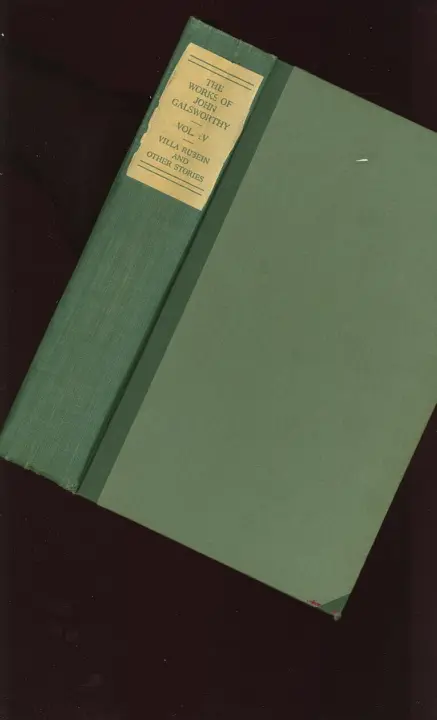
THE CLASSIC COLLECTION · 1920
"Villa Rubein and Other Stories" by John Galsworthy is a collection of short stories likely written during the early 20th century. The stories explore themes of human emotion and the complexity of relationships, often set against a backdrop of social dynamics and individual aspirations. The opening story introduces the central character, Harz, a painter who is deeply engaged in his creative process and his interactions with a mixed household at Villa Rubein, highlighting the contrasts between artistic ambition and societal expectations. The opening of the story unfolds with Harz, an artist, as he navigates his daily life in Botzen, where he meets Edmund Dawney, a doctor; their conversations reveal contrasting views on passion and duty towards their respective professions. Harz is depicted as passionate and driven by a desire to create, while Dawney is practical and focused on social success. When Harz's isolation in his creative pursuits is interrupted by interactions with the family at Villa Rubein—including the innocent and curious young girl Greta- an unexpected warmth begins to bloom. The narrative transitions into deeper explorations of relationships and the philosophical underpinnings of art and life, setting the stage for both personal and artistic growth throughout the collection.
Introduction adapted from the source catalogue; source summaries may be automatically generated.
Free to read · English · 96,246 words · No account needed
MAKE TIME FOR A GOOD BOOK
On by default. Untick to stop anonymous reading totals. Each page counts after 10 seconds in view. How this works.
Anonymous counting is on unless you have switched it off.
“Ah! my dear dears!” began Herr Paul, who in the presence of Miss Naylor always paraded his English. “Here is our friend, who has a very flattering request to make; he would paint you, yes—both together, alfresco, in the air, in the sunshine, with the birds, the little birds!”
Greta, gazing at Harz, gushed deep pink, and furtively showed him her
pig.
Christian said: “Paint us? Oh no!”
She saw Harz looking at her, and added, slowly: “If you really wish it, I suppose we could!” then dropped her eyes.
“Ah!” said Herr Paul raising his brows till his glasses fell from his nose: “And what says Gretchen? Does she want to be handed up to posterities a little peacock along with the other little birds?”
Greta, who had continued staring at the painter, said:
“Of—course—I—want—to—be.”
“Prrt!” said Herr Paul, looking at Miss Naylor. The little lady indeed opened her mouth wide, but all that came forth was a tiny squeak, as sometimes happens when one is anxious to say something, and has not arranged beforehand what it shall be.
The affair seemed ended; Harz heaved a sigh of satisfaction. But Herr Paul had still a card to play.
“There is your Aunt,” he said; “there are things to be considered—one must certainly inquire—so, we shall see.” Kissing Greta loudly on both cheeks, he went towards the house.
“What makes you want to paint us?” Christian asked, as soon as he was
gone.
“I think it very wrong,” Miss Naylor blurted out.
“Why?” said Harz, frowning.
“Greta is so young—there are lessons—it is such a waste of time!”
His eyebrows twitched: “Ah! You think so!”
“I don't see why it is a waste of time,” said Christian quietly; “there are lots of hours when we sit here and do nothing.”
“And it is very dull,” put in Greta, with a pout.
“You are rude, Greta,” said Miss Naylor in a little rage, pursing her lips, and taking up her knitting.
“I think it seems always rude to speak the truth,” said Greta. Miss Naylor looked at her in that concentrated manner with which she was in the habit of expressing displeasure.
But at this moment a servant came, and said that Mrs. Decie would be glad to see Herr Harz. The painter made them a stiff bow, and followed the servant to the house. Miss Naylor and the two girls watched his progress with apprehensive eyes; it was clear that he had been offended.
Your reading position is saved on this browser. Take it to another device with a library code. Reading pages adapt to text, rather than matching a printed edition.
John Galsworthy
John Galsworthy
John Galsworthy

John Galsworthy
BEHIND THE BOOK
This eBook is for the use of anyone anywhere in the United States and most other parts of the world at no cost and with almost no restrictions whatsoever. You may copy it, give it away or re-use it under the terms of the Project Gutenberg License included with this eBook or online at www.gutenberg.org. If you are not located in the United States, you will have to check the laws of the country where you are located before using this eBook. Read the source licence.
The original source file, including credits and licence, is retained by this library. Request an original-format copy at no charge. Please include the book title and Project Gutenberg identifier #2639.
KEEP YOUR CURIOSITY GOING
Coulson Kernahan

Maurice Baring
Frances Wright
Cécile Tormay

Frederic Jesup Stimson

W. H. P. (William Henry Pope) Jarvis