
Jocelyn
John Galsworthy
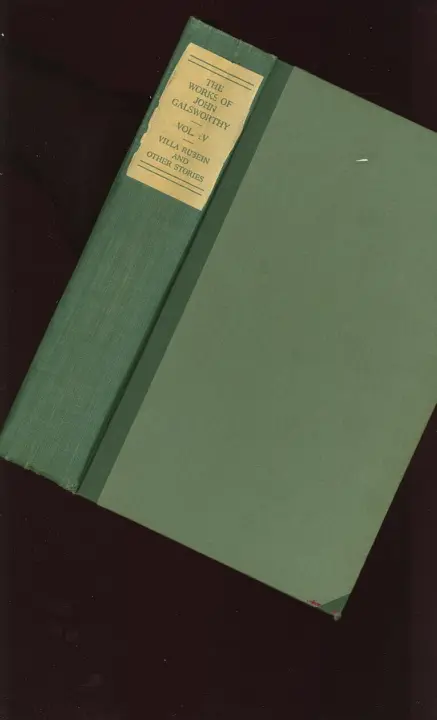
THE CLASSIC COLLECTION · 1920
"Villa Rubein and Other Stories" by John Galsworthy is a collection of short stories likely written during the early 20th century. The stories explore themes of human emotion and the complexity of relationships, often set against a backdrop of social dynamics and individual aspirations. The opening story introduces the central character, Harz, a painter who is deeply engaged in his creative process and his interactions with a mixed household at Villa Rubein, highlighting the contrasts between artistic ambition and societal expectations. The opening of the story unfolds with Harz, an artist, as he navigates his daily life in Botzen, where he meets Edmund Dawney, a doctor; their conversations reveal contrasting views on passion and duty towards their respective professions. Harz is depicted as passionate and driven by a desire to create, while Dawney is practical and focused on social success. When Harz's isolation in his creative pursuits is interrupted by interactions with the family at Villa Rubein—including the innocent and curious young girl Greta- an unexpected warmth begins to bloom. The narrative transitions into deeper explorations of relationships and the philosophical underpinnings of art and life, setting the stage for both personal and artistic growth throughout the collection.
Introduction adapted from the source catalogue; source summaries may be automatically generated.
Free to read · English · 96,246 words · No account needed
MAKE TIME FOR A GOOD BOOK
On by default. Untick to stop anonymous reading totals. Each page counts after 10 seconds in view. How this works.
Anonymous counting is on unless you have switched it off.
“Look here!” said Swithin suddenly; “which is my way to the Goldene
Alp?”
The Hungarian replied, “But you are coming with me, for a glass of
wine?”
Swithin looked at the ground. 'Not if I know it!' he thought.
“Ah!” said the Hungarian with dignity, “you do not wish for my
friendship!”
'Touchy beggar!' thought Swithin. “Of course,” he stammered, “if you put it in that way—”
The Hungarian bowed, murmuring, “Forgive me!”
They had not gone a dozen steps before a youth, with a beardless face and hollow cheeks, accosted them. “For the love of Christ, gentlemen,” he said, “help me!”
“Are you a German?” asked Boleskey.
“Yes,” said the youth.
“Then you may rot!”
“Master, look here!” Tearing open his coat, the youth displayed his skin, and a leather belt drawn tight round it. Again Swithin felt that desire to take to his heels. He was filled with horrid forebodings—a sense of perpending intimacy with things such as no gentleman had dealings with.
The Hungarian crossed himself. “Brother,” he said to the youth, “come
you in!”
Swithin looked at them askance, and followed. By a dim light they groped their way up some stairs into a large room, into which the moon was shining through a window bulging over the street. A lamp burned low; there was a smell of spirits and tobacco, with a faint, peculiar scent, as of rose leaves. In one corner stood a czymbal, in another a great pile of newspapers. On the wall hung some old-fashioned pistols, and a rosary of yellow beads. Everything was tidily arranged, but dusty. Near an open fireplace was a table with the remains of a meal. The ceiling, floor, and walls were all of dark wood. In spite of the strange disharmony, the room had a sort of refinement. The Hungarian took a bottle out of a cupboard and, filling some glasses, handed one to Swithin. Swithin put it gingerly to his nose. 'You never know your luck! Come!' he thought, tilting it slowly into his mouth. It was thick, too sweet, but of a fine flavour.
“Brothers!” said the Hungarian, refilling, “your healths!”
The youth tossed off his wine. And Swithin this time did the same; he pitied this poor devil of a youth now. “Come round to-morrow!” he said, “I'll give you a shirt or two.” When the youth was gone, however, he remembered with relief that he had not given his address.
'Better so,' he reflected. 'A humbug, no doubt.'
“What was that you said to him?” he asked of the Hungarian.
“I said,” answered Boleskey, “'You have eaten and drunk; and now you are
my enemy!'”
Your reading position is saved on this browser. Take it to another device with a library code. Reading pages adapt to text, rather than matching a printed edition.
John Galsworthy
John Galsworthy
John Galsworthy

John Galsworthy
BEHIND THE BOOK
This eBook is for the use of anyone anywhere in the United States and most other parts of the world at no cost and with almost no restrictions whatsoever. You may copy it, give it away or re-use it under the terms of the Project Gutenberg License included with this eBook or online at www.gutenberg.org. If you are not located in the United States, you will have to check the laws of the country where you are located before using this eBook. Read the source licence.
The original source file, including credits and licence, is retained by this library. Request an original-format copy at no charge. Please include the book title and Project Gutenberg identifier #2639.
KEEP YOUR CURIOSITY GOING
Coulson Kernahan

Maurice Baring
Frances Wright
Cécile Tormay

Frederic Jesup Stimson

W. H. P. (William Henry Pope) Jarvis