
Jocelyn
John Galsworthy
THE CLASSIC COLLECTION · 1920
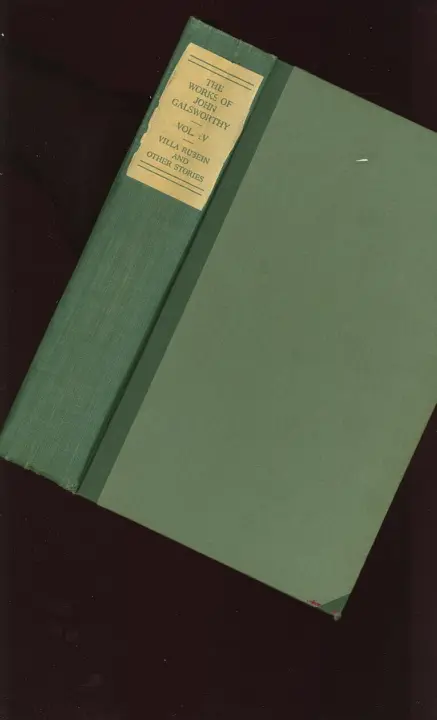
"Villa Rubein and Other Stories" by John Galsworthy is a collection of short stories likely written during the early 20th century. The stories explore themes of human emotion and the complexity of relationships, often set against a backdrop of social dynamics and individual aspirations. The opening story introduces the central character, Harz, a painter who is deeply engaged in his creative process and his interactions with a mixed household at Villa Rubein, highlighting the contrasts between artistic ambition and societal expectations. The opening of the story unfolds with Harz, an artist, as he navigates his daily life in Botzen, where he meets Edmund Dawney, a doctor; their conversations reveal contrasting views on passion and duty towards their respective professions. Harz is depicted as passionate and driven by a desire to create, while Dawney is practical and focused on social success. When Harz's isolation in his creative pursuits is interrupted by interactions with the family at Villa Rubein—including the innocent and curious young girl Greta- an unexpected warmth begins to bloom. The narrative transitions into deeper explorations of relationships and the philosophical underpinnings of art and life, setting the stage for both personal and artistic growth throughout the collection.
Introduction adapted from the source catalogue; source summaries may be automatically generated.
Free to read · English · 96,246 words · No account needed
MAKE TIME FOR A GOOD BOOK
On by default. Untick to stop anonymous reading totals. Each page counts after 10 seconds in view. How this works.
Anonymous counting is on unless you have switched it off.
“I am very sorry to hear that. I don't know the people here, but I am
very sorry to hear that.
“I would be glad to speak a few words to your sister, if it is your
sister that I want.”
And the stranger's face grew very red.
“Is it,” said Greta, “that you are a friend of Herr Harz? If you are a friend of his, you will please come and have some tea, and while you are having tea I will look for Chris.”
Perspiration bedewed the stranger's forehead.
“Tea? Excuse me! I don't drink tea.”
“There is also coffee,” Greta said.
The stranger's progress towards the arbour was so slow that Greta arrived considerably before him.
“It is a friend of Herr Harz,” she whispered; “he will drink coffee. I am going to find Chris.”
“Greta!” gasped Miss Naylor.
Mrs. Decie put up her hand.
“Ah!” she said, “if it is so, we must be very nice to him for
Christian's sake.”
Miss Naylor's face grew soft.
“Ah, yes!” she said; “of course.”
“Bah!” muttered Herr Paul, “that recommences.'
“Paul!” murmured Mrs. Decie, “you lack the elements of wisdom.”
Herr Paul glared at the approaching stranger.
Mrs. Decie had risen, and smilingly held out her hand.
“We are so glad to know you; you are an artist too, perhaps? I take a great interest in art, and especially in that school which Mr. Harz represents.”
The stranger smiled.
“He is the genuine article, ma'am,” he said. “He represents no school, he is one of that kind whose corpses make schools.”
“Ah!” murmured Mrs. Decie, “you are an American. That is so nice. Do sit down! My niece will soon be here.”
Greta came running back.
“Will you come, please?” she said. “Chris is ready.”
Gulping down his coffee, the stranger included them all in a single bow,
and followed her.
“Ach!” said Herr Paul, “garcon tres chic, celui-la!”
Christian was standing by her little table. The stranger began.
“I am sending Mr. Harz's things to England; there are some pictures here. He would be glad to have them.”
A flood of crimson swept over her face.
“I am sending them to London,” the stranger repeated; “perhaps you could give them to me to-day.”
“They are ready; my sister will show you.”
Her eyes seemed to dart into his soul, and try to drag something from it. The words rushed from her lips:
“Is there any message for me?”
The stranger regarded her curiously.
Your reading position is saved on this browser. Take it to another device with a library code. Reading pages adapt to text, rather than matching a printed edition.
John Galsworthy
John Galsworthy
John Galsworthy

John Galsworthy
BEHIND THE BOOK
This eBook is for the use of anyone anywhere in the United States and most other parts of the world at no cost and with almost no restrictions whatsoever. You may copy it, give it away or re-use it under the terms of the Project Gutenberg License included with this eBook or online at www.gutenberg.org. If you are not located in the United States, you will have to check the laws of the country where you are located before using this eBook. Read the source licence.
The original source file, including credits and licence, is retained by this library. Request an original-format copy at no charge. Please include the book title and Project Gutenberg identifier #2639.
KEEP YOUR CURIOSITY GOING
Coulson Kernahan

Maurice Baring
Frances Wright
Cécile Tormay

Frederic Jesup Stimson

W. H. P. (William Henry Pope) Jarvis