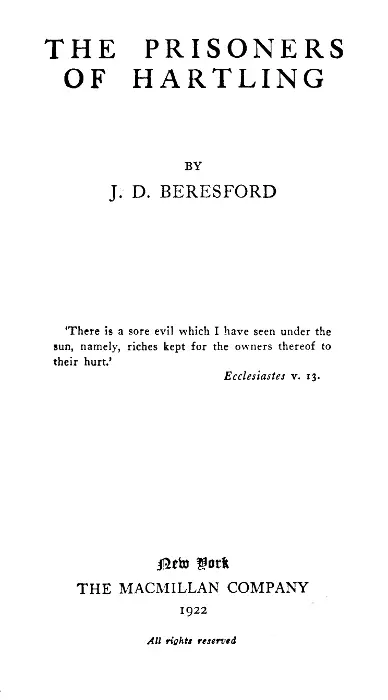
The Prisoners of Hartling
J. D. (John Davys) Beresford
THE CLASSIC COLLECTION · 1917
"The Wonder" by J. D. Beresford is a novel written in the early 20th century. The story explores themes of intelligence, abnormality, and the societal perceptions surrounding them, primarily through the lens of a remarkable child named Victor Stott. The narrative follows Ginger Stott, an ambitious cricketer whose life takes unexpected turns due to the extraordinary nature of his son. The opening of the book introduces us to a scene on a train where an unnamed narrator observes a woman with an unusual infant. The child's appearance captivates the attention of other passengers, leading to a mix of fascination and repulsion. As the narrator grapples with his own disdain for what he perceives as a “freak,” we learn that the child has not spoken or cried in his one year of life. The conversation touches on the mother’s protective behavior and the reactions of those around her, establishing the tension between normalcy and the extraordinary. This encounter hints at the complexity of Victor Stott's character and sets the stage for the exploration of his unique childhood and the challenges faced by his family.
Introduction adapted from the source catalogue; source summaries may be automatically generated.
Free to read · English · 60,640 words · No account needed
MAKE TIME FOR A GOOD BOOK
On by default. Untick to stop anonymous reading totals. Each page counts after 10 seconds in view. How this works.
Anonymous counting is on unless you have switched it off.
"Can there be any doubt about it?" replied the grocer. "I asked how old our Lord was when He began His ministry, and he"--he made an indicative gesture with one momentarily released hand towards the Wonder--"and he says he's 'uncertain.'"
"No, no," interposed Challis impatiently, "he meant that the answer to your question was uncertain."
"How's that?" returned the grocer. "I've always understood----"
"Quite, quite," interrupted Challis. "But what we have always understood does not always correspond to the actual fact."
"What did you intend by your answer?" put in Elmer quickly, addressing
the Wonder.
"The evidence rests mainly on Luke's Gospel," answered the Wonder, "but the phrase '{archomenos hosei eton triakonta}' is vague--it allows latitude in either direction. According to the chronology of John's Gospel the age might have been about thirty-two."
"It says 'thirty' in the Bible, and that's good enough for me," said the grocer, and Crashaw muttered "Heresy, heresy," in an audible under tone.
"Sounds very like blarsphemy to me," said Purvis, "like doubtin' the word of God. I'm for sending him to school."
Deane Elmer had been regarding the face of the small abstracted child with considerable interest. He put aside for the moment the grocer's intimation of his voting tendency.
"How many elements are known to chemists?" asked Elmer of the examinee.
"Eighty-one well characterised; others have been described," replied the
Wonder.
"Which has the greatest atomic weight?" asked Elmer.
"Uranium."
"And that weight is?"
"On the oxygen basis of 16--238.5."
"Extraordinary powers of memory," muttered Elmer, and there was silence for a moment, a silence broken by Squire Standing, who, in a loud voice, asked suddenly and most irrelevantly, "What's your opinion of Tariff Reform?"
"An empirical question that cannot be decided from a theoretical basis,"
replied the Wonder.
Elmer laughed out, a great shouting guffaw. "Quite right, quite right," he said, his cheeks shaking with mirth. "What have you to say to that, Standing?"
"I say that Tariff Reform's the only way to save the country," replied Squire Standing, looking very red and obstinate, "and if this Government----"
Challis rose to his feet. "Oh! aren't you all satisfied?" he said. "Is this Committee here to argue questions of present politics? What more evidence do you need?"
"I'm not satisfied," put in Purvis resolutely, "nor is the Rev. Mr.
Crashaw, I fancy."
"He has no vote," said Challis. "Elmer, what do you say?"
"I think we may safely say that the child has been, and is being, provided with an education elsewhere, and that he need not therefore attend the elementary school," replied Elmer, still chuckling.
Your reading position is saved on this browser. Take it to another device with a library code. Reading pages adapt to text, rather than matching a printed edition.
J. D. (John Davys) Beresford
BEHIND THE BOOK
This eBook is for the use of anyone anywhere in the United States and most other parts of the world at no cost and with almost no restrictions whatsoever. You may copy it, give it away or re-use it under the terms of the Project Gutenberg License included with this eBook or online at www.gutenberg.org. If you are not located in the United States, you will have to check the laws of the country where you are located before using this eBook. Read the source licence.
The original source file, including credits and licence, is retained by this library. Request an original-format copy at no charge. Please include the book title and Project Gutenberg identifier #27188.
KEEP YOUR CURIOSITY GOING
Coulson Kernahan

Maurice Baring
Frances Wright
Cécile Tormay

Frederic Jesup Stimson

W. H. P. (William Henry Pope) Jarvis