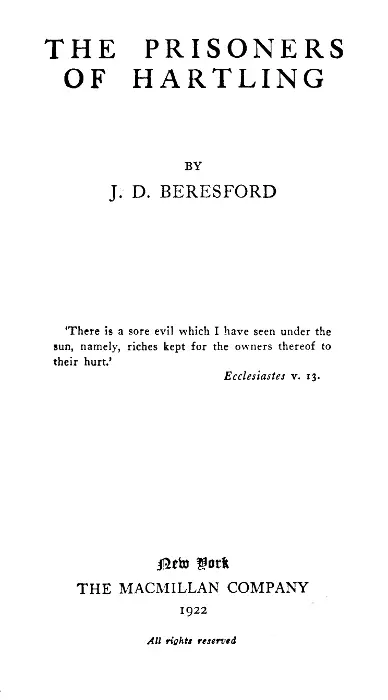
The Prisoners of Hartling
J. D. (John Davys) Beresford
THE CLASSIC COLLECTION · 1917
"The Wonder" by J. D. Beresford is a novel written in the early 20th century. The story explores themes of intelligence, abnormality, and the societal perceptions surrounding them, primarily through the lens of a remarkable child named Victor Stott. The narrative follows Ginger Stott, an ambitious cricketer whose life takes unexpected turns due to the extraordinary nature of his son. The opening of the book introduces us to a scene on a train where an unnamed narrator observes a woman with an unusual infant. The child's appearance captivates the attention of other passengers, leading to a mix of fascination and repulsion. As the narrator grapples with his own disdain for what he perceives as a “freak,” we learn that the child has not spoken or cried in his one year of life. The conversation touches on the mother’s protective behavior and the reactions of those around her, establishing the tension between normalcy and the extraordinary. This encounter hints at the complexity of Victor Stott's character and sets the stage for the exploration of his unique childhood and the challenges faced by his family.
Introduction adapted from the source catalogue; source summaries may be automatically generated.
Free to read · English · 60,640 words · No account needed
MAKE TIME FOR A GOOD BOOK
On by default. Untick to stop anonymous reading totals. Each page counts after 10 seconds in view. How this works.
Anonymous counting is on unless you have switched it off.
"In any case it has nothing to do with elementary arithmetic," replied Challis curtly, "Mr. Steven will set your mind at ease on that point."
"Certainly, certainly," murmured Steven.
Grocer Purvis closed the book carefully and replaced it on the desk. "What does half a stone o' loaf sugar at two-three-farthings come to?" he asked.
The Wonder shook his head. He did not understand the grocer's
phraseology.
"What is seven times two and three quarters?" translated Challis.
"19.25," answered the Wonder.
"What's that in shillin's?" asked Purvis.
"Wrong!" returned the grocer triumphantly.
"Er--excuse me, Mr. Purvis," interposed Steven, "I think not. The--the--er--examinee has given the correct mathematical answer to five places of decimals--that is, so far as I can check him mentally."
"Well, it seems to me," persisted the grocer, "as he's gone a long way round to answer a simple question what any fifth-standard child could do in his head. I'll give him another."
"Cast it in another form," put in the chairman. "Give it as a
multiplication sum."
Purvis tucked his fingers carefully into his waistcoat pockets. "I put the question, Mr. Chairman," he said, "as it'll be put to the youngster when he has to tot up a bill. That seems to be a sound and practical form for such questions to be put in."
Challis sighed impatiently. "I thought Mr. Steven had been delegated to conduct the first part of the examination," he said. "It seems to me that we are wasting a lot of time."
Elmer nodded. "Will you go on, Mr. Steven?" he said.
Challis was ashamed for his compeers. "What children we are," he
thought.
Steven got to work again with various arithmetical questions, which were answered instantly, and then he made a sudden leap and asked: "What is the binomial theorem?"
"A formula for writing down the coefficient of any stated term in the expansion of any stated power of a given binomial," replied the Wonder.
Elmer blew out his cheeks and looked at Challis, but met the gaze of Mr. Steven, who adjusted his glasses and said, "I am satisfied under this head."
"It's all beyond me," remarked Squire Standing frankly.
"I think, Mr. Chairman, that we've had enough theoretical arithmetic," said Purvis. "There's a few practical questions I'd like to put."
"No more arithmetic, then," assented Elmer, and Crashaw exchanged a glance of understanding with the grocer.
"Now, how old was our Lord when He began His ministry?" asked the
grocer.
"Uncertain," replied the Wonder.
Mr. Purvis smiled. "Any Sunday-school child knows that!" he said.
"Of course, of course," murmured Crashaw.
But Steven looked uncomfortable. "Are you sure you understand the purport of the answer, Mr. Purvis?" he asked.
Your reading position is saved on this browser. Take it to another device with a library code. Reading pages adapt to text, rather than matching a printed edition.
J. D. (John Davys) Beresford
BEHIND THE BOOK
This eBook is for the use of anyone anywhere in the United States and most other parts of the world at no cost and with almost no restrictions whatsoever. You may copy it, give it away or re-use it under the terms of the Project Gutenberg License included with this eBook or online at www.gutenberg.org. If you are not located in the United States, you will have to check the laws of the country where you are located before using this eBook. Read the source licence.
The original source file, including credits and licence, is retained by this library. Request an original-format copy at no charge. Please include the book title and Project Gutenberg identifier #27188.
KEEP YOUR CURIOSITY GOING
Coulson Kernahan

Maurice Baring
Frances Wright
Cécile Tormay

Frederic Jesup Stimson

W. H. P. (William Henry Pope) Jarvis