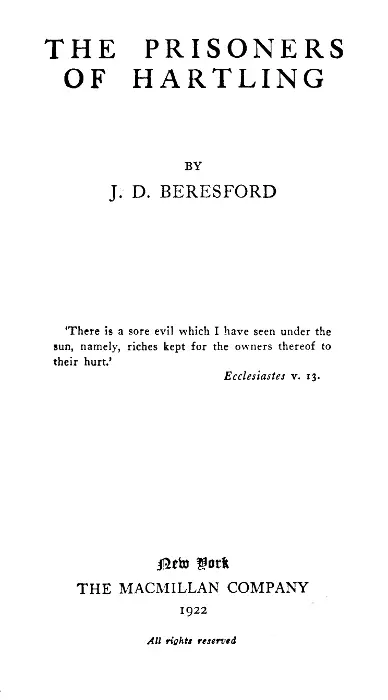
The Prisoners of Hartling
J. D. (John Davys) Beresford
THE CLASSIC COLLECTION · 1917
"The Wonder" by J. D. Beresford is a novel written in the early 20th century. The story explores themes of intelligence, abnormality, and the societal perceptions surrounding them, primarily through the lens of a remarkable child named Victor Stott. The narrative follows Ginger Stott, an ambitious cricketer whose life takes unexpected turns due to the extraordinary nature of his son. The opening of the book introduces us to a scene on a train where an unnamed narrator observes a woman with an unusual infant. The child's appearance captivates the attention of other passengers, leading to a mix of fascination and repulsion. As the narrator grapples with his own disdain for what he perceives as a “freak,” we learn that the child has not spoken or cried in his one year of life. The conversation touches on the mother’s protective behavior and the reactions of those around her, establishing the tension between normalcy and the extraordinary. This encounter hints at the complexity of Victor Stott's character and sets the stage for the exploration of his unique childhood and the challenges faced by his family.
Introduction adapted from the source catalogue; source summaries may be automatically generated.
Free to read · English · 60,640 words · No account needed
MAKE TIME FOR A GOOD BOOK
On by default. Untick to stop anonymous reading totals. Each page counts after 10 seconds in view. How this works.
Anonymous counting is on unless you have switched it off.
Dr. O'Connell's face was white and drawn, and the redness of his eyelids more pronounced than ever as he faced Stott in the pale October dawn. He clutched at his beard with a nervous, combing movement, as he shook his head decidedly in answer to the question put to him.
"If it's not dead, now, 'twill be in very few hours," he said.
Stott was shaken by the feeble passion of a man who has spent many weary hours of suspense. His anger thrilled out in a feeble stream of hackneyed profanities.
O'Connell looked down on him with contempt. At sunrise, after a sleepless night, a man is a creature of unrealised emotions.
"Damn it, control yourself, man!" growled O'Connell, himself uncontrolled, "your wife'll pull through with care, though she'll never have another child." O'Connell did not understand; he was an Irishman, and no cricketer; he had been called in because he had a reputation for his skill in obstetrics.
Stott stared at him fiercely. The two men seemed as if about to grapple desperately for life in the windy, grey twilight.
O'Connell recovered his self-control first, and began again to claw nervously at his beard. "Don't be a fool," he said, "it's only what you could expect. Her first child, and her a woman of near fifty." He returned to the upstairs room; Stott seized his cap and went out into the chill world of sunrise.
"She'll do, if there are no complications," said O'Connell to the nurse, as he bent over the still, exhausted figure of Mrs. Stott. "She's a wonderful woman to have delivered such a child alive."
The nurse shivered, and avoiding any glance at the huddle that lay on an improvised sofa-bed, she said: "It can't live, can it?"
O'Connell, still intent on his first patient, shook his head. "Never cried after delivery," he muttered--"the worst sign." He was silent for a moment and then he added: "But, to be sure, it's a freak of some kind." His scientific curiosity led him to make a further investigation. He left the bed and began to examine the huddle on the sofa-couch. Victor Stott owed his life, in the first instance, to this scientific curiosity of O'Connell's.
The nurse, a capable, but sentimental woman, turned to the window and looked out at the watery trickle of feeble sunlight that now illumined the wilderness of Stott's garden.
"Nurse!" The imperative call startled her; she turned nervously.
"Yes, doctor?" she said, making no movement towards him.
"Come here!" O'Connell was kneeling by the sofa. "There seems to be complete paralysis of all the motor centres," he went on; "but the child's not dead. We'll try artificial respiration."
Your reading position is saved on this browser. Take it to another device with a library code. Reading pages adapt to text, rather than matching a printed edition.
J. D. (John Davys) Beresford
BEHIND THE BOOK
This eBook is for the use of anyone anywhere in the United States and most other parts of the world at no cost and with almost no restrictions whatsoever. You may copy it, give it away or re-use it under the terms of the Project Gutenberg License included with this eBook or online at www.gutenberg.org. If you are not located in the United States, you will have to check the laws of the country where you are located before using this eBook. Read the source licence.
The original source file, including credits and licence, is retained by this library. Request an original-format copy at no charge. Please include the book title and Project Gutenberg identifier #27188.
KEEP YOUR CURIOSITY GOING
Coulson Kernahan

Maurice Baring
Frances Wright
Cécile Tormay

Frederic Jesup Stimson

W. H. P. (William Henry Pope) Jarvis