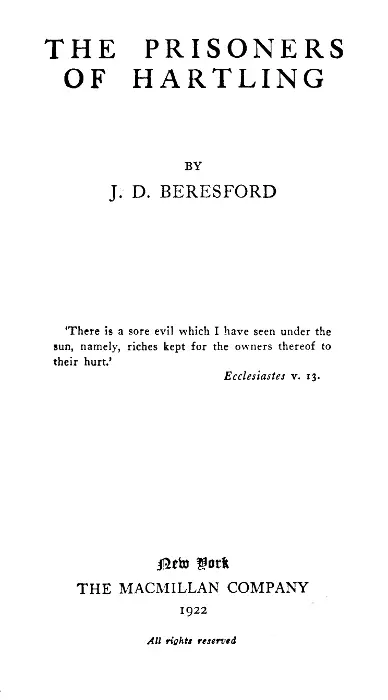
The Prisoners of Hartling
J. D. (John Davys) Beresford
THE CLASSIC COLLECTION · 1917
"The Wonder" by J. D. Beresford is a novel written in the early 20th century. The story explores themes of intelligence, abnormality, and the societal perceptions surrounding them, primarily through the lens of a remarkable child named Victor Stott. The narrative follows Ginger Stott, an ambitious cricketer whose life takes unexpected turns due to the extraordinary nature of his son. The opening of the book introduces us to a scene on a train where an unnamed narrator observes a woman with an unusual infant. The child's appearance captivates the attention of other passengers, leading to a mix of fascination and repulsion. As the narrator grapples with his own disdain for what he perceives as a “freak,” we learn that the child has not spoken or cried in his one year of life. The conversation touches on the mother’s protective behavior and the reactions of those around her, establishing the tension between normalcy and the extraordinary. This encounter hints at the complexity of Victor Stott's character and sets the stage for the exploration of his unique childhood and the challenges faced by his family.
Introduction adapted from the source catalogue; source summaries may be automatically generated.
Free to read · English · 60,640 words · No account needed
MAKE TIME FOR A GOOD BOOK
On by default. Untick to stop anonymous reading totals. Each page counts after 10 seconds in view. How this works.
Anonymous counting is on unless you have switched it off.
"Er--does it--er--can it--talk?" hesitated the rubicund man, and I grew hot at his boldness. There seemed to be something disrespectful in speaking before the child in this impersonal way.
"No, sir, he's never made a sound," replied the woman, twitching and vibrating. Her heavy, dark eyebrows jerked spasmodically, nervously.
"Never cried?" persisted the interrogator.
"Never once, sir."
"Dumb, eh?" He said it as an aside, half under his breath.
"'E's never spoke, sir."
"Hm!" The man cleared his throat and braced himself with a deliberate and obvious effort. "Is it--he--not water on the brain--what?"
I felt that a rigour of breathless suspense held every occupant of the compartment. I wanted, and I know that every other person there wanted, to say, "Look out! Don't go too far." The child, however, seemed unconscious of the insult: he still stared out through the window, lost in profound contemplation.
"No, sir, oh no!" replied the woman. "'E's got more sense than a ordinary child." She held the infant as if it were some priceless piece of earthenware, not nursing it as a woman nurses a baby, but balancing it with supreme attention in her lap.
"How old is he?"
We had been awaiting this question.
"A year and nine munse, sir."
"Ought to have spoken before that, oughtn't he?"
"Never even cried, sir," said the woman. She regarded the child with a look into which I read something of apprehension. If it were apprehension it was a feeling that we all shared. But the rubicund man was magnificent, though, like the lion tamer of my youthful experience, he was doubtless conscious of the aspect his temerity wore in the eyes of beholders. He must have been showing off.
"Have you taken opinion?" he asked; and then, seeing the woman's lack of comprehension, he translated the question--badly, for he conveyed a different meaning--thus,
"I mean, have you had a doctor for him?"
The train was slackening speed.
"Oh! yes, sir."
"And what do they say?"
The child turned its head and looked the rubicund man full in the eyes. Never in the face of any man or woman have I seen such an expression of sublime pity and contempt....
I remembered a small urchin I had once seen at the Zoological Gardens. Urged on by a band of other urchins, he was throwing pebbles at a great lion that lolled, finely indifferent, on the floor of its playground. Closer crept the urchin; he grew splendidly bold; he threw larger and larger pebbles, until the lion rose suddenly with a roar, and dashed fiercely down to the bars of its cage.
Your reading position is saved on this browser. Take it to another device with a library code. Reading pages adapt to text, rather than matching a printed edition.
J. D. (John Davys) Beresford
BEHIND THE BOOK
This eBook is for the use of anyone anywhere in the United States and most other parts of the world at no cost and with almost no restrictions whatsoever. You may copy it, give it away or re-use it under the terms of the Project Gutenberg License included with this eBook or online at www.gutenberg.org. If you are not located in the United States, you will have to check the laws of the country where you are located before using this eBook. Read the source licence.
The original source file, including credits and licence, is retained by this library. Request an original-format copy at no charge. Please include the book title and Project Gutenberg identifier #27188.
KEEP YOUR CURIOSITY GOING
Coulson Kernahan

Maurice Baring
Frances Wright
Cécile Tormay

Frederic Jesup Stimson

W. H. P. (William Henry Pope) Jarvis