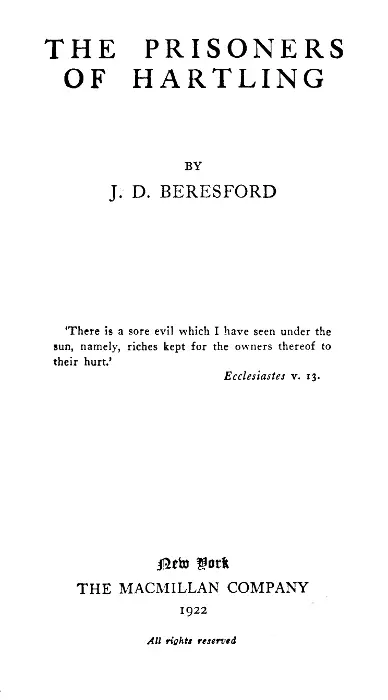
The Prisoners of Hartling
J. D. (John Davys) Beresford
THE CLASSIC COLLECTION · 1917
"The Wonder" by J. D. Beresford is a novel written in the early 20th century. The story explores themes of intelligence, abnormality, and the societal perceptions surrounding them, primarily through the lens of a remarkable child named Victor Stott. The narrative follows Ginger Stott, an ambitious cricketer whose life takes unexpected turns due to the extraordinary nature of his son. The opening of the book introduces us to a scene on a train where an unnamed narrator observes a woman with an unusual infant. The child's appearance captivates the attention of other passengers, leading to a mix of fascination and repulsion. As the narrator grapples with his own disdain for what he perceives as a “freak,” we learn that the child has not spoken or cried in his one year of life. The conversation touches on the mother’s protective behavior and the reactions of those around her, establishing the tension between normalcy and the extraordinary. This encounter hints at the complexity of Victor Stott's character and sets the stage for the exploration of his unique childhood and the challenges faced by his family.
Introduction adapted from the source catalogue; source summaries may be automatically generated.
Free to read · English · 60,640 words · No account needed
MAKE TIME FOR A GOOD BOOK
On by default. Untick to stop anonymous reading totals. Each page counts after 10 seconds in view. How this works.
Anonymous counting is on unless you have switched it off.
Altogether the Wonder spent five days, or about forty hours, on his study of the dictionary, and in the evening of his last day's work he left again by the open window. Challis, however, had been keeping him under fairly close observation, and knew that the preliminary task was finished.
"What can I give that child to read to-day?" he asked at breakfast next
morning.
"I should reverse the arrangement; let him sit on the Dictionary and read the Encyclopaedia." Lewes always approached the subject of the Wonder with a certain supercilious contempt.
"You are not convinced yet that he isn't humbugging?"
"No! Frankly, I'm not."
"Well, well, we must wait for more evidence, before we argue about it," said Challis, but they sat on over the breakfast-table, waiting for the child to put in an appearance, and their conversation hovered over the topic of his intelligence.
"Half-past ten?" Challis ejaculated at last, with surprise. "We are getting into slack habits, Lewes." He rose and rang the bell.
"Apparently the Stott infant has had enough of it," suggested Lewes. "Perhaps he has exhausted the interest of dictionary illustrations."
"We shall see," replied Challis, and then to a deferentially appearing Heathcote he said: "Has Master Stott come this morning?"
"No, sir. Leastways, no one 'asn't let 'im in, sir."
"It may be that he is mentally collating the results of the past two days' reading," said Challis, as he and Lewes made their way to the library.
"Oh!" was all Lewes's reply, but it conveyed much of impatient contempt for his employer's attitude.
Challis only smiled.
When they entered the library they found the Wonder hard at work, and he had, of his own initiative, adopted the plan ironically suggested by Lewes, for he had succeeded in transferring the Dictionary volumes to the chair, and he was deep in volume one, of the eleventh edition of the Encyclopaedia Britannica.
The library was never cleared up by any one except Challis or his deputy, but an early housemaid had been sent to dust, and she had left the casement of one of the lower lights of the window open. The means of the Wonder's entrance was thus clearly in evidence.
"It's Napoleonic," murmured Challis.
"It's most infernal cheek," returned Lewes in a loud voice, "I should not be at all surprised if that promised shaking were not administered to-day."
The Wonder took no notice. Challis says that on that morning his eyes were travelling down the page at about the rate at which one could count the lines.
"He isn't reading," said Lewes. "No one could read as fast as that, and most certainly not a child of four and a half."
Your reading position is saved on this browser. Take it to another device with a library code. Reading pages adapt to text, rather than matching a printed edition.
J. D. (John Davys) Beresford
BEHIND THE BOOK
This eBook is for the use of anyone anywhere in the United States and most other parts of the world at no cost and with almost no restrictions whatsoever. You may copy it, give it away or re-use it under the terms of the Project Gutenberg License included with this eBook or online at www.gutenberg.org. If you are not located in the United States, you will have to check the laws of the country where you are located before using this eBook. Read the source licence.
The original source file, including credits and licence, is retained by this library. Request an original-format copy at no charge. Please include the book title and Project Gutenberg identifier #27188.
KEEP YOUR CURIOSITY GOING
Coulson Kernahan

Maurice Baring
Frances Wright
Cécile Tormay

Frederic Jesup Stimson

W. H. P. (William Henry Pope) Jarvis