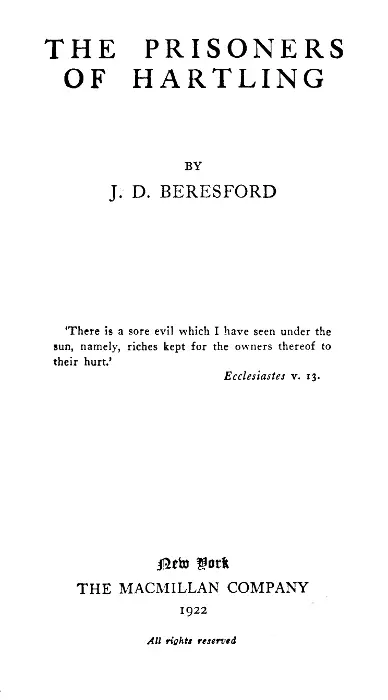
The Prisoners of Hartling
J. D. (John Davys) Beresford
THE CLASSIC COLLECTION · 1917
"The Wonder" by J. D. Beresford is a novel written in the early 20th century. The story explores themes of intelligence, abnormality, and the societal perceptions surrounding them, primarily through the lens of a remarkable child named Victor Stott. The narrative follows Ginger Stott, an ambitious cricketer whose life takes unexpected turns due to the extraordinary nature of his son. The opening of the book introduces us to a scene on a train where an unnamed narrator observes a woman with an unusual infant. The child's appearance captivates the attention of other passengers, leading to a mix of fascination and repulsion. As the narrator grapples with his own disdain for what he perceives as a “freak,” we learn that the child has not spoken or cried in his one year of life. The conversation touches on the mother’s protective behavior and the reactions of those around her, establishing the tension between normalcy and the extraordinary. This encounter hints at the complexity of Victor Stott's character and sets the stage for the exploration of his unique childhood and the challenges faced by his family.
Introduction adapted from the source catalogue; source summaries may be automatically generated.
Free to read · English · 60,640 words · No account needed
MAKE TIME FOR A GOOD BOOK
On by default. Untick to stop anonymous reading totals. Each page counts after 10 seconds in view. How this works.
Anonymous counting is on unless you have switched it off.
"His methods do not lack terseness," remarked Lewes, when he and Challis were out of earshot of the cottage.
"His methods and manners are damnable," said Challis, "but----"
"You were going to say?" prompted Lewes.
"Well, what is your opinion?"
"I am not convinced, as yet," said Lewes.
"Oh, surely," expostulated Challis.
"Not from objective, personal evidence. Let us put Crashaw out of our
minds for the moment."
"Very well; go on, state your case."
"He has, so far, made four remarks in our presence," said Lewes, gesticulating with his walking stick. "Two of them can be neglected; his repetition of your words, which he did not understand, and his condescending promise to study your library."
"Yes; I'm with you, so far."
"Now, putting aside the preconception with which we entered the cottage, was there really anything in the other two remarks? Were they not the type of simple, unreasoning questions which one may often hear from the mouth of a child of that age? 'What shall I learn from your books?' Well, it is the natural question of the ignorant child, who has no conception of the contents of books, no experience which would furnish material for his imagination."
"Well?"
"The second remark is more explicable still. It is a remark we all make in childhood, in some form or another. I remember quite well at the age of six or seven asking my mother: 'Which is me, my soul or my body?' I was brought up on the Church catechism. But you at once accepted these questions--which, I maintain, were questions possible in the mouth of a simple, ignorant child--in some deep, metaphysical acceptation. Don't you think, sir, we should wait for further evidence before we attribute any phenomenal intelligence to this child?"
"Quite the right attitude to take, Lewes--the scientific attitude," replied Challis. "Let's go by the lane," he added, as they reached the entrance to the wood.
For some few minutes they walked in silence; Challis with his head down, his heavy shoulders humped. His hands were clasped behind him, dragging his stick as it were a tail, which he occasionally cocked. He walked with a little stumble now and again, his eyes on the ground. Lewes strode with a sure foot, his head up, and he slashed at the tangle of last year's growth on the bank whenever he passed some tempting butt for the sword-play of his stick.
"Do you think, then," said Challis at last, "that much of the atmosphere--you must have marked the atmosphere--of the child's personality, was a creation of our own minds, due to our preconceptions?"
Your reading position is saved on this browser. Take it to another device with a library code. Reading pages adapt to text, rather than matching a printed edition.
J. D. (John Davys) Beresford
BEHIND THE BOOK
This eBook is for the use of anyone anywhere in the United States and most other parts of the world at no cost and with almost no restrictions whatsoever. You may copy it, give it away or re-use it under the terms of the Project Gutenberg License included with this eBook or online at www.gutenberg.org. If you are not located in the United States, you will have to check the laws of the country where you are located before using this eBook. Read the source licence.
The original source file, including credits and licence, is retained by this library. Request an original-format copy at no charge. Please include the book title and Project Gutenberg identifier #27188.
KEEP YOUR CURIOSITY GOING
Coulson Kernahan

Maurice Baring
Frances Wright
Cécile Tormay

Frederic Jesup Stimson

W. H. P. (William Henry Pope) Jarvis