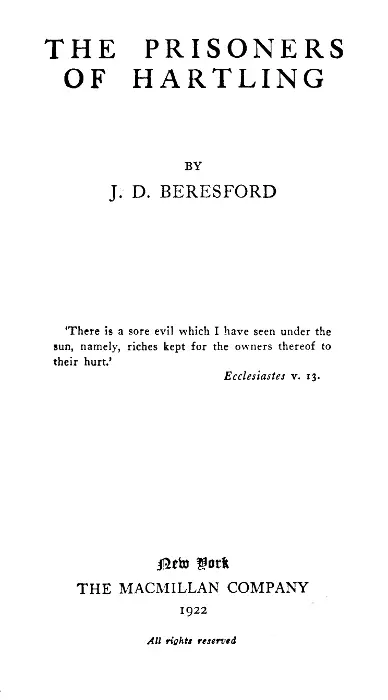
The Prisoners of Hartling
J. D. (John Davys) Beresford
THE CLASSIC COLLECTION · 1917
"The Wonder" by J. D. Beresford is a novel written in the early 20th century. The story explores themes of intelligence, abnormality, and the societal perceptions surrounding them, primarily through the lens of a remarkable child named Victor Stott. The narrative follows Ginger Stott, an ambitious cricketer whose life takes unexpected turns due to the extraordinary nature of his son. The opening of the book introduces us to a scene on a train where an unnamed narrator observes a woman with an unusual infant. The child's appearance captivates the attention of other passengers, leading to a mix of fascination and repulsion. As the narrator grapples with his own disdain for what he perceives as a “freak,” we learn that the child has not spoken or cried in his one year of life. The conversation touches on the mother’s protective behavior and the reactions of those around her, establishing the tension between normalcy and the extraordinary. This encounter hints at the complexity of Victor Stott's character and sets the stage for the exploration of his unique childhood and the challenges faced by his family.
Introduction adapted from the source catalogue; source summaries may be automatically generated.
Free to read · English · 60,640 words · No account needed
MAKE TIME FOR A GOOD BOOK
On by default. Untick to stop anonymous reading totals. Each page counts after 10 seconds in view. How this works.
Anonymous counting is on unless you have switched it off.
I did not see Stott again till August, and then I had a long talk with him on the Ailesworth County Ground, as together we watched the progress of Hampdenshire's defeat by Lancashire.
"Oh! I can't learn him nothing," he broke out, as Flower was hit to the four corners of the ground, "'alf vollies and long 'ops and then a full pitch--'e's a disgrace."
"They've knocked him off his length," I protested. "On a wicket like
this ..."
Stott shook his head. "I've been trying to learn 'im," he said, "but he can't never learn. 'E's got 'abits what you can't break 'im of."
"I suppose it is difficult," I said vaguely.
"Same with me," went on Stott, "I've been trying to learn myself to bowl without my finger"--he held up his mutilated hand--"or left-'anded; but I can't. If I'd started that way ... No! I'm always feeling for that finger as is gone. A second-class bowler I might be in time, not better nor that."
"It's early days yet," I ventured, intending encouragement, but Stott frowned and shook his head.
"I'm not going to kid myself," he said, "I know. But I'm going to find a youngster and learn 'im. On'y he must be young.
"No 'abits, you know," he explained.
The next time I met Stott was in November. I ran up against him, literally, one Friday afternoon in Ailesworth.
When he recognised me he asked me if I would care to walk out to Stoke-Underhill with him. "I've took a cottage there," he explained, "I'm to be married in a fortnight's time."
His circumstances certainly warranted such a venture. The proceeds of matinee and benefit, invested for him by the Committee of the County Club, produced an income of nearly two pounds a week, and in addition to this he had his salary as groundsman. I tendered my congratulations.
"Oh! well, as to that, better wait a bit," said Stott.
He walked with his hands in his pockets and his eyes on the ground. He had the air of a man brooding over some project.
"It is a lottery, of course ..." I began, but he interrupted me.
"Oh that!" he said, and kicked a stone into the ditch; "take my chances of that. It's the kid I'm thinking on."
"The kid?" I repeated, doubtful whether he spoke of his fiancee, or whether his nuptials pointed an act of reparation.
"What, else 'ud I tie myself up for?" asked Stott. "I must 'ave a kid of my own and learn 'im from his cradle. It's come to that."
"Oh! I understand," I said; "teach him to bowl."
Your reading position is saved on this browser. Take it to another device with a library code. Reading pages adapt to text, rather than matching a printed edition.
J. D. (John Davys) Beresford
BEHIND THE BOOK
This eBook is for the use of anyone anywhere in the United States and most other parts of the world at no cost and with almost no restrictions whatsoever. You may copy it, give it away or re-use it under the terms of the Project Gutenberg License included with this eBook or online at www.gutenberg.org. If you are not located in the United States, you will have to check the laws of the country where you are located before using this eBook. Read the source licence.
The original source file, including credits and licence, is retained by this library. Request an original-format copy at no charge. Please include the book title and Project Gutenberg identifier #27188.
KEEP YOUR CURIOSITY GOING
Coulson Kernahan

Maurice Baring
Frances Wright
Cécile Tormay

Frederic Jesup Stimson

W. H. P. (William Henry Pope) Jarvis