THE CLASSIC COLLECTION✦The Egregious EnglishCLASSIC FREE BOOKS
The Egregious English
T. W. H. (Thomas William Hodgson) Crosland
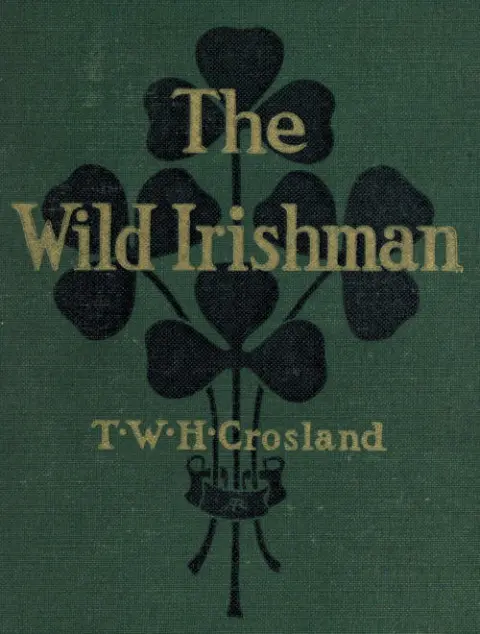
THE CLASSIC COLLECTION · 1905
"The Wild Irishman" by T. W. H. Crosland is a commentary on Irish identity and culture, written in the early 20th century. This work delves into various aspects of Irish life, weaving together social observations, critiques of political sentiments, and reflections on the Irish character and conditions. It also sheds light on the effects of emigration and the Irish experience in America, aiming to provide a perspective on Ireland's ongoing struggles and the resilience of its people. The opening of the text establishes a critical tone as it reflects on the so-called "Irish question," exploring its historical context and current relevance. Crosland discusses the contrasting perspectives of the Irish towards England and America, portraying America as a "promised land" for many Irish. He provides a detailed analysis of the social and economic distress in Ireland, emphasizing the resilience and unique culture of the Irish people amidst prevailing hardships. The preference for addressing serious cultural issues with humor and wit becomes apparent, indicating the author's broader critique of both Irish and English society while setting the stage for an exploration of Irish customs, history, and identity.
Introduction adapted from the source catalogue; source summaries may be automatically generated.
Free to read · English · 32,428 words · No account needed
MAKE TIME FOR A GOOD BOOK
On by default. Untick to stop anonymous reading totals. Each page counts after 10 seconds in view. How this works.
Anonymous counting is on unless you have switched it off.
At home, in Ireland, the Irishman of the poorer class, and even of the middle class, is absolutely without opportunity. He must take things as they are, and if he ever thinks about such matters at all, resign himself to the mean, and uninspiring facts. There is nothing in Ireland that a man who wishes to get along in life may do; the fact being that the country is exhausted, and devoid of the elements which are necessary to activity. And it seems more than likely that this state of affairs will continue for many years to come. Capital that is not backed up by arrant greed has become extremely rare of late. There is little hope for Ireland in the modern sense, unless she be exploited, and for some reason or other, exploitation is nowadays attempted only by persons without bowels, who, with all their exploiting, succeed only in enriching themselves, and degrading the persons who toil for them. I have said before that Ireland’s true regeneration must come from within. When she took to emigration she began practically this work. For years it has been the only way for her; it will go on just as long as it is necessary and good for her. Meanwhile the people at home must be roused from their apathy. If the gentlemen who periodically stump the country with a miscellaneous selection of political and religious shibboleths would direct some of their energy and oratory to the social and intimate life of the Irish people, they might yet accomplish for Ireland a work that would be of real benefit to her. There is far too much complacency, even in the ranks of Ireland’s best wishers. It is taken for granted that the main body of the people of Ireland are peasants; everybody speaks of them as peasants, and everybody talks of them as peasants. When Goldsmith wrote about “a bold peasantry, their country’s pride,” he did not mean peasantry in the same way that the glib writers and talkers of our own day mean it. The word “peasant,” like many another good word, has had its ups and downs, and for the last half-century, if not for a longer period, “peasant,” as applied to an Irishman, has amounted really to a condemnation and an excuse. “Ah, my dear sir,” cry the wise, “you do not know the Irish peasant!” If one is to believe all that one hears, the Irish peasant is a sort of inferior, inhuman creation. Anything is good enough for him, and, like the dog in the adage, the less you give him and the more you kick him, the better he will like you. One never hears the slackest politician of them all talking or writing about “the English peasant.” It is “the sturdy men of Kent,” “the hardy men of Yorkshire,” and “comrades,” and “fellow-workers,” all the time. These men eat bacon and cheese, and as much beef as they can lay tooth upon; also they drink beer in and out of season and by the bucketful; also their children are reasonably well-fed and reasonably well-clad. There’s not the smallest boy in England but travels in his shoes. Hence the English peasantry retain those qualities of boldness and masterfulness and independence, without which a peasantry cannot thrive. And nobody dare call them “peasants,” nor offer them the treatment which peasants are commonly supposed to delight in. The Irish need to be taught that they are a race of men, and not merely dreamers, and martyrs, and kickable persons. And the first thing for a proper man to do is to make sure that himself and his family live like human beings and compass the food and shelter and decencies which are nowadays considered necessary to human beings. The Irish politicians have helped Ireland to something in the nature of reasonable government; they might now conveniently lay themselves out to help her into something that resembles reasonable living. At the forthcoming General Election, we are told, great political and party play is to be made with that ancient and bedraggled question, Home Rule. The friends of Ireland, and the friends of England, fancy that they see in it something which is going to be very good for Ireland. In point of fact it is a matter of which next to nothing would have been heard, had not Mr. Balfour stood in sore need of a red herring to drag across the idiot noses of the electorate. From Mr. Balfour’s point of view, no doubt, the resurrection of the Home Rule bogy is a singularly adroit move. It will confuse the fiscal tariff-mongers; it will placate the dunder-headed Liberal party, and it will tickle the Irish to death. But any man who believes for one moment that it will be of the smallest benefit to Ireland is just a fool. England made up her mind long ago that Home Rule for Ireland was a sheer impossibility; and what is more to the point, Ireland proper, and in the mass, is of the same opinion. If she desires to take advantage of the opportunities which a General Election is bound to provide for her, she will let Home Rule severely alone, and base her demands on less political, but considerably more urgent and vital things.
Your reading position is saved on this browser. Take it to another device with a library code. Reading pages adapt to text, rather than matching a printed edition.
T. W. H. (Thomas William Hodgson) Crosland
T. W. H. (Thomas William Hodgson) Crosland
T. W. H. (Thomas William Hodgson) Crosland
BEHIND THE BOOK
This eBook is for the use of anyone anywhere in the United States and most other parts of the world at no cost and with almost no restrictions whatsoever. You may copy it, give it away or re-use it under the terms of the Project Gutenberg License included with this eBook or online at www.gutenberg.org. If you are not located in the United States, you will have to check the laws of the country where you are located before using this eBook. Read the source licence.
The original source file, including credits and licence, is retained by this library. Request an original-format copy at no charge. Please include the book title and Project Gutenberg identifier #57838.
KEEP YOUR CURIOSITY GOING

David Patterson (Spirit) Hatch

David Patterson (Spirit) Hatch

David Patterson (Spirit) Hatch
Cécile Tormay

Moritz Busch
John L. Ransom