THE CLASSIC COLLECTION✦The Egregious EnglishCLASSIC FREE BOOKS
The Egregious English
T. W. H. (Thomas William Hodgson) Crosland
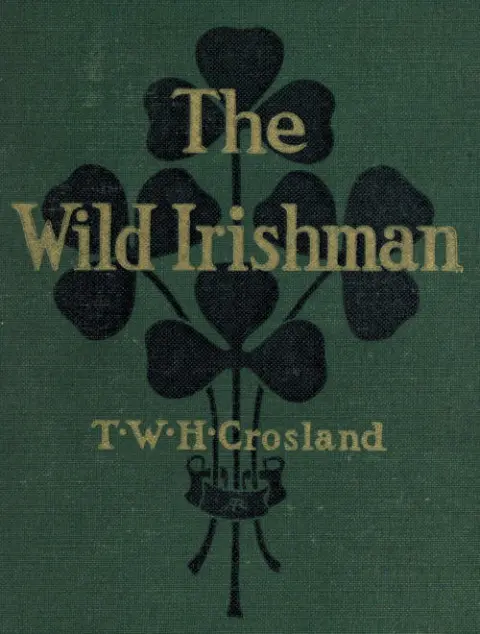
THE CLASSIC COLLECTION · 1905
"The Wild Irishman" by T. W. H. Crosland is a commentary on Irish identity and culture, written in the early 20th century. This work delves into various aspects of Irish life, weaving together social observations, critiques of political sentiments, and reflections on the Irish character and conditions. It also sheds light on the effects of emigration and the Irish experience in America, aiming to provide a perspective on Ireland's ongoing struggles and the resilience of its people. The opening of the text establishes a critical tone as it reflects on the so-called "Irish question," exploring its historical context and current relevance. Crosland discusses the contrasting perspectives of the Irish towards England and America, portraying America as a "promised land" for many Irish. He provides a detailed analysis of the social and economic distress in Ireland, emphasizing the resilience and unique culture of the Irish people amidst prevailing hardships. The preference for addressing serious cultural issues with humor and wit becomes apparent, indicating the author's broader critique of both Irish and English society while setting the stage for an exploration of Irish customs, history, and identity.
Introduction adapted from the source catalogue; source summaries may be automatically generated.
Free to read · English · 32,428 words · No account needed
MAKE TIME FOR A GOOD BOOK
On by default. Untick to stop anonymous reading totals. Each page counts after 10 seconds in view. How this works.
Anonymous counting is on unless you have switched it off.
I have no desire to offer in the present pages a re-hash of a former work of mine, which is said to have provoked the Scotch to the point of laughter. But I do desire to assert that, in my humble opinion, it is the Scotch, or alien population of Ireland, which has been at the root of Ireland’s principal troubles throughout the past century. Ulster may be a fine kingdom, the wealthiest, most industrious, and the wisest and happiest in the country, if you like. Yet it is Ulster that bars the way in all matters that make for the real good of Ireland. Every proper Irishman knows this, and Ulstermen will be at no pains to deny it. Rather are they disposed to glory in it and to brag about it. Ireland, they will tell you, is their country. It is they who have made it, they who have saved it, they who have enriched, beautified and adorned it. They point to the linen industry and to the shipbuilding industry; they crack about Belfast and Portadown, and about “eminent Ulstermen in every walk of life.” There would be no Ireland at all if it were not for themselves. They rule Ireland. What Ireland wants she may have, if it pleases Ulster. What Ireland does not want she must have, if Ulster so much as nod. That, at any rate, is the view of Ulster, the view of the thrifty, douce Scotch bodies whose fathers got gifts of other people’s lands from James I. of England and VI. of Scotland, and whose sons go up and down and to and fro upon the earth, calling themselves “Irishmen of Scotch descent.” There are no Irishmen of Scotch descent. And Ulstermen are not Irishmen unless their descent be Irish. Failing this, they are simply interlopers, or, at best, colonists and plantation men, and they had best put the fact in their pipes and smoke it. Nobody can deny that it was a bad day for Ireland when they came grabbing and grubbing to her shores, just as it was a bad day for England when she “took up” with them. They got Ulster for nothing, and they have kept it for “that same.” They have lived and waxed fat on Irish plunder, and the whole force of English legislation has been directed toward maintaining them in their place, fostering their projects, pampering and propitiating them, and “protecting” them against the wicked, degraded, unreasonable Irish outside. Nor have they been content to confine their greedy attention to their own proper “kingdom,” which is not theirs. Where the carcass is, there will the vulture be; and where there is a soft job, or obvious pickings, there you will find a Scotchman. So that throughout Ireland, Scotchmen have been scattered wherever the Government could find a place for one. There is scarcely an office, sub-office, or sub-deputy office worth the having in all Ireland which has not been made the perquisite of a Protestant Scotchman. Even the Congested Districts Board employs Scotch factors, and Thom’s Almanac is little more than a catalogue of Scotch patronymics. And the pride and insolence and unfairness of them! From a booklet called The Scot in Ulster, written by a Scotchman, and published, if you please, by Blackwood’s of Edinburgh, I take the following: “Their English and Scotch origin seems to me to give to the men of Ulster an unalienable right to protest, as far as they are concerned, against the policy of separation from Great Britain to which the Irish, with the genius for nicknames which they possess, at present give the name of Home Rule.” Could sophistry, craft, subtlety, disingenuousness, or the Scotch genius for cunning misrepresentation go further? To say that when the Irish people have said Home Rule they meant separation, is to promulgate a deliberate and wily untruth. The Irish people proper invariably mean what they say, no more and no less. Home Rule never meant more nor less to the Irish than “a parliament on college green.” It was the Scotch, and the Scotch alone, who set up the cry of “separation” for a bugbear and a bogy wherewith to frighten the timorous English ruler into stubborn acquiescence in the Scotch view of Irish affairs. Yet here we have a Scotchman assuring us in cold print that Home Rule is merely an Irish “nickname” for “separation.” I note with considerable satisfaction, however, that, as Scotchmen will, the author of The Scot in Ulster proceeds religiously to give away the whole Scotch-Irish question. “For centuries,” says he, “the Scot had been wont to wander forth over Europe in search of adventure. [The italic is ours.] As a rule, he turned his steps where fighting was to be had, and the pay for killing was reasonably good. [Again the italics are ours.]… These Scots who have flocked from Leith, or Crail, or Berwick to seek fortune, in peace or war, on the Continent of Europe were mostly the young and adventurous, for whom the old home life had become too narrow. They took with them little save their own stout hearts and their national long heads. [These, too, are our italics.]… The time arrived at last, however, when war with England ceased, and internal strife became less bloody, and Scotland began to be too small for her rapidly growing population, for in those days food did not necessarily come where there were mouths to consume it. [Italics—of our own—which famine-stricken Ireland may fittingly ponder.] Then the Scots, true to the race from which they sprung—for ‘Norman, and Saxon, and Dane are we’ [think of it!][2]—began to go forth, like the northern hordes in days of yore, the women and the children along with the bread-winners, and crossed the seas, and settled in new lands, and were ‘fruitful and multiplied and replenished the earth,’ until the globe is circled round with colonies which are of our blood, and which love and cherish the old ‘land of the mountain and the flood.’” [Tut, tut!] And now mark us: “It was in the beginning of the seventeenth century that the first of these swarms crossed the narrowest of the seas which surround Scotland; it went out from the Ayrshire and Galloway ports, and settled in the north of Ireland. The numbers which went were large. They left Scotland at a time when she was deeply moved by the great Puritan revival. They took with them their Scottish character and their Scottish Calvinism. [Clearly they had both hands full!] They founded the Scottish colony in Ulster. Thus it comes to pass ‘That the foundation of Ulster society is Scottish. It is the solid granite on which it rests.’ [Glory be!] The history of this Scottish colony seems worth telling, for it is a story of which any Scotsman at home or abroad may be proud. [Where is my crimson handkerchief?] Its early history is quaint and interesting [our italics]; there is much suffering and oppression in the story of the succeeding years [our italics]; but there are flashes of brightness to relieve the gloom. The men which this race of Scotsmen has produced are worthy of the parent stock; the contribution which this branch of the Scottish nation has made to the progress of civilization proves that it has not forgotten the old ideals; the portion of Ireland which these Scotsmen HOLD is so prosperous and contented that it permits our statesmen to forget that it is part of that most ‘distressful’ country.” I venture to thank Heaven and St. Patrick that the statements we have last italicized and the word we have put in capital letters embody the truth, the whole truth and nothing but the truth. Examine them, O sons of Erin, and take heed that You are the people, and that the Scotch are but the sons of Belial and Astoreth. What has holy Ireland to do with these vapors, these swaggerings, these smitings of righteous breasts? Who be the grubby, grimy, gallowayan, grasping, governmental hucksters that so by implication and innuendo contemn You, the proper and legitimate owners of Ulster? Ask of the winds, which far around strew Scotchmen and the devil on the fair places of the earth. You are innocent to put up with it. You fought the landlords and beat them hollow. “We conquered you before, and can do so again!” Be done with this Scotch obsession. Good can come out of Ireland and Irishmen, as well as out of Ulster and Scotchmen. Lo, that green island is yours, not theirs. Seven-tenths of it are in your hands to do with as you will. “There is not, perhaps, another country on the face of the globe where more good, solid work is waiting to be done, where greater capacities lie dormant, yet where trifling of all kinds so abounds.” That is the verdict of an Irishman and an Irish Catholic upon you. In sober truth you groan, as England groans, under the Scotch superstition. Nobody can be prosperous in Ireland save Scotchmen. Nobody can manufacture but Scotchmen, nobody can farm but Scotchmen. The view is entirely false. Encourage it no longer; remember who you are, and make an end of trifling.
Your reading position is saved on this browser. Take it to another device with a library code. Reading pages adapt to text, rather than matching a printed edition.
T. W. H. (Thomas William Hodgson) Crosland
T. W. H. (Thomas William Hodgson) Crosland
T. W. H. (Thomas William Hodgson) Crosland
BEHIND THE BOOK
This eBook is for the use of anyone anywhere in the United States and most other parts of the world at no cost and with almost no restrictions whatsoever. You may copy it, give it away or re-use it under the terms of the Project Gutenberg License included with this eBook or online at www.gutenberg.org. If you are not located in the United States, you will have to check the laws of the country where you are located before using this eBook. Read the source licence.
The original source file, including credits and licence, is retained by this library. Request an original-format copy at no charge. Please include the book title and Project Gutenberg identifier #57838.
KEEP YOUR CURIOSITY GOING

David Patterson (Spirit) Hatch

David Patterson (Spirit) Hatch

David Patterson (Spirit) Hatch
Cécile Tormay

Moritz Busch
John L. Ransom