THE CLASSIC COLLECTION✦The Egregious EnglishCLASSIC FREE BOOKS
The Egregious English
T. W. H. (Thomas William Hodgson) Crosland
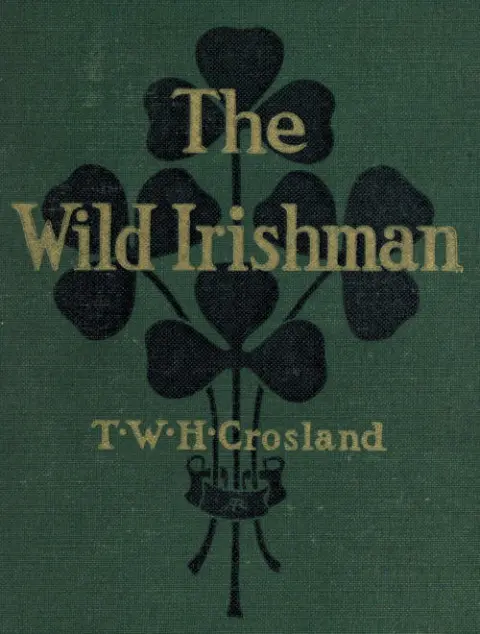
THE CLASSIC COLLECTION · 1905
"The Wild Irishman" by T. W. H. Crosland is a commentary on Irish identity and culture, written in the early 20th century. This work delves into various aspects of Irish life, weaving together social observations, critiques of political sentiments, and reflections on the Irish character and conditions. It also sheds light on the effects of emigration and the Irish experience in America, aiming to provide a perspective on Ireland's ongoing struggles and the resilience of its people. The opening of the text establishes a critical tone as it reflects on the so-called "Irish question," exploring its historical context and current relevance. Crosland discusses the contrasting perspectives of the Irish towards England and America, portraying America as a "promised land" for many Irish. He provides a detailed analysis of the social and economic distress in Ireland, emphasizing the resilience and unique culture of the Irish people amidst prevailing hardships. The preference for addressing serious cultural issues with humor and wit becomes apparent, indicating the author's broader critique of both Irish and English society while setting the stage for an exploration of Irish customs, history, and identity.
Introduction adapted from the source catalogue; source summaries may be automatically generated.
Free to read · English · 32,428 words · No account needed
MAKE TIME FOR A GOOD BOOK
On by default. Untick to stop anonymous reading totals. Each page counts after 10 seconds in view. How this works.
Anonymous counting is on unless you have switched it off.
The Irishman in London appears to lose a great deal of his luster. If you wish to see him at his best in this Metropolis you must go to the Bar. If you wish to see him at his worst you must go to the House of Commons. And both best and worst are pretty bad. The Irishmen at the Bar shall not be named, but all the world knows that they are a fairly ill-conditioned community—savage, rude, reasonably illiterate, and not in the least witty. Many of them model themselves on the late Lord Russell and come off accordingly. Others again are beefy and vulgar and notorious bullies. The judicial bench does not include an Irish judge. Possibly this is fortunate. In London journalism the Irish scarcely count. Mr. W. M. Thompson edits a sheet called Reynolds’s Newspaper to the complete satisfaction of Mr. Clement Shorter, and Mr. T. P. O’Connor edits T. P.’s Weekly and M. A. P., both of them journals with which London could well afford to dispense. As for Irish reporters and sub-editors, they are few and timid and well under the heel of the Scotch, who are numerous and rampant and unblushing. In the minor professions, such as physic, publishing, and stockbroking, the Irish do not figure at all impressively. The truly great physicians of London are mostly Scotch, so—thank Heaven!—are the truly great publishers; while the stockbrokers are commonly believed to belong to the tribe of Manasseh. Of the politicians a great deal more has been written than the politicians are worth. Let us draw a decent green veil over them. Few Englishmen nowadays know which of them is alive and which of them is dead; neither can one tell off-hand whether they are for the Government or agin it. I have heard rumors of the existence in London of an Irish Literary Society. Somewhere in Holborn there exists, too, I am told, an Irish Club. So far as letters are concerned, London is pretty well denuded of Irishmen. Mr. George Moore no longer abides with us. Mr. W. B. Yeats has latterly preferred Dublin to the Euston Road. Mr. George Bernard Shaw has become an American playwright. If these gentlemen are members of the Irish Literary Society so much the better for the Irish Literary Society. There is an Irish poetess resident in Twickenham, but Who’s Who informs us that her Celtic quality has not been stimulated by a sojourn in her native land. The Irish Club would seem to devote itself to “Smokers,” “Socials,” and “Enjoyable Evenings.” Its saturnalia are duly reported in Reynolds’s Newspaper. Probably the most distinguished Irishman in the Metropolis is Sir Thomas Lipton, whose name is as prominently associated with sport as it is with tea. Then there are the Irish Guards, one of the finest bodies of men in the King’s service, and Mr. Dennis O’Sullivan, England’s only Irish actor. It will thus be seen that the London Irish do not shine effulgently. None of them is at the top of things, as it were; none of them has got very far above the middling. The reason no doubt is that the Irish temperament is coy. The Scotchman who comes to London knows that he is an alien and an interloper, and despised of his fellow-men, but he blusters it out. The Irishman, on the other hand, feels his position keenly and refuses to be other than diffident. As a rule, too, he is without commercial aptitude, and not vastly taken with the blessed word thrift. Besides which, Irishmen do not come to London in droves, as do the Scotch. When they emigrate, their natural tendency is toward America. In any case it cannot be suggested that the London Irish have at any time presumed to be aggressive. Neither have they made pretensions to superiority, or exhibited a disposition to clannishness. That they do not count is therefore probably their own fault; for London, in a greater degree perhaps than any other city in the world, is always open to prostrate herself before the invader, providing he be assertive and pushful enough. Leaving out the more or less eminent, and glancing for a moment at the common rank of Irishmen in London, one is confronted with two facts, and two facts only. The first of them is that the London Irish can muster in sufficient force to make a St. Patrick’s Day concert or so financially successful, and the second is that the morning after, the metropolitan magistrates have invariably to deal with a fairly noble batch of Irish “drunks.” Practically this is all that is known by the Cockney respecting his Irish fellow-citizen, and I think that it is distinctly unfortunate for Ireland, because it fosters a false impression. The Scotch, who are wilier, take great care not to get drunk on St. Andrew’s Day.
Your reading position is saved on this browser. Take it to another device with a library code. Reading pages adapt to text, rather than matching a printed edition.
T. W. H. (Thomas William Hodgson) Crosland
T. W. H. (Thomas William Hodgson) Crosland
T. W. H. (Thomas William Hodgson) Crosland
BEHIND THE BOOK
This eBook is for the use of anyone anywhere in the United States and most other parts of the world at no cost and with almost no restrictions whatsoever. You may copy it, give it away or re-use it under the terms of the Project Gutenberg License included with this eBook or online at www.gutenberg.org. If you are not located in the United States, you will have to check the laws of the country where you are located before using this eBook. Read the source licence.
The original source file, including credits and licence, is retained by this library. Request an original-format copy at no charge. Please include the book title and Project Gutenberg identifier #57838.
KEEP YOUR CURIOSITY GOING

David Patterson (Spirit) Hatch

David Patterson (Spirit) Hatch

David Patterson (Spirit) Hatch
Cécile Tormay

Moritz Busch
John L. Ransom