THE CLASSIC COLLECTION✦The Egregious EnglishCLASSIC FREE BOOKS
The Egregious English
T. W. H. (Thomas William Hodgson) Crosland
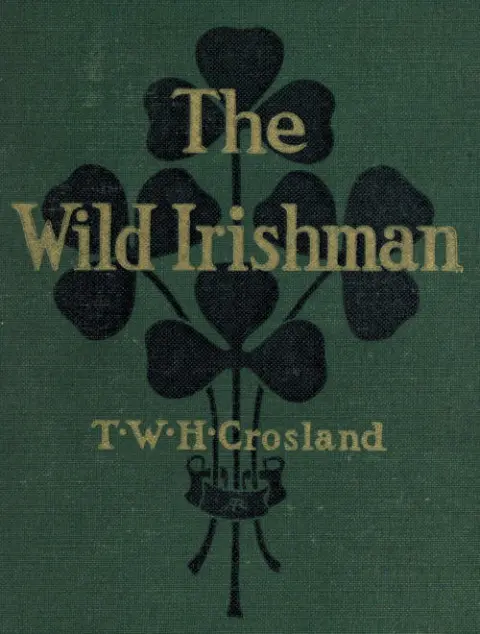
THE CLASSIC COLLECTION · 1905
"The Wild Irishman" by T. W. H. Crosland is a commentary on Irish identity and culture, written in the early 20th century. This work delves into various aspects of Irish life, weaving together social observations, critiques of political sentiments, and reflections on the Irish character and conditions. It also sheds light on the effects of emigration and the Irish experience in America, aiming to provide a perspective on Ireland's ongoing struggles and the resilience of its people. The opening of the text establishes a critical tone as it reflects on the so-called "Irish question," exploring its historical context and current relevance. Crosland discusses the contrasting perspectives of the Irish towards England and America, portraying America as a "promised land" for many Irish. He provides a detailed analysis of the social and economic distress in Ireland, emphasizing the resilience and unique culture of the Irish people amidst prevailing hardships. The preference for addressing serious cultural issues with humor and wit becomes apparent, indicating the author's broader critique of both Irish and English society while setting the stage for an exploration of Irish customs, history, and identity.
Introduction adapted from the source catalogue; source summaries may be automatically generated.
Free to read · English · 32,428 words · No account needed
MAKE TIME FOR A GOOD BOOK
On by default. Untick to stop anonymous reading totals. Each page counts after 10 seconds in view. How this works.
Anonymous counting is on unless you have switched it off.
Ireland has produced more patriots than any other country under the sun. The names of them are legion, and from Wolfe Tone down to Dr. Tanner they have all been men of reasonable parts. O’Connell, Emmet, Butt, and Parnell shine out perhaps as the greatest of them. The smaller fry do not require enumeration. But if I mistake not, while it is the fashion to flatter every Irishman who has done anything at all for Ireland with the general title of pathriot, it is only within comparatively recent times that the authentic pathriot has come into being. The fact that in England people are unkind enough to call him an agitator is of small consequence. The pathriot is singularly and peculiarly Irish. There is nothing like him in England, and there never will be anything like him; for he comes like water and like wind he goes. He begins anywhere—he may be a butcher, a publican, a schoolmaster or a farmer—he attains a seat in the House of Commons, and a certain prominence in the press, and he ends nowhere. Irish editors worship him for a season, then they wax critical of him, then they forget him altogether. Mr. Timothy Healy is a good type of the pathriot at his best. He has accomplished great things for Ireland, and achieved for himself a reputation in Parliament for a sort of savage brilliance. But there are not a dozen men in England, Ireland, Scotland or Wales to-day who care twopence where he is, or could tell you what becomes of him when Parliament is not sitting. He will end obscurely, inasmuch as it is the fate of Irish pathriots so to end. As the chief of the pathriots of the less glorious type, who however succeed in making the best of both countries, we may instance Mr. T. P. O’Connor. Mr. O’Connor is an Irishman and a Nationalist, but he has shaken the dust of Ireland from his feet, and he sits for the Scotland division of Liverpool, and has done himself rather well as a promoter of heterogeneous newspapers in London. With Mr. O’Connor, however, we shall deal fully elsewhere. Only for the sake of symmetry, do not let us forget that he is a pathriot of the finest water. The vital defect in the character of the Irish pathriot, looking at him squarely, is that in recent times at any rate he has never been a statesman. A pathriot with the proper statesmanlike qualities might, it is true, have been altogether swamped by the frothy eloquence and wild demands of the main body of pathriots. But such a one, if the Irish could only have managed to find him and keep him going, whether in the House of Commons or on English platforms, would in the long run have made a vast difference to her interests. It may be argued that Ireland did actually find a statesman in Mr. Gladstone. On the other hand it is abundantly evident that however sincere and admirable Mr. Gladstone’s proposals for the betterment of the country may have been, they were not based on anything like an exact, or for that matter even a working, knowledge of its necessities and requirements. As for Mr. Parnell, it is no disrespect to him to say of him, in full view of his amazing career, that he was not a statesman even in a small way. His aloofness, haughtiness and chilliness of temper precluded him from a really effective part or lot in the faction which he led, and ruled with a rod of iron, and, for himself, he had not sufficient spirits and imagination to carve out an independent and statesmanlike policy. Mr. Parnell made a great name and no little dust in the world, yet the verdict of history upon him will be that he was neither an O’Connell nor an Isaac Butt, and that he failed to go anything like so far as might have been expected of him. For the rest of the pathriots, the remnant, as it were, of the National party, they do not matter, and they know it. In the House of Commons they are absolutely without other than adventitious power. The English party system happened to afford them certain mechanical advantages of which they are never tired of boasting. Their sarcasms and humors and occasional displays of temper bring them from time to time a passing notoriety. But taking them as a body they are inept, irresponsible, feeble and negligible; constituting, indeed, a standing monument to the undesirable vagaries which might be looked for in the event of their being granted that much desired “little place of their own” on College Green. In fine, the Irish pathriot of our own times will not wash. He means well by his country, and well enough by himself, but he has no balance, and is entirely blind to the falsehood of extremes. It is curious to note how easily Ireland is satisfied. In pretty well all matters that concern her closely her standard of requirement is barely middling. She knows how to be grateful to the merest nonentities, and she can bestow reverence and undying fame upon persons who are little removed from mediocrity. The modern pathriot has never risen above the foot-hills; yet for Ireland he stands upon the pinnacle, and they say Hosanna to him. It is a sign of the times, however, that Erin is beginning to be alive to the fact that in the main the pathriot is just one of those persons with whom she can very well afford to dispense. Vaulting ambition hath rather overleaped itself in the matter of these gentry, and their posturings and screamings and clenchings of the fist are no longer received with altogether unanimous applause. That there is reason in all things is a simple lesson which pathriots who are not wholly careless of their future will do well to learn. Their well-worn parrot-cries of “tyranny,” “oppression,” “cowardice,” “robbery,” “murder,” and so forth are become just a trifle stale, flat, and unprofitable. Irishmen are weary of shrieks; they desire a trifle of sobriety and good sense.
Your reading position is saved on this browser. Take it to another device with a library code. Reading pages adapt to text, rather than matching a printed edition.
T. W. H. (Thomas William Hodgson) Crosland
T. W. H. (Thomas William Hodgson) Crosland
T. W. H. (Thomas William Hodgson) Crosland
BEHIND THE BOOK
This eBook is for the use of anyone anywhere in the United States and most other parts of the world at no cost and with almost no restrictions whatsoever. You may copy it, give it away or re-use it under the terms of the Project Gutenberg License included with this eBook or online at www.gutenberg.org. If you are not located in the United States, you will have to check the laws of the country where you are located before using this eBook. Read the source licence.
The original source file, including credits and licence, is retained by this library. Request an original-format copy at no charge. Please include the book title and Project Gutenberg identifier #57838.
KEEP YOUR CURIOSITY GOING

David Patterson (Spirit) Hatch

David Patterson (Spirit) Hatch

David Patterson (Spirit) Hatch
Cécile Tormay

Moritz Busch
John L. Ransom