THE CLASSIC COLLECTION✦The Egregious EnglishCLASSIC FREE BOOKS
The Egregious English
T. W. H. (Thomas William Hodgson) Crosland
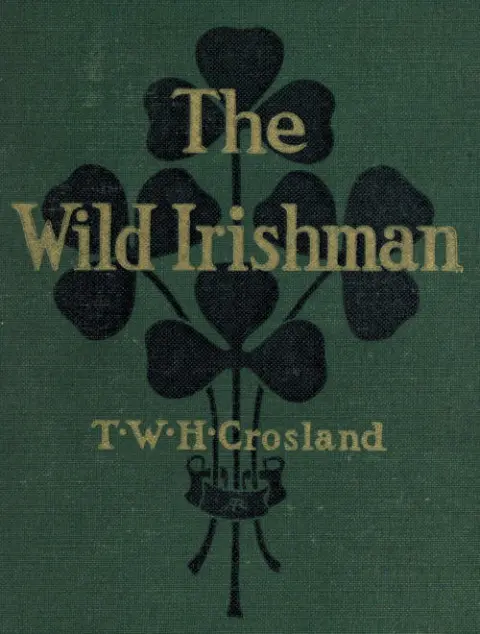
THE CLASSIC COLLECTION · 1905
"The Wild Irishman" by T. W. H. Crosland is a commentary on Irish identity and culture, written in the early 20th century. This work delves into various aspects of Irish life, weaving together social observations, critiques of political sentiments, and reflections on the Irish character and conditions. It also sheds light on the effects of emigration and the Irish experience in America, aiming to provide a perspective on Ireland's ongoing struggles and the resilience of its people. The opening of the text establishes a critical tone as it reflects on the so-called "Irish question," exploring its historical context and current relevance. Crosland discusses the contrasting perspectives of the Irish towards England and America, portraying America as a "promised land" for many Irish. He provides a detailed analysis of the social and economic distress in Ireland, emphasizing the resilience and unique culture of the Irish people amidst prevailing hardships. The preference for addressing serious cultural issues with humor and wit becomes apparent, indicating the author's broader critique of both Irish and English society while setting the stage for an exploration of Irish customs, history, and identity.
Introduction adapted from the source catalogue; source summaries may be automatically generated.
Free to read · English · 32,428 words · No account needed
MAKE TIME FOR A GOOD BOOK
On by default. Untick to stop anonymous reading totals. Each page counts after 10 seconds in view. How this works.
Anonymous counting is on unless you have switched it off.
The women of England, not to say of Scotland, have of late years lain under the reproach that they are ceasing to be possessed of the fatal gift of beauty. I am well aware that there is not a reviewer exercising his calling between Land’s End and John o’ Groats who will not profess to foam at the mouth on the strength of this statement. Yet the fact remains that ugliness is rapidly becoming the common heritage of English women and Scotch women alike. There is an old superstition, not, of course, tolerable to the minds of the smart people of to-day, that wickedness, or, not to put too fine a point upon it, ugliness of temperament is calculated gradually to induce ugliness of physique. Without going into the question of the general wickedness of Anglo-Saxon femininity, we may put it down for a scientific fact that the beauty of them is wearing away—let us hope to the land of the leal. In those remarkably æsthetic organs which sell fifty process-block portraits per week for sixpence, we are treated continually to what the editors take for types of English beauty. You pay your sixpence and you open your hot-pressed beauty-show. On the first page—that is, of course, after the advertisements—you have a speaking presentment of something with elaborate hair and an inexhaustible fund of torso which, frankly, might pass very well for a sign to a public-house called “The Bald-faced Stag.” Beneath you read in capital letters “MISS or MRS. SO AND SO—THE FAMOUS BEAUTY.” No woman in England apparently is allowed to know whether she be beautiful or not until either Mr. Keble Howard Bell or Mr. J. M. Bulloch has so labeled her; Bell and Bulloch being, of course, the only possible judges of feminine beauty England possesses. In the politest circles it is quite dangerous to praise a woman’s good looks without reference to the files of The Sketch and The Tatler. A certain nobleman, however, is understood to have earned something of a reputation for himself as connoisseur by openly avowing his contempt for both sheets, and surreptitiously swotting up the picture pages of the Daily Mirror. This, however, like the Daily Mirror, is probably neither here nor there. The solemn fact remains that the beauty of England’s fairest daughters and Scotland’s bonniest lasses alike, has become a doubtful quantity. Any person who is troubled with qualms on the subject need only visit a Court, or the Opera, or Messrs. Peter Robinson’s, or an A. B. C. shop, or a mothers’ meeting. Hard faces, bleary eyes, saw teeth, humpy shoulders, and an undignified gait, not to mention greasy complexions, scanty hair, bony hands and knock knees, are the rule and not the exception among English womankind. We have scarcely a beauty left, even at the Gaiety Theater. In fact, leaving out the ravishing pictures of the illustrated press, there are really only two beautiful women in England, and both of these are married to reviewers. Now, I say and maintain that any male person, possessed of an eye for the charms of what is commonly called the opposite sex, will find that in Ireland the decay of female beauty has not yet commenced. Whether he be in Dublin or in Cork, in Sligo or in Limerick, pretty women take his vision—as the daffodils take the winds of March—at every corner. In fine, it may be said without exaggeration that if Ireland possesses a characteristic which renders her entirely different from the countries to which, on the face of it, she displays a sort of second hand, tumble-down resemblance, it is the prettiness of her women. I take it for granted that this trait has been commented upon by other travelers; but I do not think that it has heretofore been in any sense properly impressed upon the public mind. It is generally understood among artists that Irish women have delicate hands and an eye with a sparkle about it. Irish poets, in more or less halting English verse, have done their best to indicate that Irish women are, to say the least of it, worth looking at. But I am not aware that on the whole the literature about Ireland insists, to anything like a reasonable degree, on the beauty of Irish women. If the present work were from the “exquisite” pen of Mr. Arthur Symons, our failure adequately to portray the beauty of Erin’s daughters would, no doubt, be counterbalanced by the insertion of a selection of half-tone portraits of representative specimens. As it is we are compelled to admit that words fail us, and that, even if we cared to employ them, the process-block makers would fail us also.
Your reading position is saved on this browser. Take it to another device with a library code. Reading pages adapt to text, rather than matching a printed edition.
T. W. H. (Thomas William Hodgson) Crosland
T. W. H. (Thomas William Hodgson) Crosland
T. W. H. (Thomas William Hodgson) Crosland
BEHIND THE BOOK
This eBook is for the use of anyone anywhere in the United States and most other parts of the world at no cost and with almost no restrictions whatsoever. You may copy it, give it away or re-use it under the terms of the Project Gutenberg License included with this eBook or online at www.gutenberg.org. If you are not located in the United States, you will have to check the laws of the country where you are located before using this eBook. Read the source licence.
The original source file, including credits and licence, is retained by this library. Request an original-format copy at no charge. Please include the book title and Project Gutenberg identifier #57838.
KEEP YOUR CURIOSITY GOING

David Patterson (Spirit) Hatch

David Patterson (Spirit) Hatch

David Patterson (Spirit) Hatch
Cécile Tormay

Moritz Busch
John L. Ransom