THE CLASSIC COLLECTION✦The Egregious EnglishCLASSIC FREE BOOKS
The Egregious English
T. W. H. (Thomas William Hodgson) Crosland
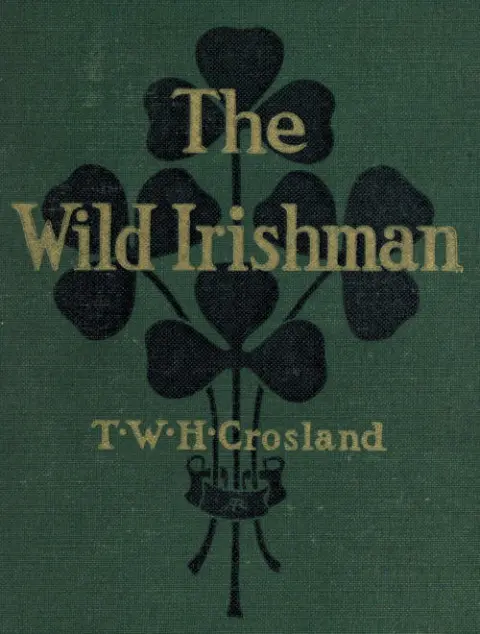
THE CLASSIC COLLECTION · 1905
"The Wild Irishman" by T. W. H. Crosland is a commentary on Irish identity and culture, written in the early 20th century. This work delves into various aspects of Irish life, weaving together social observations, critiques of political sentiments, and reflections on the Irish character and conditions. It also sheds light on the effects of emigration and the Irish experience in America, aiming to provide a perspective on Ireland's ongoing struggles and the resilience of its people. The opening of the text establishes a critical tone as it reflects on the so-called "Irish question," exploring its historical context and current relevance. Crosland discusses the contrasting perspectives of the Irish towards England and America, portraying America as a "promised land" for many Irish. He provides a detailed analysis of the social and economic distress in Ireland, emphasizing the resilience and unique culture of the Irish people amidst prevailing hardships. The preference for addressing serious cultural issues with humor and wit becomes apparent, indicating the author's broader critique of both Irish and English society while setting the stage for an exploration of Irish customs, history, and identity.
Introduction adapted from the source catalogue; source summaries may be automatically generated.
Free to read · English · 32,428 words · No account needed
MAKE TIME FOR A GOOD BOOK
On by default. Untick to stop anonymous reading totals. Each page counts after 10 seconds in view. How this works.
Anonymous counting is on unless you have switched it off.
The tourist is the curse of Ireland, as he is the curse of most places. When one comes to consider the enormous number of grievances the Irish and their political figure-heads have managed to rake up, one wonders that the tourist should hitherto have escaped. That he constitutes a grievance, and a grievance which affects seriously the main body of the Irish people, can not be doubted. It is quite obvious, to begin with, that the tourist in Ireland is usually of the hated Sassenach race. Irishmen do not tour in their own country as Englishmen do, or as Scotchmen have been known to do. They have too little money for indulgences of that kind, and if money be plentiful they prefer to visit England or America. The Englishman, however, insists on taking a holiday in Ireland sometime in his life, even though it be only on his honeymoon. So that in the more suitable months the country bristles with tourists, and the great majority of them are English. Secondly, the tourist, being English, is always more or less hilarious, supercilious and aggressive, and these are qualities of which the Irish of all people least like a display, at any rate from an Englishman. Time out of mind the English tourist has been the covert bête noire of the Continental peoples on account of these very traits. An Englishman on the Continent, especially if he be a middle-class Englishman, or a very wealthy Englishman, has a knack of divesting himself utterly of the thin veneer of social decency which he manages to maintain at home. Somehow the air of the Continent exhilarates him to all sorts of posturing and ridiculousness. The vulgarian, the Philistine and the snob in him become greatly emphasized. He can shout aloud, and be rude to everybody, because he believes that nobody understands what he is pleased to call his lingo. Besides which the Englishman on the Continent always believes in his private bosom that he is a philanthropist, a sort of circular-touring benevolence, as it were. “Who is it,” he inquires grandiloquently, “that keeps these pore foreigners going? Why, the English, and the English alone. It is we who bring millions of pounds to their starved, tax-burdened countries. It is we who populate their rapacious hotels and make their seasons for them, and drop our idiot moneys at their gambling tables, and pay francs at the entrances to their art galleries, and climb their rotten mountains, and steam, to soft Lydian airs, up their rivers, and bathe in their lukewarm seas, and tip them and patronize them, and joke with them, and generally afford them opportunities for existence.” This attitude has been noted and laughed at by the cynical, time out of mind; but it can not be eradicated from the Englishman’s fairly comprehensive stock of idiosyncrasies, and it remains to this day typical of the breed. To Ireland the English tourist proceeds focused for pretty well the same view of things. Of course, he is disposed to look upon your Irishman as being rather more of a man and a brother than is the low foreigner. Further, he invariably believes that by a judicious expenditure on “drinks,” coupled with an easy, slap-you-on-the-back but still superior manner, he can extract from the Irishmen with whom he comes in contact the whole secret of the Irish Question. In other words, he makes a point of going to Ireland with his eyes open; so that when he returns he may remark huskily in his club—“Sir, I have visited Ireland, and I know the Irish people through and through. Waiter, a large Scotch, please!” Thus is the altruism of the tourist in Ireland tempered with a taste for inquiry and politics. I suppose that in no country in the world is the tourist allowed so much of his fling as in this same green Erin. For example, in Ireland he takes care to call every man “Pat,” and every woman “Kathleen mavourneen.” If he called a Frenchman “Froggy,” or a German “Johnny Deutscher” he would stand a good chance of getting his nose pulled. But in Ireland a bold peasantry has learned to smile and smile and touch the hat, and take the coppers, and provide the political information for which his honor is gasping without so much as turning a hair. It is not really in the Irish blood to take these traveling mountebanks, with their loud suits and louder manners and louder money, seriously or even indifferently. On the other hand, your true Irish resent in their hearts the entire business. It is their poverty and not their wills which consent; though singularly enough, as I have already said, you will seldom find an Irishman indulging himself in growls about it. And it is this very poverty which might reasonably give rise to the Irishman’s third grievance against the tourist. For an Englishman traveling in Ireland is always a sort of perambulating incitement to envy, because of his apparent wealth. He may be only a clerk out for a fortnight’s “rest and change” on money squeezed out of the meagerest kind of salary; yet to the penniless Irishman he seems literally to be made of wealth. And Pat—let us call him Pat, so that the tourists of this world may know whom we mean—is not without certain reasoning powers of his own, poverty-stricken though he may be. It seems to me only human that he should reason about the English tourist in a way which brings him little comfort and throws considerable discredit on England. He perceives that compared with himself the Englishman is not altogether a person of genius or an angel of light. His ignorance is appalling, even to an Irishman; his manners are none of the choicest; his capacity for eating and drinking borders on the marvelous. “Pat” notes these things and wonders. He wonders why there should be such tremendous gulfs between loving subjects of the King. He wonders where people who travel on cheap tickets get all their money; he wonders how they manage to pay fifty pounds a rod for certain fishing; or fifty pounds a gun for certain shooting; he wonders why they cackle so about priestcraft, and Home Rule, and the development of industry; he wonders whether they have really been elected by heaven to be a dominant people; he wonders why he himself should have been given over to their governance; and with all his wondering he is not consoled. There is probably nobody to tell him that for irremediable reasons the Irish are never likely to become a happy and prosperous nation. There is nobody to tell him that this dazzling Englishman is so much gross material, with no tradition of spirituality at the back of him. There is nobody to tell him that it is the British habit to think first and foremost of its own welfare and comfort, and that it pities rather than admires those countries or persons who have been foredoomed to contribute to them. Therefore he goes on wondering without consolation, and within him there is discontent and bitterness, despite his outward subservience. There has been very tall talk in sundry well-meaning circles as to the advantages which are to accrue to Ireland from the development of her trade in tourists. No doubt it is extremely heterodox to say so, but for myself, I incline to the opinion that the tourist business on its present lines is a snare and a delusion and a demoralization. It takes money into the country certainly, but it takes other things which are not by any means so desirable. Moreover, that very money helps materially to cloud and confuse important issues. The real condition of Ireland, as it is known to Irish officialdom, and as it should be known to Englishmen, is glossed over and hidden away as a direct result of the eleemosynary tendencies of the English tourist. A people of the temper and parts of the Irish people should be in a position to live out of Irish land and Irish industry, and not be in any serious sense dependent upon the fitful generosity of sight-seers and problem-solvers. Ireland has had far too much largesse, both private and public. The English tourist distributes his shillings; the English Government distributes its loans and other financial bolsterings-up. What is wanted is a fair field and no favor for Irish labor. It will take many generations of tourists to provide for Ireland any such good gift. I do not believe that the Government loans can provide either. A newer and little less rapacious and less unintelligent race of landlords might achieve it. The bland, benevolent money-dropping Englishman, who out of his generosity or his scheme of politics desires to assist the Irish people, should buy a place in Ireland and do his best to live there. The country is full of properties which would be cheap at treble the prices that are now being asked for them. There is plenty of land and there is plenty of labor. The Land Laws, it is true, seem on the face of them ridiculous, that is to say, if you happen to be a landlord whose eye is forever on the rent-roll and the automatic improvement of properties at other people’s expense. But if, on the other hand, you are a comfortable, high Tory, patriarchal landlord, with bowels, and a proper appreciation of sport, and a proper interest in agriculture and the breeding of cattle, Ireland need have no terrors for you. There is a notion abroad that the Irish farmer has deep-rooted prejudices against landlords of whatever degree. We are told that he is a confirmed shirker of the prime duty of rent-paying, and that he will let a holding go to rack and ruin for the sole purpose of cheapening its value, so that he may himself buy it in for the merest song. The demand throughout the country, we are told, is for farmer and peasant proprietorship, and the legislature has formulated wonderful machinery in the interest of such proprietorship. My own view is that of two evils the Irish cultivators have in this matter chosen the lesser. On the one hand they had rack rents, absentee landlords and agents who, if they had bodies to be shot, appear to have had very small souls to be saved. On the other hand, they have been offered schemes of purchase that sound very well but do not work out quite so well in practise. Still a bad scheme of purchase is better than bad landlords and worse agents. An intelligent and reasonable landlord of bucolic tastes, who will look as sharply after his agent or factor as he will look after his tenants on rent-day, could in my opinion do quite as well in Ireland as he can do in England. In a sentence, Ireland wants settling, not touring.
Your reading position is saved on this browser. Take it to another device with a library code. Reading pages adapt to text, rather than matching a printed edition.
T. W. H. (Thomas William Hodgson) Crosland
T. W. H. (Thomas William Hodgson) Crosland
T. W. H. (Thomas William Hodgson) Crosland
BEHIND THE BOOK
This eBook is for the use of anyone anywhere in the United States and most other parts of the world at no cost and with almost no restrictions whatsoever. You may copy it, give it away or re-use it under the terms of the Project Gutenberg License included with this eBook or online at www.gutenberg.org. If you are not located in the United States, you will have to check the laws of the country where you are located before using this eBook. Read the source licence.
The original source file, including credits and licence, is retained by this library. Request an original-format copy at no charge. Please include the book title and Project Gutenberg identifier #57838.
KEEP YOUR CURIOSITY GOING

David Patterson (Spirit) Hatch

David Patterson (Spirit) Hatch

David Patterson (Spirit) Hatch
Cécile Tormay

Moritz Busch
John L. Ransom