THE CLASSIC COLLECTION✦The Egregious EnglishCLASSIC FREE BOOKS
The Egregious English
T. W. H. (Thomas William Hodgson) Crosland
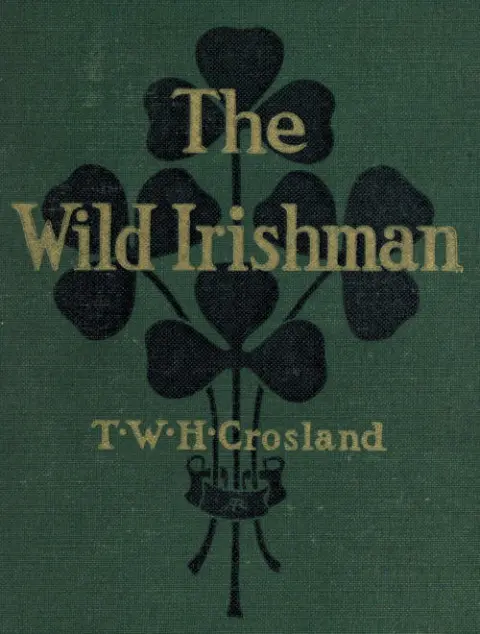
THE CLASSIC COLLECTION · 1905
"The Wild Irishman" by T. W. H. Crosland is a commentary on Irish identity and culture, written in the early 20th century. This work delves into various aspects of Irish life, weaving together social observations, critiques of political sentiments, and reflections on the Irish character and conditions. It also sheds light on the effects of emigration and the Irish experience in America, aiming to provide a perspective on Ireland's ongoing struggles and the resilience of its people. The opening of the text establishes a critical tone as it reflects on the so-called "Irish question," exploring its historical context and current relevance. Crosland discusses the contrasting perspectives of the Irish towards England and America, portraying America as a "promised land" for many Irish. He provides a detailed analysis of the social and economic distress in Ireland, emphasizing the resilience and unique culture of the Irish people amidst prevailing hardships. The preference for addressing serious cultural issues with humor and wit becomes apparent, indicating the author's broader critique of both Irish and English society while setting the stage for an exploration of Irish customs, history, and identity.
Introduction adapted from the source catalogue; source summaries may be automatically generated.
Free to read · English · 32,428 words · No account needed
MAKE TIME FOR A GOOD BOOK
On by default. Untick to stop anonymous reading totals. Each page counts after 10 seconds in view. How this works.
Anonymous counting is on unless you have switched it off.
A gentleman who is universally applauded as a handler of the pencil and a smart after-dinner speaker lately remarked that if he were compelled to give up one of two things, to wit, tobacco or Christianity, he would give up Christianity. Then, with a slack-minded man’s weakness, he went on to explain that a Christianity which prohibited tobacco would not be Christianity at all. “When all things were made,” we are told, “nothing was made better than tobacco.” Without being an anti-tobacconist, without being a non-smoker, without, indeed, being other than “a great blower of the cloud,” it is quite reasonable for one to doubt whether on the whole tobacco is the blessing that modern men hold it to be. There is no evidence to show that men’s intellects have improved since the introduction of smoking. It seems probable that the high-water mark of British brains had been reached somewhat prior to the time in which James I. had occasion to adorn polite letters with his notorious “Counterblast.” Shakespeare did not smoke. Mitcham shag was nothing to Ben Jonson, nor navy plug to Milton. It is our Barries, and our J. K. Jeromes, and our F. C. Goulds who electrify the country with their pipes in their mouths. Now, the person who is commonly credited with having introduced the art and practise of tobacco smoking into England is Sir Walter Raleigh. There is a legend that when that gentleman’s servant first saw him smoking, he rushed out for a bucket of water, in the belief that his master was on fire. By a strange coincidence, it is this same Sir Walter Raleigh who is commonly credited with having introduced the potato into Ireland. Could Sir Walter Raleigh’s servant have perceived what black and fearsome troubles the potatoes in his master’s pockets or other receptacle would one day call down upon the Irish people, it is conceivable that he might have rushed out for something even more drastic than a bucket of water. The potato, undoubtedly, is an elegant fruit. All men know that with beef, mutton, and flesh meats in general, it is everything that could be desired. As a staple article of food, however, it cannot be considered otherwise than as a flagrant and wicked mistake. In Ireland the potato has become a staple article of food. Whole generations of Irishmen have battened upon it—in good times, with the addendum of a little buttermilk or a scrap of bacon, in bad times with the addendum of a pinch of salt. And as the times in Ireland have been immemorially bad times, the pinch of salt has been most frequently to the fore. In plain words, the Irish people are a potato-fed people. In theory the potato might well have been specially created by Providence to fit in with the Irish temperament. The Irish temperament has distinct tendencies in the direction of indolence; the potato, heaven be thanked, is a tuber which does not demand too great a skill or too great an amount of labor in cultivation. You cut it up, dump it into the ground, and it grows of itself. Also it is a prolific plant, and will make more dead weight to the rood than almost anything else that grows—the which, of course, saves digging. A peasant with a potato-patch is believed to be wholly beyond the reach of hunger, and his standard of emolument may conveniently be adjusted for him accordingly. He himself is aware that it is out of his potato-patch that he and his family have got to subsist, and that all the rest is luxury of the most bloated order. Philosophers can invariably dispense with luxury, and the Irishman is a philosopher. He can afford to sit and watch his potatoes growing, as content as any king. For not only shall that green plant yield unto him and the “childer” the staff of life, but it shall also furnish for him the wherewithal for the innocent manufacture of potheen, which is life itself. It is a singular fact, though a fact big with meaning, that while the Irishman has been a potato-grower from Raleigh’s time, he has not succeeded in attracting to himself any special reputation as a cultivator in this department. Nobody sets up the Irish potato for a peculiar delicacy. Jersey, Cheshire, Lancashire, and parts of Yorkshire and Lincolnshire have secured for themselves all the glory and honor and profit which is to be got out of potato-growing. It is said, however, that the Irish can cook a potato against anybody in the world; but this is doubtful, inasmuch as the Dublin potato—and for that matter the Cork or Kilkenny or Newry potato—is neither better nor worse cooked than the common tuber of Cockaigne. This, however, is by the way. The hard fact is that all over Ireland you are brought face to face with a poverty and a desolation which are the palpable outcome of too great a reliance upon a doubtful staple. The very physique of the people bears abundant witness to the circumstance that a diet of pure potato is not good for one. It induces a ricketiness of build, a lankness and a want of tone; not to mention a confirmed hungriness of look. Quite half the people of Ireland might pass for persons who had lately been emulating the fasting man, or had just been let loose from a severe term of penal servitude. It is intolerable that it should be so, but there is no getting away from it. The Irish people are physiologically underfed. They may eat to repletion, but as even an Irish potato consists mainly of starch and water, precious little corporeal good is to be got out of it. When the body is starved, the mind dwindles and languishes. A potato-fed man can no more be witty or wise or energetic than a man fed on draff and husks. That is why the Irish have almost entirely lost the spirits and the volatility and the graces for which they were formerly renowned. If you are to make good use of an Irishman, as of any other man, you must ply him with nutriment. The potato is not nutriment in anything like a complete sense. Even that exceedingly popular work, The Encyclopædia Britannica, has no feeling for the potato where the Irish are concerned. Under the head of “Ireland” I find, among others, the following sentences: “Introduced by Raleigh in 1610, the cultivation of this dangerous tuber developed with extraordinary rapidity.” “When Petty wrote, early in Charles II.’s reign, this demoralizing esculent was already the national food.” “When the ‘precarious exotic’ failed, an awful famine was the result.” The Encyclopædia Britannica also obliges us with the appended information: “The labor of one man could plant potatoes enough to feed forty.… Potatoes cannot be kept very long, but there was no attempt to keep them at all; they were left in the ground, and dug as required. A frost which penetrated deep caused the famine of 1739. Even with the modern system of storing in pits, the potato does not last through the summer, and the ‘meal months’—June, July and August—always brought great hardship.… Between 1831 and 1842, there were six seasons of dearth, approaching in some places to famine.… In 1845 the population had swelled to 8,295,061, the greater part of whom depended on the potato only.” The greater part of the population of Ireland proper—that is to say of Ireland with Northern Diamond left out—depends upon the potato to this day. It is a state of affairs which cannot be too severely deprecated; it is a state of affairs which ought in no circumstances to be allowed to continue; it is a state of affairs which convinces one only too clearly that Ireland has for centuries been governed either by rogues or by blockheads. Yet the potato, like the tourist, does not appear hitherto to have been written down for an Irish grievance or injustice. True, The Encyclopædia Britannica condemns it as we have seen; but it does so rather by innuendo than of set purpose. I am not aware that the restriction of potato growing has ever figured as a plank in the platform of the Irish Party. Indeed, to suggest it, would have looked like infamy in the face of the condition of the people. But until the Irish are taught that the potato is not the first and last thing God made, they will remain open to the disasters and the disabilities which too great a dependence upon it have invariably brought about. It is lamentable to note the limitations of the Irish mind as to what is possible in the matter of food. With sixpence, your indigenous, starving Irishman will purchase inevitably a dish of potatoes and as much whisky as can be screwed out of the money when the potatoes have been paid for. The beer and bread and cheese, or bread and bacon of the English rustic may be reckoned a Lucullian feast in comparison, and they are at least three times more nourishing to the body, if not to the brain. And the worst of it is, that your proper potato-fed Irishman cannot forego his hereditary appetite for the “esculent” aliment of his country any more than a Scotchman can forego oatmeal and offal. In the midst of plenty an Irishman of the Irish will make for potatoes as surely as the needle makes for the north. He prefers them. To take an instance, Mr. George Bernard Shaw believes himself to be a vegetarian by free-will and out of altruism. In point of fact, vegetarianism is easy and possible for him, because he is an Irishman, and consequently comes of an ingrained, potato-feeding stock, however remote. His wit and other parts, if any, are to be accounted for by the circumstance that he has the good sense to supplement his potato-flour with pea-meal, coco-butter, and other garnishes. A few thousand tons of lentils, with pepper and salt to taste, would do Ireland more good than a new Land Act. She has had enough potato and enough Land Acts to last her for the next hundred years.
Your reading position is saved on this browser. Take it to another device with a library code. Reading pages adapt to text, rather than matching a printed edition.
T. W. H. (Thomas William Hodgson) Crosland
T. W. H. (Thomas William Hodgson) Crosland
T. W. H. (Thomas William Hodgson) Crosland
BEHIND THE BOOK
This eBook is for the use of anyone anywhere in the United States and most other parts of the world at no cost and with almost no restrictions whatsoever. You may copy it, give it away or re-use it under the terms of the Project Gutenberg License included with this eBook or online at www.gutenberg.org. If you are not located in the United States, you will have to check the laws of the country where you are located before using this eBook. Read the source licence.
The original source file, including credits and licence, is retained by this library. Request an original-format copy at no charge. Please include the book title and Project Gutenberg identifier #57838.
KEEP YOUR CURIOSITY GOING

David Patterson (Spirit) Hatch

David Patterson (Spirit) Hatch

David Patterson (Spirit) Hatch
Cécile Tormay

Moritz Busch
John L. Ransom