THE CLASSIC COLLECTION✦The Egregious EnglishCLASSIC FREE BOOKS
The Egregious English
T. W. H. (Thomas William Hodgson) Crosland
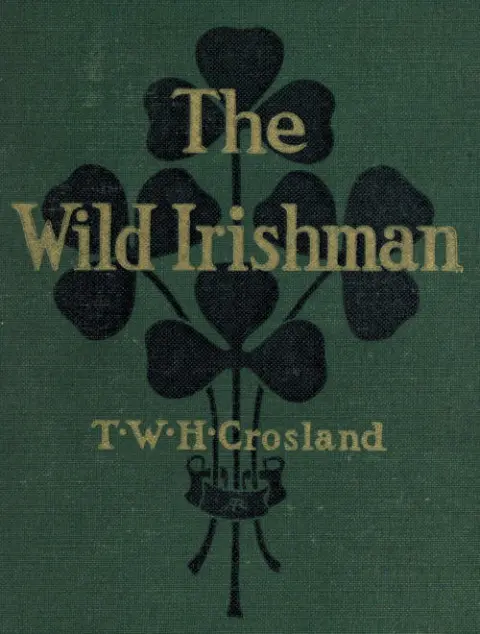
THE CLASSIC COLLECTION · 1905
"The Wild Irishman" by T. W. H. Crosland is a commentary on Irish identity and culture, written in the early 20th century. This work delves into various aspects of Irish life, weaving together social observations, critiques of political sentiments, and reflections on the Irish character and conditions. It also sheds light on the effects of emigration and the Irish experience in America, aiming to provide a perspective on Ireland's ongoing struggles and the resilience of its people. The opening of the text establishes a critical tone as it reflects on the so-called "Irish question," exploring its historical context and current relevance. Crosland discusses the contrasting perspectives of the Irish towards England and America, portraying America as a "promised land" for many Irish. He provides a detailed analysis of the social and economic distress in Ireland, emphasizing the resilience and unique culture of the Irish people amidst prevailing hardships. The preference for addressing serious cultural issues with humor and wit becomes apparent, indicating the author's broader critique of both Irish and English society while setting the stage for an exploration of Irish customs, history, and identity.
Introduction adapted from the source catalogue; source summaries may be automatically generated.
Free to read · English · 32,428 words · No account needed
MAKE TIME FOR A GOOD BOOK
On by default. Untick to stop anonymous reading totals. Each page counts after 10 seconds in view. How this works.
Anonymous counting is on unless you have switched it off.
“Did you notice no suspicious character about the neighborhood?” said a magistrate to an inexperienced policeman. “Shure, yer hanner,” replied the policeman, “I saw but one man, an’ I asked him what he was doing there at that time o’ night? Sez he, ‘I have no business here just now, but I expect to open a jewelry sthore in the vicinity later on.’ At that I sez, ‘I wish you success, sor.’” “Yes,” said the magistrate, “and he did open a jewelry store in the vicinity later on, and stole seventeen watches.” “Begorra, yer hanner,” answered the constable after a pause, “the man may have been a thafe, but he was no liar!”
“Bridget, I don’t think it is quite the thing for you to entertain company in the kitchen.” “Don’t ye worry, mum. Shure, an’ oi wouldn’t be afther deprivin’ ye o’ th’ parler.”
An old lady in Dublin, weighing about sixteen stone, engaged a car-driver to convey her to a North Wall steamer. Arrived there, she handed the driver his legal fare—sixpence. Gazing disconsolately at the coin in his hand, and then at the fat old lady, he exclaimed as he turned away—“I’ll lave ye to the Almoighty, ma’am!”
“Prisoner,” demanded a magistrate of a man charged with begging, “have you any visible means of support?” “Yes, yer honor,” replied the prisoner, and then turning to his wife who was in court, he said, “Bridget, stand up, so that the coort can see yez!”
Now it is plain that we have here a fairly representative selection of the kind of wit and humor that is supposed to come to us out of Ireland. Some of it no doubt is reasonably good, some of it is quite mild. Possibly it is amusing, and calculated to tickle old-fashioned people. Yet one has distinct qualms about it when one considers it as a means for provoking the laughter of the twentieth-century person. The fact is that humor has been made so much of a cult in the modern mind that it has to be very humorous indeed, not to say a trifle subtle, if it is to raise a smile. And in considering the examples quoted, we are faced with a further difficulty. Are these anecdotes of unquestionable Irish extraction? I am afraid not. Their authenticity is impeachable. Mutatis mutandis, they have been told of Cockneys and Yorkshire men, and Somersetshire men, and even of Scotchmen. Furthermore, there is nothing in them that can be considered peculiarly and exclusively Irish, or indicative of the Irish temperament and character as it exists to-day. Your modern Irishman, as I have pointed out, is a dreary and melancholy wight. Laughter and sprightliness have died out of him, and whether in thought or word he is about as dull and plantigrade as even a sad man can well be. The eminent people who stand for Ireland in this country are all of them afflicted with a similar lack of cheerfulness. Rouse them, and they can be as bitter and vituperative and aboriginal as any Scotchman of them all; but their ordinary habit is sad, uncertain, and inept, and they do not know how to laugh. Here and there one of them at the Bar, or in the House of Commons, or at a greasy journalistic banquet, does his feeble best to keep up the Irish tradition for smartness and wittiness of remark. But the attempt is invariably a failure, because at the back of it there is no real brain and no real flow of spirits. One of the biggest bullies at the Bar is a beefy Irishman who esteems himself a great humorist. I have heard him fire off twenty or thirty idiotic jokes in the course of half an hour or so, and always does he snigger at the beginning of his precious gibe; always does he snigger in the middle; always does he make pretense of becoming apoplectic with chortle at the end. The circumstance that people laugh at him and not with him, does not appear to occur to his small, if legal, mind. His dearest friends call him “the sniggerer,” and it is said that he is in the habit of retiring to his chambers of afternoons for the purpose of having a protracted fit of giggling. Primed with four or five glasses of cheap port, his capacity for low comedy becomes so evident that one trembles lest some enterprising theatrical manager should offer him the Leno-Welch part in next year’s “Little Goody Two-shoes.” Another “witty” Irishman, who shall be nameless, came to these shores with a fair array of good gifts at his disposal. Knowing himself for an Irishman, and having faith in the Irish tradition, he forthwith set up in business as a posturing clown and professional grinner through horse-collars, with the result that his genius is altogether obscured. Irishmen of all degrees will do better if they endeavor to remember that they have really no sense of humor left. The only one of them who has made anything like a satisfactory reputation in London, Mr. W. B. Yeats to wit, has helped himself to it by being as devoid of humor as a bone-yard. Mr. Yeats has never been known publicly to try his hand at the very smallest joke. The sobriety of the hearse is his, and much good sense also. For the eminent Irish, as we know them among us, are by nature neither witty nor humorous; and those who try to be so, succeed in being only fatuous and vulgar. Somebody has said cuttingly that a Frenchman consists of equal parts of tiger and monkey. Of certain of the eminent Irish in London it may be said that they are half jackal and half performing dog; for they are at once hungry and fantastic.
Your reading position is saved on this browser. Take it to another device with a library code. Reading pages adapt to text, rather than matching a printed edition.
T. W. H. (Thomas William Hodgson) Crosland
T. W. H. (Thomas William Hodgson) Crosland
T. W. H. (Thomas William Hodgson) Crosland
BEHIND THE BOOK
This eBook is for the use of anyone anywhere in the United States and most other parts of the world at no cost and with almost no restrictions whatsoever. You may copy it, give it away or re-use it under the terms of the Project Gutenberg License included with this eBook or online at www.gutenberg.org. If you are not located in the United States, you will have to check the laws of the country where you are located before using this eBook. Read the source licence.
The original source file, including credits and licence, is retained by this library. Request an original-format copy at no charge. Please include the book title and Project Gutenberg identifier #57838.
KEEP YOUR CURIOSITY GOING

David Patterson (Spirit) Hatch

David Patterson (Spirit) Hatch

David Patterson (Spirit) Hatch
Cécile Tormay

Moritz Busch
John L. Ransom