
The Yoke of the Thorah
Henry Harland
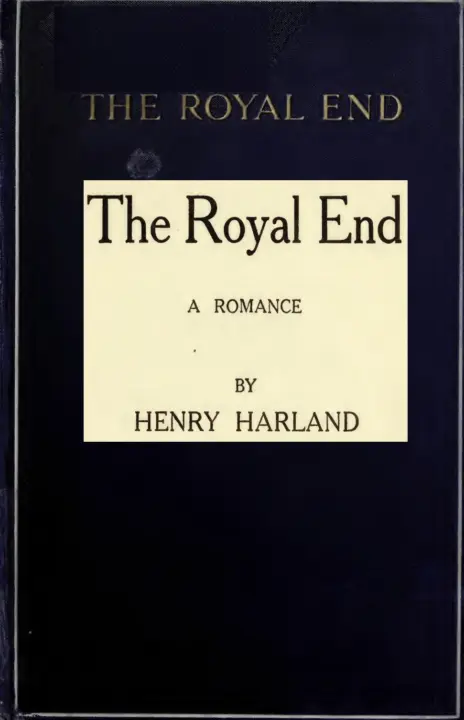
THE CLASSIC COLLECTION · 1909
"The Royal End: A Romance" by Henry Harland is a novel written in the early 20th century. The story is set in Venice and follows the intricate lives of its main characters, specifically Lucilla Dor and her companion Ruth Adgate, as they encounter a charming man named Bertram and navigate romantic entanglements amid social expectations. As Balzatore, the dog, flits through scenes of flirtation and adventure, themes of admiration, social status, and identity come to the forefront, evoking the challenges of love against a backdrop of societal intrigue. At the start of the novel, the setting is established as Lucilla and Ruth dine at a hotel in Venice, where they unknowingly attract the attention of Bertram and his canine companion, Balzatore. This signals the beginning of a romantic entanglement fueled by misunderstandings and societal norms. As the characters interact against the enchanting backdrop of the city, the narrative delves into their personalities, exploring Lucilla's flirtatiousness and Ruth's contrasting reserve. Their evening takes a turn when they find themselves stranded on the Lido, ultimately leading to Bertram's gallant intervention. The opening sets a tone rich with fascination and sharp social commentary as the characters' complexities begin to intertwine.
Introduction adapted from the source catalogue; source summaries may be automatically generated.
Free to read · English · 55,898 words · No account needed
MAKE TIME FOR A GOOD BOOK
On by default. Untick to stop anonymous reading totals. Each page counts after 10 seconds in view. How this works.
Anonymous counting is on unless you have switched it off.
The varied, finished, complex Tuscan landscape passed all leisurely before their eyes; the olive groves, the orange-pink willows; the white streams romping under grey arches; the villages, the mediaeval cytties, scattered by the way, the rose-coloured or white monasteries and villas on the sun-decked hillsides. From the little old churches and campaniles of the plain, from the convents perched far above them, innumerable silvery peals of chimes came floating, in tune, out of tune, it mattered not. As a matter of fact, they were shockingly out of tune; the quality of the Tuscan air is, however, so extraordinary an embellisher of sound as well as of scene, that all sounds become harmonious, even as every scene arranges itself into a primitive picture, thanks to this most beautifying of mediums.
“How can I leave it, how can I leave it?” Ruth was saying to herself.
“You know, I think I'm a goose,” she let fall at last, smiling at Pontycroft through her tears.
“My sweet child,” said Pontycroft, “we must aye live and learn! And you're so young that living and learning may still be supposed to hold elements of interest. There's a lot ahead of you that's new and strange, so dry your pretty eyes, and Sursum Corda.”
“My soul misgives me that the new and strange will contain nothing approaching to this,” Ruth said, nodding her head towards the window. “And I don't think I shall like doing without it,” she added plaintively.
“God's country,” said Pontycroft, “won't look like this, to be sure, nor give you a single blessed one of these fine emotions, these raptures. But after all, it's the first wrench that costs, says the prophet, and since we're not here entirely, he assures us, to amuse ourselves, a visit to God's country may prove a salutary if bitter pill to a young lady surfeited with the sweets of Europe.”
“Dio mio,” Ruth cried, “since when has Pontycroft turned moralist?”
“From the hour he was made to realise the fatal effects of reckless paradox,” Ponty answered, with mock solemnity.
They fell to chaffing one another as naturally as possible and the time
flew.
“Genoa la Suferba, Genoa la Suferba! How perfectly, how radiantly the word describes her fits her,” murmured Ruth when, after a succession of tunnels, in the early afternoon, the sumptuous town burst upon them. The dazzling town, her flashing panoply of palaces, villas, gardens, churches, mounting up, and up--her hill, leaning firmly against the background of blue skies, blue as the Virgin Mary's robe.
Your reading position is saved on this browser. Take it to another device with a library code. Reading pages adapt to text, rather than matching a printed edition.
Henry Harland

Henry Harland

Henry Harland

Henry Harland
BEHIND THE BOOK
This eBook is for the use of anyone anywhere in the United States and most other parts of the world at no cost and with almost no restrictions whatsoever. You may copy it, give it away or re-use it under the terms of the Project Gutenberg License included with this eBook or online at www.gutenberg.org. If you are not located in the United States, you will have to check the laws of the country where you are located before using this eBook. Read the source licence.
The original source file, including credits and licence, is retained by this library. Request an original-format copy at no charge. Please include the book title and Project Gutenberg identifier #51980.
KEEP YOUR CURIOSITY GOING
Coulson Kernahan

Maurice Baring
Frances Wright
Cécile Tormay

Frederic Jesup Stimson

W. H. P. (William Henry Pope) Jarvis