
The Yoke of the Thorah
Henry Harland
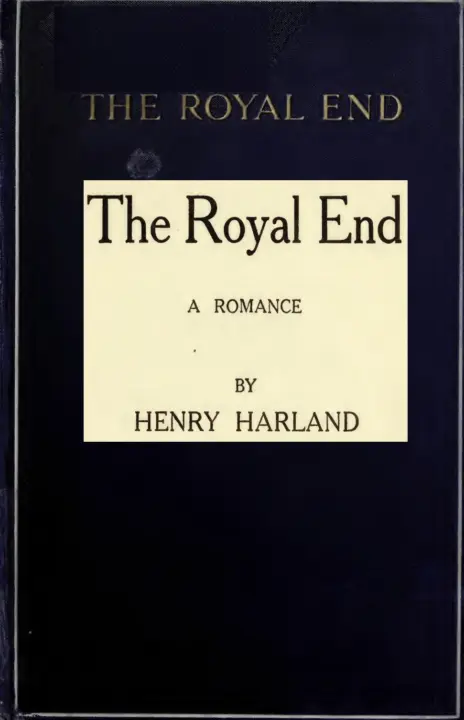
THE CLASSIC COLLECTION · 1909
"The Royal End: A Romance" by Henry Harland is a novel written in the early 20th century. The story is set in Venice and follows the intricate lives of its main characters, specifically Lucilla Dor and her companion Ruth Adgate, as they encounter a charming man named Bertram and navigate romantic entanglements amid social expectations. As Balzatore, the dog, flits through scenes of flirtation and adventure, themes of admiration, social status, and identity come to the forefront, evoking the challenges of love against a backdrop of societal intrigue. At the start of the novel, the setting is established as Lucilla and Ruth dine at a hotel in Venice, where they unknowingly attract the attention of Bertram and his canine companion, Balzatore. This signals the beginning of a romantic entanglement fueled by misunderstandings and societal norms. As the characters interact against the enchanting backdrop of the city, the narrative delves into their personalities, exploring Lucilla's flirtatiousness and Ruth's contrasting reserve. Their evening takes a turn when they find themselves stranded on the Lido, ultimately leading to Bertram's gallant intervention. The opening sets a tone rich with fascination and sharp social commentary as the characters' complexities begin to intertwine.
Introduction adapted from the source catalogue; source summaries may be automatically generated.
Free to read · English · 55,898 words · No account needed
MAKE TIME FOR A GOOD BOOK
On by default. Untick to stop anonymous reading totals. Each page counts after 10 seconds in view. How this works.
Anonymous counting is on unless you have switched it off.
“You mustn't mind my interrupting,” he said, as he came up. “It's really in your own interest. It's bad for your little brain to let it think so hard, and it will do you good to tell me what it was thinking so hard about.”
Slowly, calmly, Ruth raised her eyes to his. “My little brain was thinking about Prince Charming,” she apprised him, in a voice that sounded grave.
Pontycroft's wrinkled brow contracted.
“Prince Charming----?”
“The young Astyanax, the hope of--Altronde,” she explained. “Your friend, Bertrando Bertrandoni. I was meditating his manifold perfections.”
Pontycroft shook his head. “I miss the point of your irony,” he
remarked.
“Irony?” protested she, with spirit. “When was I ever ironical? He's perfectly delightful--so unassuming and unspoiled; and so romantic, like a king in exile. And with such a nice thin figure, and such large sagacious eyes. And he speaks such chaste and classic English, and is so quick to take a joke. If I weren't restrained by a sense of what's becoming to me as a single woman, I should make desperate love to him.”
Pontycroft shook his head again. “I still miss the point,” he said.
“I express myself blunderingly, I know,” said Ruth. “You see, it's somewhat embarrassing for a girl to have to avow such sentiments. But really and truly and honestly, and all jesting apart, I think he's an extremely nice young man, quite the nicest that I've met for a long, long while.”
“You sang a different song yesterday,” said Pontycroft, bewilderment and suspicion mingled in his gaze.
“La nuit porte conseil,” Ruth reminded him. “I've had leisure in which to revise my impressions. He's a fellow who can talk, a fellow who's curious about things. I hope we shall see a great deal of him.” She lifted up her oleander, pressed it to her face, and took a deep inhalation. “Bless its red fragrant heart,” she said.
“I never can tell when you are sincere,” Ponty hopelessly complained.
“I'm always sincere--but seldom serious,” Ruth replied. “What's the good of being serious? Isn't levity the soul of wit? Come, come! Life's grim enough, in all conscience, without making it worse by being serious.”
“I give you up,” said Ponty. “You're in one of your mystifying moods, and your long-suffering friends must wait until it passes.” Then nodding towards the open letter in her lap, “Whom's your letter from?” he asked.
“I don't know,” said Ruth, smiling with what seemed to him artificial
brightness.
“Don't know? Haven't you read it?” he demanded.
Your reading position is saved on this browser. Take it to another device with a library code. Reading pages adapt to text, rather than matching a printed edition.
Henry Harland

Henry Harland

Henry Harland

Henry Harland
BEHIND THE BOOK
This eBook is for the use of anyone anywhere in the United States and most other parts of the world at no cost and with almost no restrictions whatsoever. You may copy it, give it away or re-use it under the terms of the Project Gutenberg License included with this eBook or online at www.gutenberg.org. If you are not located in the United States, you will have to check the laws of the country where you are located before using this eBook. Read the source licence.
The original source file, including credits and licence, is retained by this library. Request an original-format copy at no charge. Please include the book title and Project Gutenberg identifier #51980.
KEEP YOUR CURIOSITY GOING
Coulson Kernahan

Maurice Baring
Frances Wright
Cécile Tormay

Frederic Jesup Stimson

W. H. P. (William Henry Pope) Jarvis