
The Yoke of the Thorah
Henry Harland
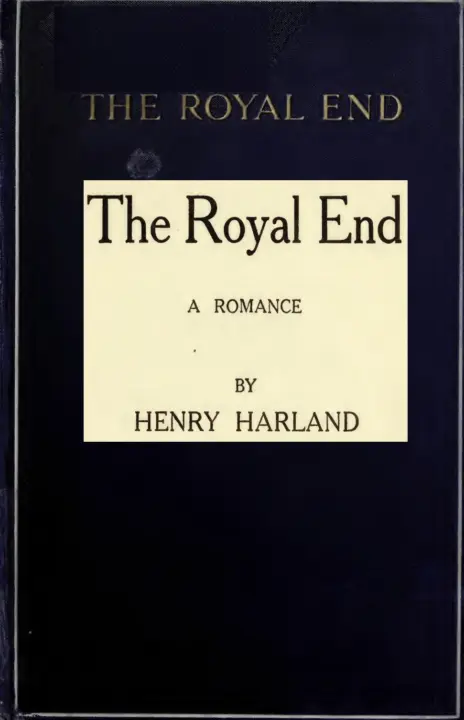
THE CLASSIC COLLECTION · 1909
"The Royal End: A Romance" by Henry Harland is a novel written in the early 20th century. The story is set in Venice and follows the intricate lives of its main characters, specifically Lucilla Dor and her companion Ruth Adgate, as they encounter a charming man named Bertram and navigate romantic entanglements amid social expectations. As Balzatore, the dog, flits through scenes of flirtation and adventure, themes of admiration, social status, and identity come to the forefront, evoking the challenges of love against a backdrop of societal intrigue. At the start of the novel, the setting is established as Lucilla and Ruth dine at a hotel in Venice, where they unknowingly attract the attention of Bertram and his canine companion, Balzatore. This signals the beginning of a romantic entanglement fueled by misunderstandings and societal norms. As the characters interact against the enchanting backdrop of the city, the narrative delves into their personalities, exploring Lucilla's flirtatiousness and Ruth's contrasting reserve. Their evening takes a turn when they find themselves stranded on the Lido, ultimately leading to Bertram's gallant intervention. The opening sets a tone rich with fascination and sharp social commentary as the characters' complexities begin to intertwine.
Introduction adapted from the source catalogue; source summaries may be automatically generated.
Free to read · English · 55,898 words · No account needed
MAKE TIME FOR A GOOD BOOK
On by default. Untick to stop anonymous reading totals. Each page counts after 10 seconds in view. How this works.
Anonymous counting is on unless you have switched it off.
“Pooh!” said Pontycroft, blowing the subject from him in a whiff of smoke. “He's a baseless fabrication. He's a herring you've just invented to draw across the trail of my inquiries. But even if he were authentic, he wouldn't matter, since he's well-advised enough not to sue for your hand. Have you ever heard of a man called Bertrando Bertrandoni?”
“Bertrando Bertrandoni--Phoebus! what a name!” laughed Ruth.
“Yes,” assented Pontycroft, “it's a trifle cumbrous, also perhaps a trifle flamboyant. So his English friends (he was educated in England, and you'd never know he wasn't English) have docked it to simple Bertram. Have you ever heard of him?”
“I don't think so,” said Ruth, shaking her head.
“And yet he's a pretty well-known man,” said Pontycroft. “He writes--every now and then you'll see an article of his in one of the reviews. He paints, too--you'll see his pictures at the Salon; and plays the fiddle, and sings. A jack-of-many-trades, but, by exception, really rather a dab at 'em all. A sportsman besides--goes in for yachtin', huntin', fencin'. But over and above all that, a thorough good sort and a most amusing companion--a fellow who can talk, a fellow who's curious about things. Finally, a Serene and Semi-Royal Highness.”
“Oh?” questioned Ruth, wondering.
“Ah,” said Pontycroft, “you prick up your pretty ears. Yes, a Serene and Semi-Royal Highness. Has it ever struck you how chuckle-headed--saving their respect--our ancestors were? I suppose they drank the wrong sort of tea. Anyhow, they were mistaken about nearly everything, and most of their mistakes they elevated to the dignity of maxims. Now, for example, they had a maxim about Silence being golden, and another about Curiosity being a vice. It's pitiful to think of the enormous number of more or less tedious anecdotes they laboriously imagined to illustrate and enforce those two profound untruths. Silence golden? My dear, silence is simply piggish. Your silent man is simply a monstrous Egotist, who, in what should be the reciprocal game of conversation, takes without giving--allows himself to be entertained, perhaps enriched, at his interlocuter's expense, and is too soddenly self-complacent to feel that he owes anything in return. Oh, I know, you'll plead shyness for him--you'll tell me he doesn't speak because he's shy. In a certain number of cases, I grant, that is the fact. But what then? Why, shyness is Egotism multiplied by itself. Your shy person is a person so sublimely (or infernally) conscious of his own existence and his own importance, so penetrated by the conviction that he is the centre of the Universe and that all eyes are fixed upon him, and therewith so concerned about the effect he may produce, the figure he may cut, that he dare not move lest he shouldn't produce an heroic effect or cut an Olympian figure. And then, curiosity! A vice? Look here. You are born, with eyes, ears, and a brain, into a world that God created. You have eyes, ears, and a brain, and all round you is a world that God created--and yet you are not curious about it. A world that God created, and that man, your duplicate man, lives in; a world in which everything counts, small things as well as big things--the farthest planet and the trifling-est affair of your next-door neighbour, the course of Empire and the price of figs. But no--God's world, man's life--they leave you cold, they fail to interest you; you glance indifferently at them, they hardly seem worth your serious attention, you shrug and turn away. 'Tis a world that God created, and you treat it as if it were a child's mud-pie! Good heavens! And the worst of it is that the people who do that are mightily proud of themselves in their smug fashion. Curiosity is a vice and a weakness; they are above it. My sweet child, no single good thing has ever happened to mankind, no single forward step has ever been taken in what they call human progress, but it has been primarily due to some one's 'curiosity.'” He brought the word out with a flourish, making it big. Then he lay back, and puffed hard at his cigarette.
Your reading position is saved on this browser. Take it to another device with a library code. Reading pages adapt to text, rather than matching a printed edition.
Henry Harland

Henry Harland

Henry Harland

Henry Harland
BEHIND THE BOOK
This eBook is for the use of anyone anywhere in the United States and most other parts of the world at no cost and with almost no restrictions whatsoever. You may copy it, give it away or re-use it under the terms of the Project Gutenberg License included with this eBook or online at www.gutenberg.org. If you are not located in the United States, you will have to check the laws of the country where you are located before using this eBook. Read the source licence.
The original source file, including credits and licence, is retained by this library. Request an original-format copy at no charge. Please include the book title and Project Gutenberg identifier #51980.
KEEP YOUR CURIOSITY GOING
Coulson Kernahan

Maurice Baring
Frances Wright
Cécile Tormay

Frederic Jesup Stimson

W. H. P. (William Henry Pope) Jarvis