
The Yoke of the Thorah
Henry Harland
THE CLASSIC COLLECTION · 1909
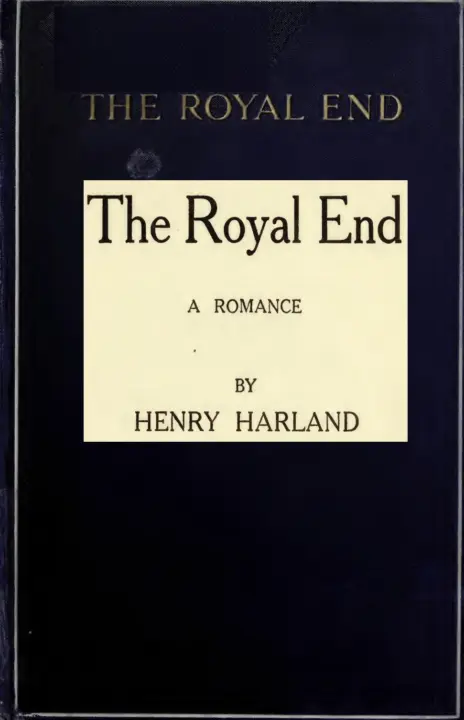
"The Royal End: A Romance" by Henry Harland is a novel written in the early 20th century. The story is set in Venice and follows the intricate lives of its main characters, specifically Lucilla Dor and her companion Ruth Adgate, as they encounter a charming man named Bertram and navigate romantic entanglements amid social expectations. As Balzatore, the dog, flits through scenes of flirtation and adventure, themes of admiration, social status, and identity come to the forefront, evoking the challenges of love against a backdrop of societal intrigue. At the start of the novel, the setting is established as Lucilla and Ruth dine at a hotel in Venice, where they unknowingly attract the attention of Bertram and his canine companion, Balzatore. This signals the beginning of a romantic entanglement fueled by misunderstandings and societal norms. As the characters interact against the enchanting backdrop of the city, the narrative delves into their personalities, exploring Lucilla's flirtatiousness and Ruth's contrasting reserve. Their evening takes a turn when they find themselves stranded on the Lido, ultimately leading to Bertram's gallant intervention. The opening sets a tone rich with fascination and sharp social commentary as the characters' complexities begin to intertwine.
Introduction adapted from the source catalogue; source summaries may be automatically generated.
Free to read · English · 55,898 words · No account needed
MAKE TIME FOR A GOOD BOOK
On by default. Untick to stop anonymous reading totals. Each page counts after 10 seconds in view. How this works.
Anonymous counting is on unless you have switched it off.
“Hum,” said Vincent. “Of course,” he added after a minute, as a sort of envoi to his tale, “rumour has it that Pontycroft and the heiress are by way of making a match. Well, why not? It would be inhuman to let her pass out of the family. Heigh? and the girl is really very pretty. Yes, I expect before a great while we'll read in the Morning Post that a marriage has been arranged.”
“Hum,” said Bertram.
And then the next afternoon he saw them still again, and learned still more about them. Mrs. Wilberton, the brisk, well-dressed, elderly-handsome, amiably-worldly wife of the Bishop of Lanchester, was having tea with him on his balcony, when all at once she leaned forward, waved her hand, and bestowed her most radiant smile, her most gracious bow, upon the occupants of a passing gondola. Afterwards, turning to Bertram, her finely-modelled, fresh-complexioned face, under its pompadour of grey hair, charged with mystery and significance. “Do you know those women?” she asked.
Well, strictly speaking, he didn't know them; and his visitor's countenance was a promise as well as a provocative to curiosity; so I hope he was justified in answering, “Who are they?”
The mystery and significance in Mrs. Wilberton's face had deepened to solemnity, to solemnity touched with severity. She sank back a little in her red-and-white cane armchair and slowly, solemnly shook her head. “Ah, it's a sad scandal,” she said, making her voice low and impressive.
But this was leagues removed from anything that Bertram had bargained for. “A scandal?” he repeated, looking blank.
Mrs. Wilberton fixed him with solemn eyes.
“Have you ever heard,” she asked, “of a man, one of our great landowners, the head of one of our oldest families, a very rich man, a man named Henry Pontycroft?”
Bertram smiled, though there was anxiety in his smile, though there was suspense. “I know Henry Pontycroft very well,” he answered.
“Do you?” said she. “Well, the elder of those two women was Henry Pontycroft's sister, Lucilla Dor.”
Her voice died away and she gazed at her listener in silence, meaningly, as if this announcement in itself contained material for pause and rumination.
But Bertram was anxious, was in suspense. “Yes?” he said, his eyes, attentive and expectant, urging her to continue.
“But it's the other,” she presently did continue, “it's the young woman with her. Of course one has read of such things in the papers--one knows that they are done--but when they happen under one's own eyes, in one's own set! And she a Pontycroft! The other, the young woman with Lucilla Dor,--oh, it's quite too disgraceful.”
Your reading position is saved on this browser. Take it to another device with a library code. Reading pages adapt to text, rather than matching a printed edition.
Henry Harland

Henry Harland

Henry Harland

Henry Harland
BEHIND THE BOOK
This eBook is for the use of anyone anywhere in the United States and most other parts of the world at no cost and with almost no restrictions whatsoever. You may copy it, give it away or re-use it under the terms of the Project Gutenberg License included with this eBook or online at www.gutenberg.org. If you are not located in the United States, you will have to check the laws of the country where you are located before using this eBook. Read the source licence.
The original source file, including credits and licence, is retained by this library. Request an original-format copy at no charge. Please include the book title and Project Gutenberg identifier #51980.
KEEP YOUR CURIOSITY GOING
Coulson Kernahan

Maurice Baring
Frances Wright
Cécile Tormay

Frederic Jesup Stimson

W. H. P. (William Henry Pope) Jarvis