
Love Letters of a Violinist, and Other Poems
Eric Mackay
THE CLASSIC COLLECTION · 1795
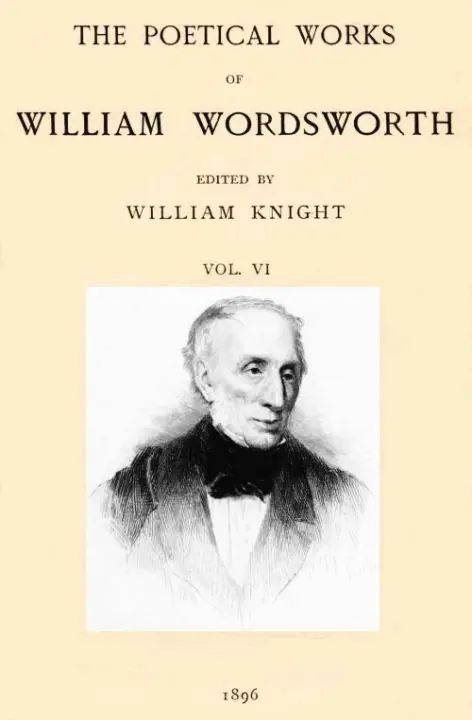
"The Poetical Works of William Wordsworth — Volume 6 (of 8)" by William Wordsworth is a collection of poetry published in the late 19th century. This volume contains a selection of Wordsworth's works from the years 1814 to 1820, showcasing his thematic focus on nature, human emotion, and the profound connection between the two. Readers can expect to find insightful reflections on personal and national identities, drawing on historical figures and settings, illustrated through the poet’s unique lens of Romanticism. The opening of this collection introduces several poems, starting with "Laodamia," which explores themes of love, loss, and the transcendent nature of human emotion through the story of a faithful wife yearning for her slain husband. Wordsworth’s mastery of language is evident as he blends mythological elements with deep emotional resonance, setting a reflective tone that permeates the selection. Additionally, the beginnings of poems such as "The Brownie's Cell" and "Yarrow Visited" highlight Wordsworth's interest in Scottish landscapes and folklore, drawing the reader into a vibrant tapestry of the natural world, as well as his reflections on heritage and history. Through these verses, Wordsworth invites readers into his intimate thoughts and contemplations, setting the foundation for a deeply enriching literary experience.
Introduction adapted from the source catalogue; source summaries may be automatically generated.
Free to read · English · 117,891 words · No account needed
MAKE TIME FOR A GOOD BOOK
On by default. Untick to stop anonymous reading totals. Each page counts after 10 seconds in view. How this works.
Anonymous counting is on unless you have switched it off.
Medea's spells dispersed the weight of years.
The story is found in Ovid, Metamorphoses, vii. 159-293.
Elysian beauty, melancholy grace,
Brought from a pensive though a happy place.
This is a perfect rendering of the tone of the Sixth Æneid.
Spake of heroic arts in graver mood
Revived, with finer harmony pursued.
Quae gratia currum
Armorumque fuit vivis, quae cura nitentes
Pascere equos, eadem sequitur tellure repostos.
Æneid vi. 653.
The charm of chariot and armour that they had in life, and the same care to pasture their glossy steeds, follow them deep buried under earth.
An ampler ether, a diviner air.
Largior hic campos aether et lumine vestit
Purpureo, solemque suum, sua sidera norunt.
Here an 'ampler ether' spreads around the plains, and clothes them in purple light, and they recognise a sun of their own, their own constellations.--Æneid vi. 640.
Yet bitter, oft-times bitter, was the pang.
Cf. Agamemnon's words, Iphigeneia in Aulide, 451-468.
My new-planned cities, and unfinished towers.
Cf. Homer, Iliad, ii. 700.
τοῦ δὲ καὶ ἀμφιδρυφὴς ἄλοχος Φυλάκῃ ἐλέλειπτο καὶ δόμος ἡμιτελής.
But his wife too had been left at Phylace, her cheeks all marred with grief, and his palace half-finished.
In soul I swept the indignity away.
καὶ γὰρ οὐδέ τοί τι λίαν ἐμὲ φιλοψυχεῖν χρεών.
For neither of a surety ought I to cling to life too
fondly.--Iphigeneia in Aulide, 1385.
It is from the character of Iphigeneia that Wordsworth derives these
traits.
By the just Gods whom no weak pity moved.
We think of Virgil's tender line in the similar passage about Orpheus and Eurydice. Georg. iv. 488.
Quum subita incautum dementia cepit amantem, Ignoscenda quidem, scirent si ignoscere Manes.
Pardonable indeed, were pardon known in the world of death.
Was doomed to wear out her appointed time.
Virg. Æn. vi. 445--
His Phaedram Procrimque locis maestamque Eriphylen
Crudelis nati monstrantem volnera cernit,
Evadnenque et Pasiphaën:
His Laodamia
It comes.
Those who died of love dwelt in the 'Lugentes Campi,' in the outer
regions of Orcus.
A knot of spiry trees ...
The passage in Pliny is--
Sunt hodie ex adverso Iliensium urbis juxta Hellespontum in Protesilai sepulcro arbores, quae omnibus aevis cum in tantum accrevere ut Ilium aspiciant, inarescunt rursusque adolescunt.--Hist. Nat. 16, 44 (88).
Opposite to Ilium and close to the Hellespont there are to this day trees growing on Protesilaus' tomb, which, in every generation, as soon as they have grown high enough to see Ilium, wither away and again shoot up.
Cf. Anthologia Graeca Pal. vii. 141.
σᾶμα δέ τοι πτελέῃσι συηρεφὲς ἀμφικομεῦσι Νύμφαι ἀπεχθομένης Ἰλίου ἀντιπέρας, δένδρεα δυσμήνιτα, καὶ ἤν ποτε τεῖχος ἴδωσι Τρώϊον αὐαλέην φυλλοχοεῦντι κόμην.
But right opposite hated Ilium the nymphs shroud thy tomb with a roof of elms; trees blighting with a lasting wrath, and if ever they see the walls of Troy, they shed their withering leaves.
And again, vii. 385--
καρφοῦται πετάλων κόσμον ἀναινόμενα.
They wither, disowning the glory of leaves.
Your reading position is saved on this browser. Take it to another device with a library code. Reading pages adapt to text, rather than matching a printed edition.
BEHIND THE BOOK
This eBook is for the use of anyone anywhere in the United States and most other parts of the world at no cost and with almost no restrictions whatsoever. You may copy it, give it away or re-use it under the terms of the Project Gutenberg License included with this eBook or online at www.gutenberg.org. If you are not located in the United States, you will have to check the laws of the country where you are located before using this eBook. Read the source licence.
The original source file, including credits and licence, is retained by this library. Request an original-format copy at no charge. Please include the book title and Project Gutenberg identifier #47651.
KEEP YOUR CURIOSITY GOING
Eric Mackay
Edmund Gosse
Sophia Margaretta Hensley
Gilbert Parker
George MacDonald

Elizabeth Bibesco