
Love Letters of a Violinist, and Other Poems
Eric Mackay
THE CLASSIC COLLECTION · 1795
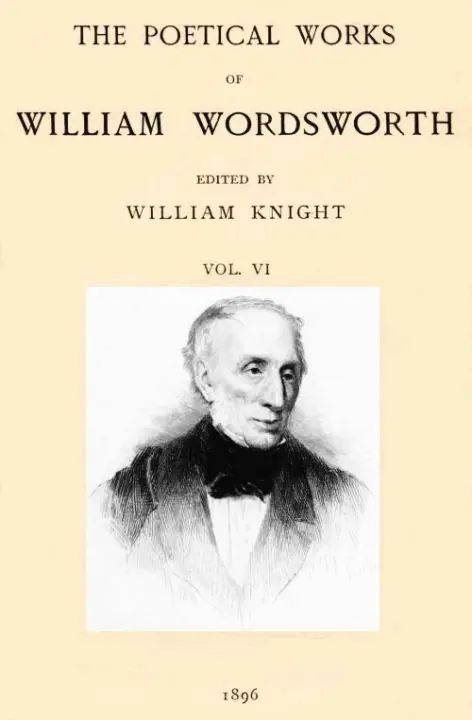
"The Poetical Works of William Wordsworth — Volume 6 (of 8)" by William Wordsworth is a collection of poetry published in the late 19th century. This volume contains a selection of Wordsworth's works from the years 1814 to 1820, showcasing his thematic focus on nature, human emotion, and the profound connection between the two. Readers can expect to find insightful reflections on personal and national identities, drawing on historical figures and settings, illustrated through the poet’s unique lens of Romanticism. The opening of this collection introduces several poems, starting with "Laodamia," which explores themes of love, loss, and the transcendent nature of human emotion through the story of a faithful wife yearning for her slain husband. Wordsworth’s mastery of language is evident as he blends mythological elements with deep emotional resonance, setting a reflective tone that permeates the selection. Additionally, the beginnings of poems such as "The Brownie's Cell" and "Yarrow Visited" highlight Wordsworth's interest in Scottish landscapes and folklore, drawing the reader into a vibrant tapestry of the natural world, as well as his reflections on heritage and history. Through these verses, Wordsworth invites readers into his intimate thoughts and contemplations, setting the foundation for a deeply enriching literary experience.
Introduction adapted from the source catalogue; source summaries may be automatically generated.
Free to read · English · 117,891 words · No account needed
MAKE TIME FOR A GOOD BOOK
On by default. Untick to stop anonymous reading totals. Each page counts after 10 seconds in view. How this works.
Anonymous counting is on unless you have switched it off.
Brugès I saw attired with golden light (Streamed from the west) as with a robe of power: The splendour fled; and now the sunless hour, That, slowly making way for peaceful night,[474] Best suits with fallen grandeur, to my sight 5 Offers the beauty, the magnificence,[475] And sober graces,[476] left her for defence Against the injuries of time, the spite Of fortune, and the desolating storms Of future war. Advance not--spare to hide, 10 O gentle Power of darkness! these mild hues; Obscure not yet these silent avenues Of stateliest architecture, where the Forms Of nun-like females, with soft motion, glide!
This is not the first poetical tribute which in our times has been paid to this beautiful City. Mr. Southey, in the Poet's Pilgrimage, speaks of it in lines which I cannot deny myself the pleasure of connecting with my own.
"Time hath not wronged her, nor hath Ruin sought
Rudely her splendid Structures to destroy,
Save in those recent days, with evil fraught,
When Mutability, in drunken joy
Triumphant, and from all restraint released,
Let loose her fierce and many-headed beast.
"But for the scars in that unhappy rage
Inflicted, firm she stands and undecayed;
Like our first Sires, a beautiful old age
Is hers in venerable years arrayed;
And yet, to her, benignant stars may bring,
What fate denies to man,--a second spring.
"When I may read of tilts in days of old,
And tourneys graced by Chieftains of renown,
Fair dames, grave citizens, and warriors bold,
If fancy would pourtray some stately town,
Which for such pomp fit theatre should be,
Fair Bruges, I shall then remember thee."
"In this city are many vestiges of the splendour of the Burgundian Dukedom, and the long black mantle universally worn by the females is probably a remnant of the old Spanish connection, which, if I do not much deceive myself, is traceable in the grave deportment of its inhabitants. Bruges is comparatively little disturbed by that curious contest, or rather conflict, of Flemish with French propensities in matters of taste, so conspicuous through other parts of Flanders. The hotel to which we drove at Ghent furnished an odd instance. In the passages were paintings and statues, after the antique, of Hebe and Apollo; and in the garden, a little pond, about a yard and a half in diameter, with a weeping willow bending over it, and under the shade of that tree, in the centre of the pond a wooden painted statue of a Dutch or Flemish boor, looking ineffably tender upon his mistress, and embracing her. A living duck, tethered at the feet of the sculptured lovers, alternately tormented a miserable eel and itself with endeavours to escape from its bonds and prison. Had we chanced to espy the hostess of the hotel in this quaint rural retreat, the exhibition would have been complete. She was a true Flemish figure, in the dress of the days of Holbein; her symbol of office, a weighty bunch of keys, pendent from her portly waist. In Brussels, the modern taste in costume, architecture, etc., has got the mastery; in Ghent there is a struggle: but in Bruges old images are still paramount, and an air of monastic life among the quiet goings-on of a thinly-peopled city is inexpressibly soothing; a pensive grace seems to be cast over all, even the very children." (Extract from Journal.)--W. W. 1822.
Your reading position is saved on this browser. Take it to another device with a library code. Reading pages adapt to text, rather than matching a printed edition.
BEHIND THE BOOK
This eBook is for the use of anyone anywhere in the United States and most other parts of the world at no cost and with almost no restrictions whatsoever. You may copy it, give it away or re-use it under the terms of the Project Gutenberg License included with this eBook or online at www.gutenberg.org. If you are not located in the United States, you will have to check the laws of the country where you are located before using this eBook. Read the source licence.
The original source file, including credits and licence, is retained by this library. Request an original-format copy at no charge. Please include the book title and Project Gutenberg identifier #47651.
KEEP YOUR CURIOSITY GOING
Eric Mackay
Edmund Gosse
Sophia Margaretta Hensley
Gilbert Parker
George MacDonald

Elizabeth Bibesco