
Love Letters of a Violinist, and Other Poems
Eric Mackay
THE CLASSIC COLLECTION · 1795
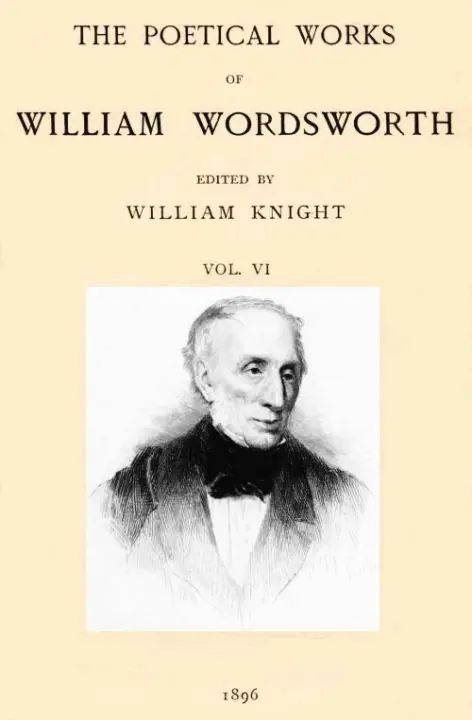
"The Poetical Works of William Wordsworth — Volume 6 (of 8)" by William Wordsworth is a collection of poetry published in the late 19th century. This volume contains a selection of Wordsworth's works from the years 1814 to 1820, showcasing his thematic focus on nature, human emotion, and the profound connection between the two. Readers can expect to find insightful reflections on personal and national identities, drawing on historical figures and settings, illustrated through the poet’s unique lens of Romanticism. The opening of this collection introduces several poems, starting with "Laodamia," which explores themes of love, loss, and the transcendent nature of human emotion through the story of a faithful wife yearning for her slain husband. Wordsworth’s mastery of language is evident as he blends mythological elements with deep emotional resonance, setting a reflective tone that permeates the selection. Additionally, the beginnings of poems such as "The Brownie's Cell" and "Yarrow Visited" highlight Wordsworth's interest in Scottish landscapes and folklore, drawing the reader into a vibrant tapestry of the natural world, as well as his reflections on heritage and history. Through these verses, Wordsworth invites readers into his intimate thoughts and contemplations, setting the foundation for a deeply enriching literary experience.
Introduction adapted from the source catalogue; source summaries may be automatically generated.
Free to read · English · 117,891 words · No account needed
MAKE TIME FOR A GOOD BOOK
On by default. Untick to stop anonymous reading totals. Each page counts after 10 seconds in view. How this works.
Anonymous counting is on unless you have switched it off.
Non voltus, non color unus,
Non comptae mansere comae; sed pectus anhelum,
Et rabie fera corda tument; majorque videri,
Nec mortale sonans. Æneid vi. 47.
Neither face nor hue remained unchanged, nor braided the locks of her hair: but the bosom heaves and the heart swells wild with frenzy, and she is more majestic to behold, and her voice has no mortal sound.
. . . . wingèd Mercury.
Ἑρμῆς ψυχαγωγός or ψυχοπομπός, the conductor
of souls.
. . . . with his wand.
Tum virgam capit: hac animas ille evocat Orco, Pallentes, alias sub Tartara tristia mittit, Dat somnos adimitque. Æneid iv. 242.
Then he takes the wand: with this he summons pale ghosts from Orcus, others he sends to gloomy Tartarus below: with this he gives and takes away sleep.
But unsubstantial Form eludes her grasp.
Ter conatus ibi collo dare bracchia circum, Ter frustra comprensa manus effugit imago, Par levibus ventis volucrique simillima somno. Æneid vi. 700.
Thrice thereon he tried to cast his arms around his neck: thrice was the phantom grasped in vain and escaped the embrace, unsubstantial as the fleeting winds and shadowy like as winged sleep.
But in reward of thy fidelity.
And something also did my worth obtain.
'Vicit iter durum pietas,' is realised by these lines. 'Fidelity has prevailed to traverse the awful path.'
Thou knowest, the Delphic oracle foretold.
Sors quoque nescio quem fato designat iniquo, Qui primus Danaum Troada tangat humum. Ovid, Heroides, xiii. 93.
An oracle, moreover, destines some one or other for a cruel doom, who first of the Greeks sets foot on Trojan soil.
A nobler counsellor than my poor heart.
See Laodamia's words, Ovid, Heroides, xiii. 95.
Infelix quae prima virum lugebit ademptum;
Di faciant ne tu strenuus esse velis.
Hoc quoque praemoneo: de nave novissimus exi,
Non est quo properes terra paterna tibi.
Unhappy wife who shall be the first to lament a husband slain: God grant you may not choose the forward part: this warning too I give, be last to disembark: 'tis no fatherland to hasten to, no fatherland for you.
Give, on this well known couch, one nuptial kiss.
This is probably an adaptation of Ovid, Heroides, xiii. 117.
Quando erit ut lecto mecum bene junctus in uno
Militiae referas splendida facta tuae.
When will the time be that you will share the couch, and lovingly at my side recount the glorious deeds of your warfare?
Be taught, O faithful Consort, to control
Rebellious passion: for the Gods approve
The depth, and not the tumult, of the soul, etc.
Cf. Euripides, Iphigeneia in Aulide, 547:
γαλανείᾳ χρησάμενοι
μαινομένων οἴστρων.
Stilling to calmness the frenzied passions of love.
And again:
εἴη δέ μοι μετρία μὲν
χάρις πόθοι δ' ὅσιοι.
Mine be 'moderate transports' and holy yearnings.
... Did not Hercules by force.
This refers to the struggle between Hercules and Θάνατος.
Your reading position is saved on this browser. Take it to another device with a library code. Reading pages adapt to text, rather than matching a printed edition.
BEHIND THE BOOK
This eBook is for the use of anyone anywhere in the United States and most other parts of the world at no cost and with almost no restrictions whatsoever. You may copy it, give it away or re-use it under the terms of the Project Gutenberg License included with this eBook or online at www.gutenberg.org. If you are not located in the United States, you will have to check the laws of the country where you are located before using this eBook. Read the source licence.
The original source file, including credits and licence, is retained by this library. Request an original-format copy at no charge. Please include the book title and Project Gutenberg identifier #47651.
KEEP YOUR CURIOSITY GOING
Eric Mackay
Edmund Gosse
Sophia Margaretta Hensley
Gilbert Parker
George MacDonald

Elizabeth Bibesco