
Love Letters of a Violinist, and Other Poems
Eric Mackay
THE CLASSIC COLLECTION · 1795
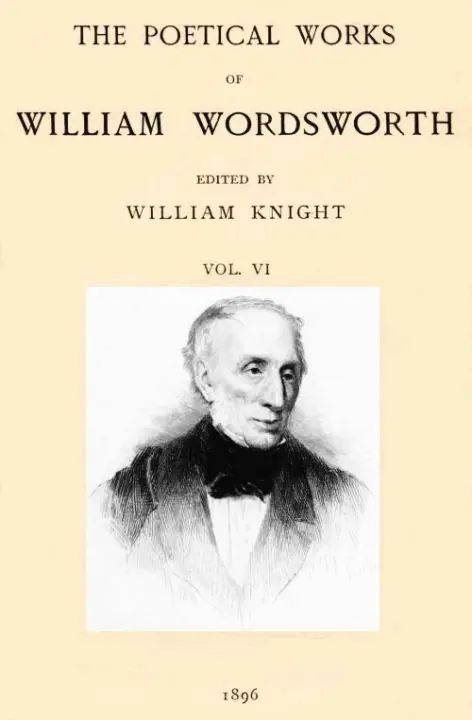
"The Poetical Works of William Wordsworth — Volume 6 (of 8)" by William Wordsworth is a collection of poetry published in the late 19th century. This volume contains a selection of Wordsworth's works from the years 1814 to 1820, showcasing his thematic focus on nature, human emotion, and the profound connection between the two. Readers can expect to find insightful reflections on personal and national identities, drawing on historical figures and settings, illustrated through the poet’s unique lens of Romanticism. The opening of this collection introduces several poems, starting with "Laodamia," which explores themes of love, loss, and the transcendent nature of human emotion through the story of a faithful wife yearning for her slain husband. Wordsworth’s mastery of language is evident as he blends mythological elements with deep emotional resonance, setting a reflective tone that permeates the selection. Additionally, the beginnings of poems such as "The Brownie's Cell" and "Yarrow Visited" highlight Wordsworth's interest in Scottish landscapes and folklore, drawing the reader into a vibrant tapestry of the natural world, as well as his reflections on heritage and history. Through these verses, Wordsworth invites readers into his intimate thoughts and contemplations, setting the foundation for a deeply enriching literary experience.
Introduction adapted from the source catalogue; source summaries may be automatically generated.
Free to read · English · 117,891 words · No account needed
MAKE TIME FOR A GOOD BOOK
On by default. Untick to stop anonymous reading totals. Each page counts after 10 seconds in view. How this works.
Anonymous counting is on unless you have switched it off.
For a legend showing a similar sympathy between nature and man, see
Æneid, iii. 22."
As Wordsworth tells us in the Fenwick note to Laodamia, that "it cost him more trouble than almost anything of equal length he had ever written," and as there are many incomplete passages and suppressed readings among his MSS., the two following stanzas--intended at first to follow the second stanza in the poem as it now stands--may be given in a supplementary note.--ED.
That rapture failing, the distracted Queen
Knelt, and embraced the Statue of the God:
"Mighty the boon I ask, but Earth has seen
Effects as awful from thy gracious nod;
All-ruling Jove, unbind the mortal chain,
Nor let the force of prayer be spent in vain!"
Round the high-seated Temple a soft breeze
Along the columns sighed--all else was still--
Mute, vacant as the face of summer seas,
No sign accorded of a favouring will.
Dejected she withdraws--her palace-gate
Enters--and, traversing a room of state,
O terror! etc. etc.
[Footnote 1: 1827.
... before the rising morn
Performed, my slaughtered Lord have I required;
And in thick darkness, amid shades forlorn,
Him of the infernal Gods have I desired: 1815.
]
[Footnote 2: 1820.
... did ... 1815.
]
[Footnote 3: 1820.
That ... 1815.
]
[Footnote 4: 1845.
That thou should'st cheat ... 1815.
]
[Footnote 5: 1836.
Know, virtue were not virtue if the joys 1815.
]
[Footnote 6: 1820.
The fervor--not the impotence of love. 1815.
]
[Footnote 7: 1827.
... in beauty's bloom? 1815.
]
[Footnote 8: 1827.
Spake, as a witness, of a second birth
For all that is most perfect upon earth; 1815.
]
[Footnote 9: 1820.
Our future course, upon the silent sea;[B] 1815.
]
[Footnote 10: 1836.
Towards 1815.
]
[Footnote 11: 1827.
this 1815.
]
[Footnote 12: 1845.
Ah, judge her gently who so deeply loved! Her, who, in reason's spite, yet without crime, Was in a trance of passion thus removed; Delivered from the galling yoke of time And these frail elements--to gather flowers 1815.
By no weak pity might the Gods be moved; She who thus perished not without the crime Of Lovers that in Reason's spite have loved, Was doomed to wander in a grosser clime, Apart from happy Ghosts--that gather flowers 1827.
Was doomed to wear out her appointed time, Apart from happy Ghosts-- 1832.
She--who, though warned, exhorted, and reproved, Thus died, from passion desperate to a crime-- By the just Gods, whom no weak pity moved, Was doomed to wear out. 1840.
She perished thus, admonished and reproved In vain; and even as for a wilful crime By the just Gods, C.
Thus, though forewarned, exhorted, and reproved,
She perished; and even as for a wilful crime, C.
]
[Footnote A: Wordsworth mentioned in a letter to De Quincey (February 8, 1815) that this stanza was added while the poem was passing through the press.--ED.]
Your reading position is saved on this browser. Take it to another device with a library code. Reading pages adapt to text, rather than matching a printed edition.
BEHIND THE BOOK
This eBook is for the use of anyone anywhere in the United States and most other parts of the world at no cost and with almost no restrictions whatsoever. You may copy it, give it away or re-use it under the terms of the Project Gutenberg License included with this eBook or online at www.gutenberg.org. If you are not located in the United States, you will have to check the laws of the country where you are located before using this eBook. Read the source licence.
The original source file, including credits and licence, is retained by this library. Request an original-format copy at no charge. Please include the book title and Project Gutenberg identifier #47651.
KEEP YOUR CURIOSITY GOING
Eric Mackay
Edmund Gosse
Sophia Margaretta Hensley
Gilbert Parker
George MacDonald

Elizabeth Bibesco