
Love Letters of a Violinist, and Other Poems
Eric Mackay
THE CLASSIC COLLECTION · 1795
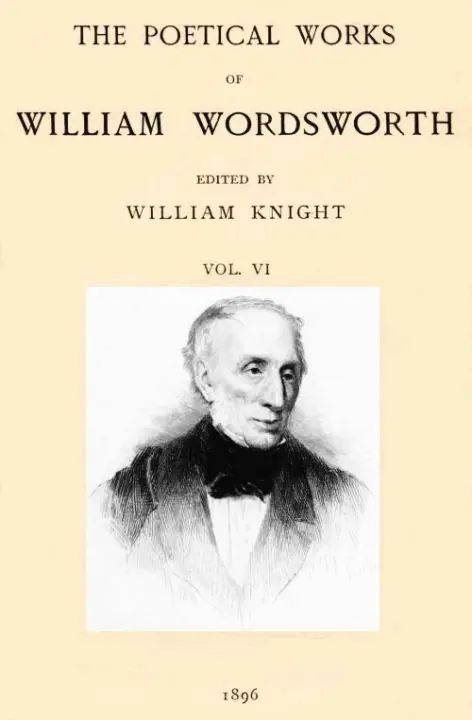
"The Poetical Works of William Wordsworth — Volume 6 (of 8)" by William Wordsworth is a collection of poetry published in the late 19th century. This volume contains a selection of Wordsworth's works from the years 1814 to 1820, showcasing his thematic focus on nature, human emotion, and the profound connection between the two. Readers can expect to find insightful reflections on personal and national identities, drawing on historical figures and settings, illustrated through the poet’s unique lens of Romanticism. The opening of this collection introduces several poems, starting with "Laodamia," which explores themes of love, loss, and the transcendent nature of human emotion through the story of a faithful wife yearning for her slain husband. Wordsworth’s mastery of language is evident as he blends mythological elements with deep emotional resonance, setting a reflective tone that permeates the selection. Additionally, the beginnings of poems such as "The Brownie's Cell" and "Yarrow Visited" highlight Wordsworth's interest in Scottish landscapes and folklore, drawing the reader into a vibrant tapestry of the natural world, as well as his reflections on heritage and history. Through these verses, Wordsworth invites readers into his intimate thoughts and contemplations, setting the foundation for a deeply enriching literary experience.
Introduction adapted from the source catalogue; source summaries may be automatically generated.
Free to read · English · 117,891 words · No account needed
MAKE TIME FOR A GOOD BOOK
On by default. Untick to stop anonymous reading totals. Each page counts after 10 seconds in view. How this works.
Anonymous counting is on unless you have switched it off.
But thou, O Goddess! in thy favourite Isle
(Freedom's impregnable redoubt,
The wide earth's store-house fenced about
With breakers roaring to the gales
That stretch a thousand thousand sails) 155
Quicken the slothful, and exalt the vile!--
Thy impulse is the life of Fame;
Glad Hope would almost cease to be
If torn from thy society;
And Love, when worthiest of his name,[426] 160
Is proud to walk the earth with Thee!
[Footnote 411: 1837.
... a ... 1822.
]
[Footnote 412: The edition of 1849 has "Briton's," evidently a
misprint.]
[Footnote 413: 1822.
... to youthful Courage ... C.
]
[Footnote 414: 1845.
Or ... 1822.
]
[Footnote 415: 1837.
And thou (if rightly I rehearse
What wondering Shepherds told in verse)
From rocky fortress in mid air
(The food which pleased thee best to win)
Did'st oft the flame-eyed Eagle scare
With infant shout,--as often sweep, 1822.
And thou, whose earliest thoughts held dear
Allurements that were edged with fear,
(The food that pleased thee best, to win)
From rocky fortress in mid air
The flame-eyed Eagle oft would scare
With infant shout,--as often sweep, 1827.
And thou, whose earliest thoughts held dear
Allurements that were edged with fear,
(The food that pleased thee best, to win)
With infant shout wouldst often scare
From her rock-fortress in mid air
The flame-eyed Eagle--often sweep, 1832.
]
[Footnote 416: 1837.
And, ... 1822.
]
[Footnote 417: 1837.
... and a couch of rest;
Thou to his dangers dost enchain,
'Mid the blank world of snow and ice,
The ... 1822.
... and a couch of rest;
'Mid the blank world of snow and ice,
Thou to his dangers dost enchain
The ... 1832.
]
[Footnote 418: 1837.
... glide serene
From cloud to cloud, ... 1822.
]
[Footnote 419: 1832.
Or, in their bells ... 1822.
]
[Footnote 420: 1832.
... in ghastly silence sleep?
--Within ... 1822.
]
[Footnote 421: 1832.
... an abject ... 1827.
]
[Footnote 422: This stanza was first added in the edition of 1827.]
[Footnote 423: 1837.
Or stifled under weight ... 1822.
]
[Footnote 424: 1845.
Heaving with convulsive throes,-- It quivers--and is still; 1822.
Raised in a moment; with convulsive throes
It heaved--and all is still; 1837.
]
[Footnote 425: 1840.
While ... 1822.
And withered leaves, from Earth's cold breast Up-caught in whirlwinds, nowhere can find rest. 1832.
... like sleet
Clothing a tall pine's northern side,
In rough November days when winds have tried
Their force on all things else--left naked far and wide. 1837.
]
[Footnote 426: 1837.
... of the name, 1822.
]
[Footnote EO:
Awhile the living hill
Heaved with convulsive throes, and all was still.
--Dr. Darwin describing the destruction of the army of Cambyses.--W. W.
1822.
Compare Memoirs of Wordsworth, vol. ii. p. 225.--ED.]
[Footnote EP: The nightingale. Compare Il Penseroso, l. 62.--ED.]
Composed 1820.--Published 1820
Your reading position is saved on this browser. Take it to another device with a library code. Reading pages adapt to text, rather than matching a printed edition.
BEHIND THE BOOK
This eBook is for the use of anyone anywhere in the United States and most other parts of the world at no cost and with almost no restrictions whatsoever. You may copy it, give it away or re-use it under the terms of the Project Gutenberg License included with this eBook or online at www.gutenberg.org. If you are not located in the United States, you will have to check the laws of the country where you are located before using this eBook. Read the source licence.
The original source file, including credits and licence, is retained by this library. Request an original-format copy at no charge. Please include the book title and Project Gutenberg identifier #47651.
KEEP YOUR CURIOSITY GOING
Eric Mackay
Edmund Gosse
Sophia Margaretta Hensley
Gilbert Parker
George MacDonald

Elizabeth Bibesco