
Love Letters of a Violinist, and Other Poems
Eric Mackay
THE CLASSIC COLLECTION · 1795
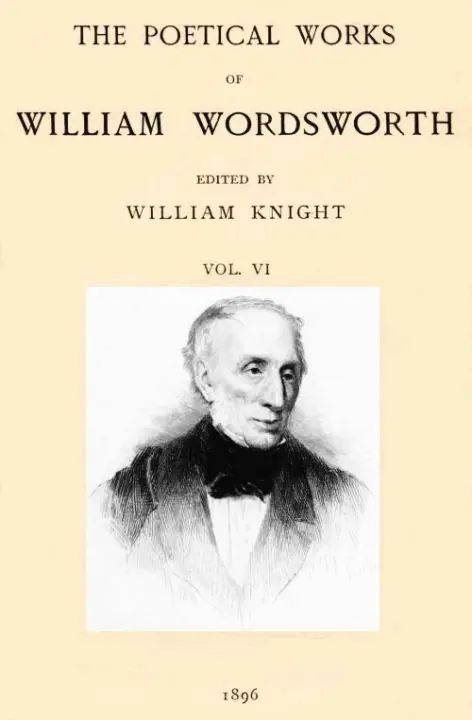
"The Poetical Works of William Wordsworth — Volume 6 (of 8)" by William Wordsworth is a collection of poetry published in the late 19th century. This volume contains a selection of Wordsworth's works from the years 1814 to 1820, showcasing his thematic focus on nature, human emotion, and the profound connection between the two. Readers can expect to find insightful reflections on personal and national identities, drawing on historical figures and settings, illustrated through the poet’s unique lens of Romanticism. The opening of this collection introduces several poems, starting with "Laodamia," which explores themes of love, loss, and the transcendent nature of human emotion through the story of a faithful wife yearning for her slain husband. Wordsworth’s mastery of language is evident as he blends mythological elements with deep emotional resonance, setting a reflective tone that permeates the selection. Additionally, the beginnings of poems such as "The Brownie's Cell" and "Yarrow Visited" highlight Wordsworth's interest in Scottish landscapes and folklore, drawing the reader into a vibrant tapestry of the natural world, as well as his reflections on heritage and history. Through these verses, Wordsworth invites readers into his intimate thoughts and contemplations, setting the foundation for a deeply enriching literary experience.
Introduction adapted from the source catalogue; source summaries may be automatically generated.
Free to read · English · 117,891 words · No account needed
MAKE TIME FOR A GOOD BOOK
On by default. Untick to stop anonymous reading totals. Each page counts after 10 seconds in view. How this works.
Anonymous counting is on unless you have switched it off.
I thought of Thee, my partner and my guide, As being past away.--Vain sympathies! For, backward, Duddon! as I cast my eyes, I see what was, and is, and will abide; Still glides the Stream, and shall for ever glide;[465][GL] 5 The Form remains, the Function never dies; While we, the brave, the mighty, and the wise, We Men, who in our morn of youth defied The elements, must vanish;--be it so! Enough, if something from our hands have power 10 To live, and act, and serve the future hour; And if, as toward the silent tomb we go, Through love, through hope, and faith's transcendent dower, We feel that we are greater than we know.[GM]
[Footnote 465: 1820 (1st edition).
... and shall not cease to glide; 1820. (2nd edition.)
The text of 1840 returns to that of the 2nd edition of 1820.]
[Footnote GL: Compare The Fountain (vol. ii. p. 92)--
'Twill murmur on a thousand years,
And flow as now it flows.
And Tennyson's Brook,
Men may come and men may go,
But I go on for ever.
[Footnote GM:
And feel that I am happier than I know.--MILTON.[466]
The allusion to the Greek poet will be obvious to the classical
reader.--W. W. 1820.
I was indebted to Professor Jebb, in 1883, for the following note:--
"While we, the brave, the mighty, and the wise,
...
... must vanish, ...
has been suggested by the well-known lines in the
Ἐπιτάφιον Βίωνος, by the pastoral poet Moschus of Syracuse
(circ. 200 B.C.):--
αἴ, αἴ, ταὶ μαλάχαι μὲν ἐπὰν κατὰ κᾶπον ὄλωνται, ἢ τὰ χλωρὰ σέλινα, τό τ' εὐθαλὲς οὖλον ἄνηθον, ὕστερον αὖ ζώοντι καὶ εἰς ἔτος ἄλλο φύοντι· ἄμμες δ', οἱ μεγάλοι καὶ καρτεροὶ ἢ σοφοὶ ἄνδρες, ὁππότε πρᾶτα θάνωμες, ἀνάκοοι ἐν χθονὶ κοίλᾳ εὕδομες εὖ μάλα μακρὸν ἀτέρμονα νήγρετον ὕπνον.]
(Vv. 103-108.)
You will see that Wordsworth has translated the Greek verse which I underline ('brave' representing μεγάλοι). The 'mallows,' 'parsley,' 'anise' of the Greek poet's garden--which are to live again--are represented by Wordsworth's stream which 'shall for ever glide.'
One might contrast the lines in the Christian Year about the autumn
leaves:--
How like decaying life they seem to glide!
And yet no second spring have they in store,
But where they fall, forgotten to abide
Is all their portion, and they ask no more."
With this Afterthought compare Virgil, Georgics II. 458, 459--
O fortunatos nimium sua si bona norint
Agricolas, etc.
A poet, whose works are not yet known as they deserve to be,[GN] thus enters upon his description of the "Ruins of Rome":
The rising Sun
Flames on the ruins in the purer air
Towering aloft;
and ends thus--
The setting Sun displays
His visible great round, between yon towers,
As through two shady cliffs.
Mr. Crowe, in his excellent loco-descriptive Poem, Lewesdon Hill, is still more expeditious, finishing the whole on a May-morning before breakfast.
To-morrow for severer thought, but now
To breakfast, and keep festival to-day.
Your reading position is saved on this browser. Take it to another device with a library code. Reading pages adapt to text, rather than matching a printed edition.
BEHIND THE BOOK
This eBook is for the use of anyone anywhere in the United States and most other parts of the world at no cost and with almost no restrictions whatsoever. You may copy it, give it away or re-use it under the terms of the Project Gutenberg License included with this eBook or online at www.gutenberg.org. If you are not located in the United States, you will have to check the laws of the country where you are located before using this eBook. Read the source licence.
The original source file, including credits and licence, is retained by this library. Request an original-format copy at no charge. Please include the book title and Project Gutenberg identifier #47651.
KEEP YOUR CURIOSITY GOING
Eric Mackay
Edmund Gosse
Sophia Margaretta Hensley
Gilbert Parker
George MacDonald

Elizabeth Bibesco