
Love Letters of a Violinist, and Other Poems
Eric Mackay
THE CLASSIC COLLECTION · 1795
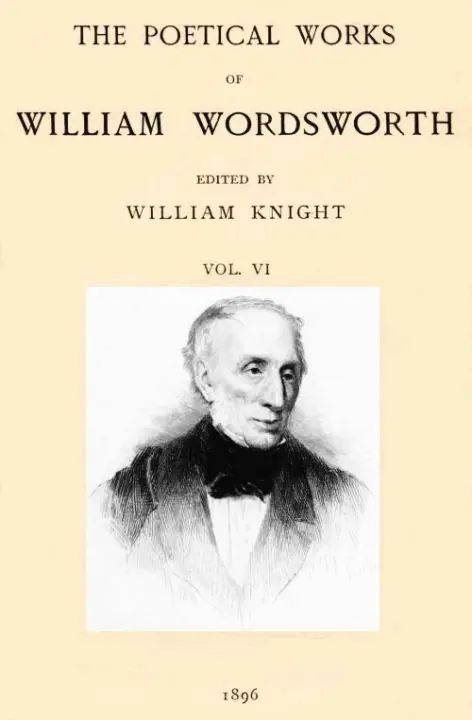
"The Poetical Works of William Wordsworth — Volume 6 (of 8)" by William Wordsworth is a collection of poetry published in the late 19th century. This volume contains a selection of Wordsworth's works from the years 1814 to 1820, showcasing his thematic focus on nature, human emotion, and the profound connection between the two. Readers can expect to find insightful reflections on personal and national identities, drawing on historical figures and settings, illustrated through the poet’s unique lens of Romanticism. The opening of this collection introduces several poems, starting with "Laodamia," which explores themes of love, loss, and the transcendent nature of human emotion through the story of a faithful wife yearning for her slain husband. Wordsworth’s mastery of language is evident as he blends mythological elements with deep emotional resonance, setting a reflective tone that permeates the selection. Additionally, the beginnings of poems such as "The Brownie's Cell" and "Yarrow Visited" highlight Wordsworth's interest in Scottish landscapes and folklore, drawing the reader into a vibrant tapestry of the natural world, as well as his reflections on heritage and history. Through these verses, Wordsworth invites readers into his intimate thoughts and contemplations, setting the foundation for a deeply enriching literary experience.
Introduction adapted from the source catalogue; source summaries may be automatically generated.
Free to read · English · 117,891 words · No account needed
MAKE TIME FOR A GOOD BOOK
On by default. Untick to stop anonymous reading totals. Each page counts after 10 seconds in view. How this works.
Anonymous counting is on unless you have switched it off.
Jesu! bless our slender Boat,
By the current swept along;
Loud its threatenings--let them not
Drown the music of a song
Breathed thy mercy to implore, 5
Where these troubled waters roar!
Saviour, for our warning, seen[488]
Bleeding on that precious Rood;
If, while through the meadows green
Gently wound the peaceful flood, 10
We forgot Thee, do not Thou
Disregard thy Suppliants now!
Hither, like yon ancient Tower
Watching o'er the River's bed,
Fling the shadow of thy power, 15
Else we sleep among the dead;
Thou who trod'st[489] the billowy sea,
Shield us in our jeopardy!
Guide our Bark among the waves;
Through the rocks our passage smooth; 20
Where the whirlpool frets and raves
Let thy love its anger soothe:
All our hope is placed in Thee;
Miserere Domine![HG]
[Footnote 488: 1837.
Lord and Saviour! who art seen 1822.
Saviour, in thy image, seen 1827.
]
[Footnote 489: 1827.
Traveller on ... 1822.
]
[Footnote HG: Miserere Domine.
See the beautiful Song in Mr. Coleridge's Tragedy, "THE REMORSE." Why is the Harp of Quantock silent?--W. W. 1822.
The following is the song, Miserere Domine, from Coleridge's
Remorse, act III. scene i.:--
Hear, sweet spirit, hear the spell,
Lest a blacker charm compel!
So shall the midnight breezes swell
With thy deep long-lingering knell.
And at evening evermore,
In a Chapel on the shore,
Shall the Chaunters sad and saintly,
Yellow tapers burning faintly,
Doleful Masses chaunt for thee,
Miserere Domine!
Hark! the cadence dies away
On the quiet moonlight sea:
The boatmen rest their oars and say,
Miserere Domine!
This song was set to music by Mr. Carnaby in 1802.--ED.
"26th July.--Reached Heidelberg.... We walked a while about the garden and ruins of the Castle. Looked down upon the grey-roofed Town, with its Cathedral running parallel with the river Neckar, over which, by a fine bridge, we had crossed on entering; boats shooting curiously over the rapids; vines, hanging gardens climbing up the hill, clothing the rocks, and creeping into their crevices, on every side of us, and up to the very point where we stood. The Town, with its squares and fountains, its narrow long streets, with arched gateways, towers, and spires, courts, and quaint flower gardens, fill the deep valley. The river disappears, winding away among the hills to the right. Before us it holds a direct course--through a widening tract of the same prolific country--to the Rhine, seen in the distance.... 27th... The passage through the bridge being somewhat dangerous, those who accompany the rafts, as they approach, fall down upon their knees to pray, then raise their voices and sing an appropriate anthem till the peril is past." (Mrs. Wordsworth's Journal.)
Your reading position is saved on this browser. Take it to another device with a library code. Reading pages adapt to text, rather than matching a printed edition.
BEHIND THE BOOK
This eBook is for the use of anyone anywhere in the United States and most other parts of the world at no cost and with almost no restrictions whatsoever. You may copy it, give it away or re-use it under the terms of the Project Gutenberg License included with this eBook or online at www.gutenberg.org. If you are not located in the United States, you will have to check the laws of the country where you are located before using this eBook. Read the source licence.
The original source file, including credits and licence, is retained by this library. Request an original-format copy at no charge. Please include the book title and Project Gutenberg identifier #47651.
KEEP YOUR CURIOSITY GOING
Eric Mackay
Edmund Gosse
Sophia Margaretta Hensley
Gilbert Parker
George MacDonald

Elizabeth Bibesco