THE CLASSIC COLLECTION✦An outlaw’s diary: the CommuneCLASSIC FREE BOOKS
An outlaw’s diary: the Commune
Cécile Tormay
THE CLASSIC COLLECTION · 1872
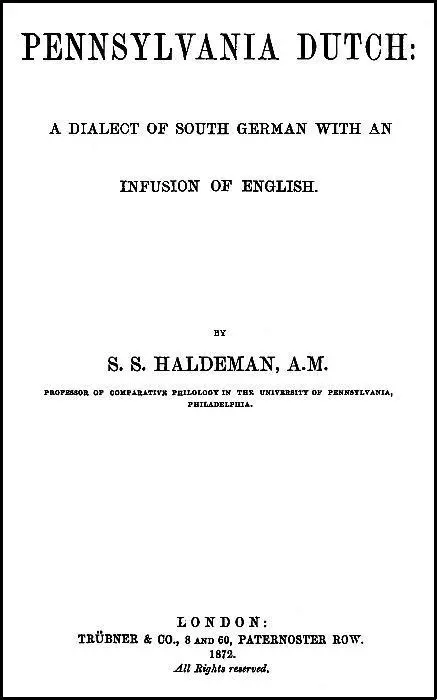
"Pennsylvania Dutch: A Dialect of South German With an Infusion of English" by S. S. Haldeman is a scientific publication written in the late 19th century. The book explores the unique linguistic characteristics of Pennsylvania Dutch, a dialect formed by German-speaking immigrants to Pennsylvania, highlighting its blend of South German roots and English influences. The text delves into various aspects of the dialect, including its phonology, vocabulary, and syntax, making it a valuable resource for those interested in comparative philology and language evolution. The opening of the work introduces the rationale behind studying this dialect, emphasizing its formation over a century within a linguistically diverse community. It describes the historical context of German immigration to Pennsylvania and how various dialects from regions like Rhenish Bavaria and Alsace contributed to the development of Pennsylvania Dutch. The author outlines the influences of limited interactions among the largely agricultural immigrant populations, which led to distinct linguistic changes, thus setting the stage for a detailed examination of phonology, vocabulary, and syntax in subsequent chapters.
Introduction adapted from the source catalogue; source summaries may be automatically generated.
Free to read · English · 27,823 words · No account needed
MAKE TIME FOR A GOOD BOOK
On by default. Untick to stop anonymous reading totals. Each page counts after 10 seconds in view. How this works.
Anonymous counting is on unless you have switched it off.
=Glei=, adv. (soon).--ær kummt glei--he comes (will be here) directly. Swiss gly and gleich have the same meaning.
=Abartich=, =bartich=, Ch. viii., § 3, ¶ 6 (adj. unusual, strange); (adv. especially). G. abartig degenerate.
"Der duckter sogt eara complaint wær ... conclommereashen im kup, so dos se so unfergleichlich schwitza mus in der nacht, =abbordich= wan se tsu gedeckt is mit em fedder bet."--Rauch, Feb. 1, 1870. The doctor asserts her 'complaint' to be ... 'conglomeration' in the head, so that she must sweat uncommonly in the night, PARTICULARLY when she is covered [tsu is accented] in with the feather bed.
=Biibi=, =piipi=, =biibǝli=; Swiss bibi, bibeli, bidli (a young chicken). Used also to call fowls--the second form in the vicinal English, in which a male fowl is often called a hé-biddy.
The Swiss use in PG. of the genitive form des of the article, instead of the neuter nominative das, causes little or no confusion, because this genitive is not required, and its new use prevents confusion between das and dasz. Where German uses des, as in Der Gaul des (or meines) Nachbars (the horse of the, or my, neighbor), PG. uses a dative form--
... dem (or meim for meinem) nochbǝr sei˛ gaul (the neighbor his horse). See the quotation (p. 28) from Schöpf.
PG. inflects most of its verbs regularly, as in 'gedenkt' for G. gedacht, from denken (to think). In the following list, the German infinitive, as backen (to bake), is followed by the third person of the present indicative (er) bäckt, PG. (ær) 'bakt' (he bakes). The PG. infinitive of blasen, braten, fragen, rathen, dürfen, verderben, is 'bloosǝ, brootǝ, frooghǝ, rootǝ, dærfǝ, f'rdærwǝ.' 'bloosǝ' (to blow) and 'nemmǝ' (to take) occur below, in the extract from Miss Bahn.
blasen blow, bläst bloost
braten bake, brät broot
brechen break, bricht brecht
dreschen thrash, drischt drescht
dürfen dare, darf dærf
fahren drive, fährt faart
fallen fall, fällt fallt
fragen ask, frägt frookt
essen eat, iszt esst
fressen devour, friszt fresst
geben give, giebt gept
graben dig, gräbt graapt
helfen help, hilft helft
laufen run, läuft laaft
lesen read, liest leest
lassen let, läszt lǝsst
messen measure, miszt messt
nehmen take, nimmt nemmt
rathen advise, räth root
saufen tipple, säuft sauft
schelten scold, schilt schelt
schlafen sleep, schläft schlooft
schwellen swell, schwillt schwellt
sehen see, sieht seet
stehlen steal, stiehlt schteelt
tragen carry, trägt traagt
verderben spoil, verdirbt f'rdærpt
vergessen forget, vergiszt f'rgesst
Your reading position is saved on this browser. Take it to another device with a library code. Reading pages adapt to text, rather than matching a printed edition.
BEHIND THE BOOK
This eBook is for the use of anyone anywhere in the United States and most other parts of the world at no cost and with almost no restrictions whatsoever. You may copy it, give it away or re-use it under the terms of the Project Gutenberg License included with this eBook or online at www.gutenberg.org. If you are not located in the United States, you will have to check the laws of the country where you are located before using this eBook. Read the source licence.
The original source file, including credits and licence, is retained by this library. Request an original-format copy at no charge. Please include the book title and Project Gutenberg identifier #48417.
KEEP YOUR CURIOSITY GOING
Cécile Tormay

Moritz Busch
John L. Ransom
Frances Wright
Cécile Tormay

Mabel Potter Daggett