THE CLASSIC COLLECTION✦An outlaw’s diary: the CommuneCLASSIC FREE BOOKS
An outlaw’s diary: the Commune
Cécile Tormay
THE CLASSIC COLLECTION · 1872
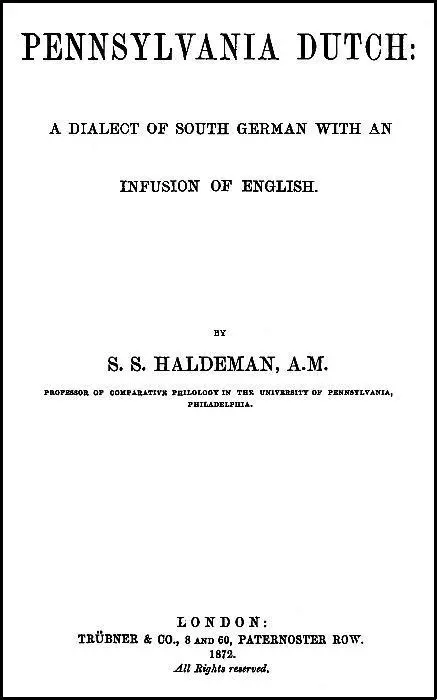
"Pennsylvania Dutch: A Dialect of South German With an Infusion of English" by S. S. Haldeman is a scientific publication written in the late 19th century. The book explores the unique linguistic characteristics of Pennsylvania Dutch, a dialect formed by German-speaking immigrants to Pennsylvania, highlighting its blend of South German roots and English influences. The text delves into various aspects of the dialect, including its phonology, vocabulary, and syntax, making it a valuable resource for those interested in comparative philology and language evolution. The opening of the work introduces the rationale behind studying this dialect, emphasizing its formation over a century within a linguistically diverse community. It describes the historical context of German immigration to Pennsylvania and how various dialects from regions like Rhenish Bavaria and Alsace contributed to the development of Pennsylvania Dutch. The author outlines the influences of limited interactions among the largely agricultural immigrant populations, which led to distinct linguistic changes, thus setting the stage for a detailed examination of phonology, vocabulary, and syntax in subsequent chapters.
Introduction adapted from the source catalogue; source summaries may be automatically generated.
Free to read · English · 27,823 words · No account needed
MAKE TIME FOR A GOOD BOOK
On by default. Untick to stop anonymous reading totals. Each page counts after 10 seconds in view. How this works.
Anonymous counting is on unless you have switched it off.
=Schteiper=, n. (Lat. stîpes), a prop, as of timber. G. nautical term steiper, a stanchion. =Schteiperǝ=, v.t. to prop; to set a prop.
=Fǝrhúttǝlǝ=, v. intrans. 'Ich bin f'r-huttlt,' (I am confused, perplexed.) 'Ich denk dii bissnǝss iss 'n bissli f'r-huttlt.' (I think the 'business' is a bit mixed up.) G. verhūdeln (to spoil, bungle.)
=Paanhaas=, as if, G. pfanne-hase (pan-hare). Maize flour boiled in the metsel-soup, afterwards fried and seasoned like a hare. (Compare Welsh rabbit.) The word is used in English, conjointly with scrapple.
=Loos= (a sow), as in Swiss and Suabian.
=Laad=, fem. (coffin), toodlaad, toodǝlaad, as in Alsace. G. die lade (chest, box, case). PG. bettlaad, Suab. bettlade, for G. bettgestell (bedstead).
=Schtreel=, m. (a comb), Swiss, Alsatian, Suab. der strähl. But G. striegel, PG. striegel, PG. strigl, is a currycomb.
=Aarsch=, the butt end of an egg, as in Suabian.
=Falsch= (angry), as in Swiss, Bavarian, and Austrian. PG. Sel hǝt mich falsch g'macht. That made me angry.
=Hoochtsich=, Alsat. hoochtsitt, G. hochzeit (a wedding).
=Heemǝln=, Swiss heimeln (to cause a longing, to cause home
feelings).
"Wie hämelt mich do alles a'! Wii heemlt mich doo allǝs aa˛! Ich steh, un denk, un guck; ich schtee, un denk, un gukk; Un was ich schier vergessa hab, un was ich schiir f'rgessǝ hab, Kummt wider z'rück, wie aus seim Grab, kummt widd'r tsrik, wii aus seim graab, Un steht do wie e' Spook!" Harb. un schteet doo wii ǝ schpukk!
(G. Wie alles da anheimelt mich) How all here impresses me with home, I stand, and think, and look; and what I had almost forgotten, comes back again as out of its grave, and stands here like a ghost.
=Drǝp=, pl. =drep= (simpleton, poor soul). "O du armer Tropff!" (Suabian). Radlof, 2, 10. "Die arma Drep!"--Harbaugh.
=Schwalme= (Swiss, for G. schwalbe, a swallow).
=Jaa= (O. Eng. yes), is used in answer to affirmative questions.
=Joo= (O. Eng. yea), is used in answer to negative questions. See Ch. viii. § 1, ¶ 12, and § 3, ¶ 2.
"Sin dii sachǝ dei˛? Jaa, sii sin." (Are the things thine? Yes, they are.) "Sin dii sachǝ net dei˛? Joo, sii sin." (Are the things not thine. Yea, they are.) "Bischt du net g'sund? Joo, ich bin."[23] (Are you not well? Yea, I am well.)
=saagt=, G. sagt (he says): =secht=, as if G. sägt, for sagte (he said), as if it were a strong verb.
=Gleich=, to like, be fond of, Eng. to like, but perhaps not Eng. See Ch. viii., ¶ 3. PG. ær gleicht 's geld--he loves money.
Your reading position is saved on this browser. Take it to another device with a library code. Reading pages adapt to text, rather than matching a printed edition.
BEHIND THE BOOK
This eBook is for the use of anyone anywhere in the United States and most other parts of the world at no cost and with almost no restrictions whatsoever. You may copy it, give it away or re-use it under the terms of the Project Gutenberg License included with this eBook or online at www.gutenberg.org. If you are not located in the United States, you will have to check the laws of the country where you are located before using this eBook. Read the source licence.
The original source file, including credits and licence, is retained by this library. Request an original-format copy at no charge. Please include the book title and Project Gutenberg identifier #48417.
KEEP YOUR CURIOSITY GOING
Cécile Tormay

Moritz Busch
John L. Ransom
Frances Wright
Cécile Tormay

Mabel Potter Daggett