THE CLASSIC COLLECTION✦An outlaw’s diary: the CommuneCLASSIC FREE BOOKS
An outlaw’s diary: the Commune
Cécile Tormay
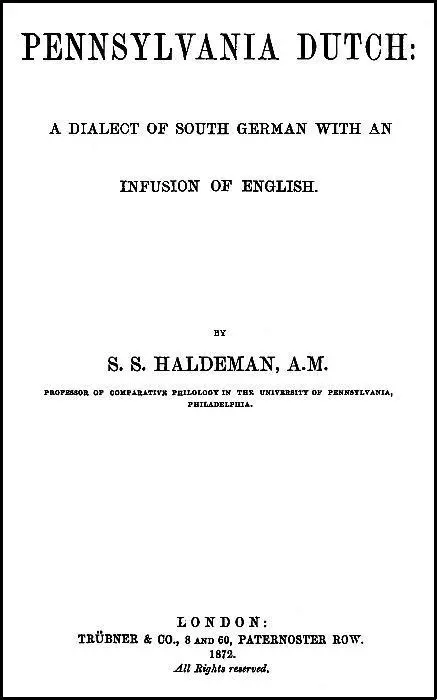
THE CLASSIC COLLECTION · 1872
"Pennsylvania Dutch: A Dialect of South German With an Infusion of English" by S. S. Haldeman is a scientific publication written in the late 19th century. The book explores the unique linguistic characteristics of Pennsylvania Dutch, a dialect formed by German-speaking immigrants to Pennsylvania, highlighting its blend of South German roots and English influences. The text delves into various aspects of the dialect, including its phonology, vocabulary, and syntax, making it a valuable resource for those interested in comparative philology and language evolution. The opening of the work introduces the rationale behind studying this dialect, emphasizing its formation over a century within a linguistically diverse community. It describes the historical context of German immigration to Pennsylvania and how various dialects from regions like Rhenish Bavaria and Alsace contributed to the development of Pennsylvania Dutch. The author outlines the influences of limited interactions among the largely agricultural immigrant populations, which led to distinct linguistic changes, thus setting the stage for a detailed examination of phonology, vocabulary, and syntax in subsequent chapters.
Introduction adapted from the source catalogue; source summaries may be automatically generated.
Free to read · English · 27,823 words · No account needed
MAKE TIME FOR A GOOD BOOK
On by default. Untick to stop anonymous reading totals. Each page counts after 10 seconds in view. How this works.
Anonymous counting is on unless you have switched it off.
§ 1. PG. not Swiss.
PG. is not Swiss, altho it has a number of Swiss characteristics, and
the line (Radlof, 2, 68)--
"Was isch säll für e sufere kärli?"
is very near its PG. form--
Was isch sel f'r ǝ saubǝr kærli? What sort of cleanly fellow is that?
PG. has both 'ær iss' and 'ær isch' (he is) according to the locality, of which the latter may be less common. The Rev. D. Ziegler (a native, like myself) refers the 'isch' variety to the Mennonite and Dunker population, and as there were many Dunkers (or Tunkers) where my early years were passed, I heard more of this than of the other.
The indicative mood present tense of haben and sein are, with some variations, as follows (Stalder, 1, 47-50)--
Swiss. PG.
i hah; ich hab, hap, I have.
de hest; du hǝscht, thou hast.
er hed, hett; ær hat, he has.
mer hend; m'r hen, we have.
der hend; d'r hent, you have.
sj hend; sii hen, they have.
i bi; ich bin, I am.
de bisch, bist; du bischt, thou art.
er isch, ist; ær iss, isch, he is.
mer sind; m'r sin, we are.
der sind; d'r sint, you are.
sj sind; sii sin, they are.
Here the dative singular mir (to me) is used in the nominative plural instead of wir (we), and also in impersonal expressions; and the dative singular dir (to thee) is similarly used for Ihr (you), as in 'd'r sint' for G. Ihr seid (you are). G. Ihr habet (you have) has forced its t upon the first and third persons plural of the Swiss forms; and in PG. the second person is sometimes forced upon the third, as in the following, from the Wollenweber's Gemälde (in the German character), 1869, p. 124,--
For äbout 32 Johr z'rick, do =hent= unsre ... Schaffleut ... im Stenbruch geschafft, un sten gebroche, for de grosze Damm zu fixe.
'Fr ǝbaut' tswee-un-dreissich joor tsrik, do hent unsre ... schaffleit ... im schtee˛bruch geschafft, un schtee˛ gebrǝchǝ f'r di grosse 'damm' tsu fixǝ.
'For about' thirty-two years back, here have our laborers worked in the quarry, and quarried stone to 'fix' the big 'dam.' (Here the English fix and dam are used, instead of G. fixîren, and der damm.)
Here the first for may be regarded as English, but the second occurs in the Palatinate--"for den Herr Ring sehr ungünschtig" (Kobell), for Mr. Ring very unfavorable--"for sei Lügerei,"--for his truthlessness.
Your reading position is saved on this browser. Take it to another device with a library code. Reading pages adapt to text, rather than matching a printed edition.
BEHIND THE BOOK
This eBook is for the use of anyone anywhere in the United States and most other parts of the world at no cost and with almost no restrictions whatsoever. You may copy it, give it away or re-use it under the terms of the Project Gutenberg License included with this eBook or online at www.gutenberg.org. If you are not located in the United States, you will have to check the laws of the country where you are located before using this eBook. Read the source licence.
The original source file, including credits and licence, is retained by this library. Request an original-format copy at no charge. Please include the book title and Project Gutenberg identifier #48417.
KEEP YOUR CURIOSITY GOING
Cécile Tormay

Moritz Busch
John L. Ransom
Frances Wright
Cécile Tormay

Mabel Potter Daggett