THE CLASSIC COLLECTION✦An outlaw’s diary: the CommuneCLASSIC FREE BOOKS
An outlaw’s diary: the Commune
Cécile Tormay
THE CLASSIC COLLECTION · 1872
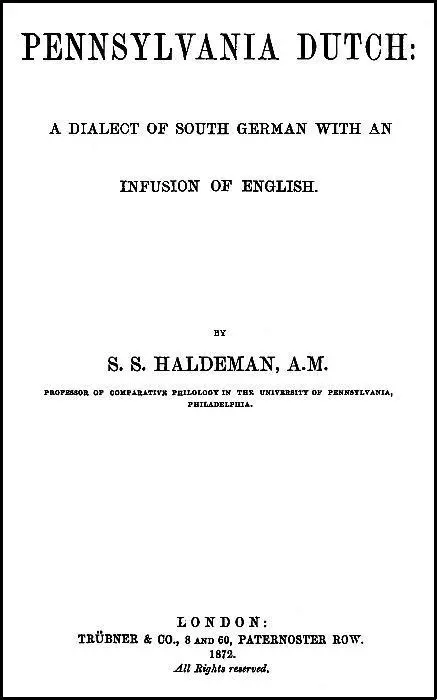
"Pennsylvania Dutch: A Dialect of South German With an Infusion of English" by S. S. Haldeman is a scientific publication written in the late 19th century. The book explores the unique linguistic characteristics of Pennsylvania Dutch, a dialect formed by German-speaking immigrants to Pennsylvania, highlighting its blend of South German roots and English influences. The text delves into various aspects of the dialect, including its phonology, vocabulary, and syntax, making it a valuable resource for those interested in comparative philology and language evolution. The opening of the work introduces the rationale behind studying this dialect, emphasizing its formation over a century within a linguistically diverse community. It describes the historical context of German immigration to Pennsylvania and how various dialects from regions like Rhenish Bavaria and Alsace contributed to the development of Pennsylvania Dutch. The author outlines the influences of limited interactions among the largely agricultural immigrant populations, which led to distinct linguistic changes, thus setting the stage for a detailed examination of phonology, vocabulary, and syntax in subsequent chapters.
Introduction adapted from the source catalogue; source summaries may be automatically generated.
Free to read · English · 27,823 words · No account needed
MAKE TIME FOR A GOOD BOOK
On by default. Untick to stop anonymous reading totals. Each page counts after 10 seconds in view. How this works.
Anonymous counting is on unless you have switched it off.
The vocabulary of PG. has but few synonyms, a single word being used where High German has several, as 'plats' (place) for G. platz and ort. Of the German words for horse (pferd, ross, gaul, etc.), 'gaul' is universal in speech, ross seems not to be known, and pferd is almost restricted to print.[15] A colt is not called füllen as in German, but 'hutsch,' with a diminutival 'hutschli' (in Suabian hutschel, hutschele, Westerwald husz, Lusatian huszche.)
A pig is not ferkel (Lat. porc-ell-us, Welsh porch-ell) but 'seili' (from sau), and children call it 'wuts' (Suab. butzel) a repetition of this being used (as well in vicinal English) in calling these animals. 'Kalb' (calf, pl. 'kelwǝr') is named by children 'hamǝli'[16] when a suckling. Cows are called with 'kum see! see! see hamǝli! see!' and when close at hand with 'suk suk suk' (as in forsook)--used also in the English of the locality.[17]
Of G. knabe (boy) and bube, pl. buben, PG. takes the latter as 'buu,' pl. 'buuwǝ;' and of the G. haupt and kopf (head) it prefers the latter as 'kǝp.' Of the verbs schmeissen and werfen (to throw), kriegen and bekommen (to obtain), hocken and sitzen (to sit), schwetzen and sprechen (to talk), erzählen and sagen (to tell), PG. uses 'schmeissǝ,' 'kriighǝ,' 'hǝkǝ,' 'schwetsǝ' and 'saaghǝ' almost exclusively.
The suffix -lein, condensed to-li and -l, is the universal diminutival, as in Swisserland and South Germany--a small house being called 'heissli' and not häus-chen, and a girl 'meedl' and not mädchen. It is, however, very often associated with the adjective klee˛ (little) G. klein, as in PG. 'ǝ klee˛ bichli' (a little book).
German kartoffeln (potatoes) is rejected for G. grundbirnen[18] under the form of 'krumpiirǝ,' where 'krum' is accepted by some as krumm (crooked), while some regard the latter part as meaning pears, and others as berries.
=F'rleícht=, =Fileícht= (perhaps, G. vielleicht) are in use, but the former seems the more common.
=Sauǝrampl=, G. sauerampfer (sorrel, Rumex).
=Rewwǝr=, =Krik=, =Krikli= (Eng. river, creek) have thrust
aside G. flusz and bach.
=Laafǝ= (to walk; G. laufen to run, and to walk).
=Schpring-ǝ= (to run, a Swiss usage. G. springen, to leap,
spring, gush).
=Petsǝ= (to pinch), Alsace pfetsǝ, Swiss pfätzen, Suab.
pfetzen.
=Tref= (Suab., a knock, blow). PG. 'ich tref dich' (I strike
thee).
=Schmuts= (a hearty kiss). Swiss, Suab., in G. schmatz.
=Un'ich= (under), G. unter, occurs in provincial German as unn-ig and unt-ig; hinnig occurs also, PG. 'hinnich,' as in '=hinnich= d'r diir' behind the door.
Your reading position is saved on this browser. Take it to another device with a library code. Reading pages adapt to text, rather than matching a printed edition.
BEHIND THE BOOK
This eBook is for the use of anyone anywhere in the United States and most other parts of the world at no cost and with almost no restrictions whatsoever. You may copy it, give it away or re-use it under the terms of the Project Gutenberg License included with this eBook or online at www.gutenberg.org. If you are not located in the United States, you will have to check the laws of the country where you are located before using this eBook. Read the source licence.
The original source file, including credits and licence, is retained by this library. Request an original-format copy at no charge. Please include the book title and Project Gutenberg identifier #48417.
KEEP YOUR CURIOSITY GOING
Cécile Tormay

Moritz Busch
John L. Ransom
Frances Wright
Cécile Tormay

Mabel Potter Daggett