THE CLASSIC COLLECTION✦An outlaw’s diary: the CommuneCLASSIC FREE BOOKS
An outlaw’s diary: the Commune
Cécile Tormay
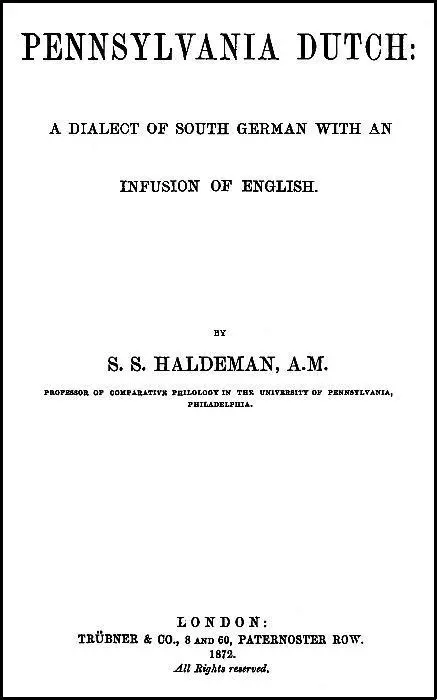
THE CLASSIC COLLECTION · 1872
"Pennsylvania Dutch: A Dialect of South German With an Infusion of English" by S. S. Haldeman is a scientific publication written in the late 19th century. The book explores the unique linguistic characteristics of Pennsylvania Dutch, a dialect formed by German-speaking immigrants to Pennsylvania, highlighting its blend of South German roots and English influences. The text delves into various aspects of the dialect, including its phonology, vocabulary, and syntax, making it a valuable resource for those interested in comparative philology and language evolution. The opening of the work introduces the rationale behind studying this dialect, emphasizing its formation over a century within a linguistically diverse community. It describes the historical context of German immigration to Pennsylvania and how various dialects from regions like Rhenish Bavaria and Alsace contributed to the development of Pennsylvania Dutch. The author outlines the influences of limited interactions among the largely agricultural immigrant populations, which led to distinct linguistic changes, thus setting the stage for a detailed examination of phonology, vocabulary, and syntax in subsequent chapters.
Introduction adapted from the source catalogue; source summaries may be automatically generated.
Free to read · English · 27,823 words · No account needed
MAKE TIME FOR A GOOD BOOK
On by default. Untick to stop anonymous reading totals. Each page counts after 10 seconds in view. How this works.
Anonymous counting is on unless you have switched it off.
§ 1. Gender of English Words in Pennsylvania German.
German gender and declension might be said to be in a state of barbarism, were it not that some of the languages of savages have refinements which are wanting in the tongues of civilised people. German gender being in a high degree arbitrary and irrational, there seem but few principles applicable to introduced words, and yet, the linguistic instinct produces a measure of uniformity. The clear distinction in modern English between a spring and a well, does not exist between the German der quell (and die quelle, PG. 'dii qkel') and der brunnen, but German has der spring also, which may be used alone, or compounded in springquell or springquelle. Influenced by English, PG. uses 'dii schpring' for a natural spring of water, keeping 'd'r brunnǝ' for a well, 'tsig-brunnǝ' for a draw-well with a windlas and bucket--but also 'laafǝndǝ brunnǝ' for a spring.
As a German says 'dii' for the English article the, which he hears applied to everything singular and plural, and as this die is his own feminine and plural article, he will be likely to say 'dii fens' for the fence, 'dii set' (set, of tools, etc.), 'dii faundri' (foundry), 'dii bænk' (bank of a stream), 'dii færm' (farm), 'dii plantaaschǝ' (plantation), 'dii témǝti' (timothy hay), 'dii portsch,' 'dii schtæmp' ('stämp' in print, for G. der stempel), 'dii watsch' (timepiece), 'dii bel hat geringt' (the 'bell' has 'rung'), "Stohrstube ... mit einer offenen Front," (Store-room with an open front), "die Fronte[24] des Hauses" (the 'front' of the house), "Die Sanitäts Board," "Eine Lot Stroh," "Eine Lotte Grund," etc. All of these are feminine in PG., together with the English nouns alley, road, borough, square (of a town), fair, forge, creek (a stream), climate, bowl, vendue, court (at law), law, lawsuit, jury, yard (of a house),--
Als Herr Yost ... einen groszen Neufundländer Hund in seiner =Yard=[1] anders anbinden wollte, fiel ihn das Thier an ... der Hund wieder an ihn sprang, und ihn gegen die =Fenz=[25] drängte, ... Der Pennsylvanier, Lebanon, Pa. Sept. 1, 1869.
Of the masculine gender are river (PG. 'rewǝr'), bargain, crop, beef (but 'gedörtes beef' makes it neuter), carpet, turnpike (or pike), store, gravel, shop, smith-shop, shed, and of course words like squire, lawyer, and "assignie."
Of the neuter gender are "das främ" (frame), "das flaur" (flour, influenced by G. das mehl), das screen, das photograph, das piano, das supper, das buggy.
Your reading position is saved on this browser. Take it to another device with a library code. Reading pages adapt to text, rather than matching a printed edition.
BEHIND THE BOOK
This eBook is for the use of anyone anywhere in the United States and most other parts of the world at no cost and with almost no restrictions whatsoever. You may copy it, give it away or re-use it under the terms of the Project Gutenberg License included with this eBook or online at www.gutenberg.org. If you are not located in the United States, you will have to check the laws of the country where you are located before using this eBook. Read the source licence.
The original source file, including credits and licence, is retained by this library. Request an original-format copy at no charge. Please include the book title and Project Gutenberg identifier #48417.
KEEP YOUR CURIOSITY GOING
Cécile Tormay

Moritz Busch
John L. Ransom
Frances Wright
Cécile Tormay

Mabel Potter Daggett