THE CLASSIC COLLECTION✦An outlaw’s diary: the CommuneCLASSIC FREE BOOKS
An outlaw’s diary: the Commune
Cécile Tormay
THE CLASSIC COLLECTION · 1872
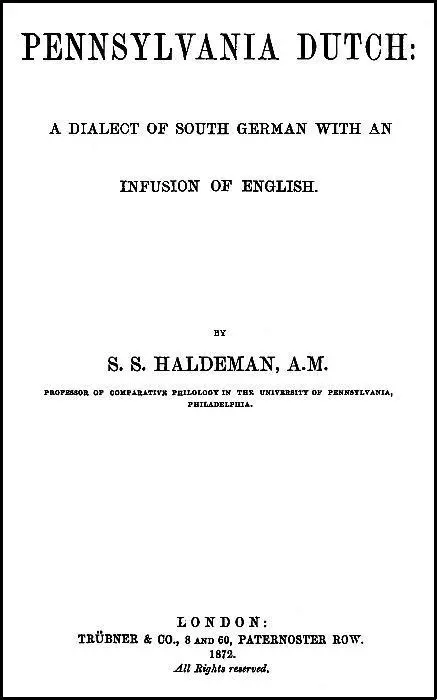
"Pennsylvania Dutch: A Dialect of South German With an Infusion of English" by S. S. Haldeman is a scientific publication written in the late 19th century. The book explores the unique linguistic characteristics of Pennsylvania Dutch, a dialect formed by German-speaking immigrants to Pennsylvania, highlighting its blend of South German roots and English influences. The text delves into various aspects of the dialect, including its phonology, vocabulary, and syntax, making it a valuable resource for those interested in comparative philology and language evolution. The opening of the work introduces the rationale behind studying this dialect, emphasizing its formation over a century within a linguistically diverse community. It describes the historical context of German immigration to Pennsylvania and how various dialects from regions like Rhenish Bavaria and Alsace contributed to the development of Pennsylvania Dutch. The author outlines the influences of limited interactions among the largely agricultural immigrant populations, which led to distinct linguistic changes, thus setting the stage for a detailed examination of phonology, vocabulary, and syntax in subsequent chapters.
Introduction adapted from the source catalogue; source summaries may be automatically generated.
Free to read · English · 27,823 words · No account needed
MAKE TIME FOR A GOOD BOOK
On by default. Untick to stop anonymous reading totals. Each page counts after 10 seconds in view. How this works.
Anonymous counting is on unless you have switched it off.
"Der wind, horch yusht, wie er D'r wint, harich juscht wii ær drum drum bloss'd,... bloost,... Gar nix for ihm fersichert is, Gaar niks f'r iim f'rsichǝrt iss, Er nemmt sei aegner waek ær nemmt sei, eegnǝr week, Dorch ennich rissly geht er neih, darich ennich rissli geet ær nei, Un geht ah nuf die staek." un geet aa 'nuf dii schteek.
The wind, just listen how it therefore (an expletive) blows, ... quite nothing is secure for (on account of) him, he takes his (eigener weg) own way; through (einig, einiges) any crack he goes (hinein) in, and goes also (hinauf) up the (stiege) stair.
The reader of PG. may be puzzled with 'ma' as used in "ous so ma subject ... mit ma neia Rail Road" (Rauch); 'fun mǝ' or 'fun ǝmǝ,' Ger. dative von einem, Old High German 'vone einemo;' G. dem, Ohg. 'demo;' G. meinem, Gothic 'meinamma,' which accounts for the final PG. vowel. Miss Bahn writes it 'mah'--
''S is noch so 'n anre glaener 's iss noch so 'n anre gleenǝr drup, drǝp, Mit so mah grosse dicke kup, mit soo mǝ grossǝ dikkǝ kǝp, Der doh uf English screech-owl dær doo uf eng-lisch 'skriitsch-aul' haest, heest, Der midde drin hut ah sei nesht.' dær middǝ drin hǝt aa sei nescht.
There is yet such another little fellow, with such a large thick head, this here in English is called 'screech-owl,' the middle therein [of the tree] has also its nest.
Remarking on "grosse dicke kup" in the second line, my reverend friend Ziegler sends me the following declensions of the united article and adjective. The dative is used for the genitive, as will appear in the chapter on Syntax.
Nom., Accus. ǝn ('n) grosser dicker kopp, Dat., Gen. ǝmǝ ('mǝ) grossǝ dickǝ kopp.
Singular.
Nom. der root wei˛ iss guut. The red wine is good. Gen. dem rootǝ wei˛ sei˛ farb is schee˛. Dat. " " " hab ich 's tsu fǝrdankǝ. Acc. dii rootǝ wei˛ hat ær gedrunkǝ.
Plural.
Nom. dii rootǝ wei˛ sin guut. The red wines are good. Gen. dennǝ rootǝ wei˛ iir farb etc. (G. der rothen Weine Farbe ist schön.) Dat. " " " hab ich 's etc. (G. den rothen Weinen.) Acc. dii rootǝ wei˛ hat ær, etc.
[15] Of words not occurring in print, the Swiss, Bavarian, and Suabian form bruntsen replaces harnen and its synonyms.
[16] Seemingly akin to Swiss ammeli, mammeli (a child's sucking-glass), whence mämmelen (to like to drink). G. amme (a wet-nurse), in Bavaria, also a mother.
[17] PG. des kalb sukt (this calf sucks,) G. saugt.
Your reading position is saved on this browser. Take it to another device with a library code. Reading pages adapt to text, rather than matching a printed edition.
BEHIND THE BOOK
This eBook is for the use of anyone anywhere in the United States and most other parts of the world at no cost and with almost no restrictions whatsoever. You may copy it, give it away or re-use it under the terms of the Project Gutenberg License included with this eBook or online at www.gutenberg.org. If you are not located in the United States, you will have to check the laws of the country where you are located before using this eBook. Read the source licence.
The original source file, including credits and licence, is retained by this library. Request an original-format copy at no charge. Please include the book title and Project Gutenberg identifier #48417.
KEEP YOUR CURIOSITY GOING
Cécile Tormay

Moritz Busch
John L. Ransom
Frances Wright
Cécile Tormay

Mabel Potter Daggett